
MCB stands for Miniature Circuit Breaker. It is an automatic switch that cuts off a circuit when the current goes above a safe value, either because of a sustained overload or because of a short circuit, and unlike a fuse it can simply be switched back on once the fault is cleared. In India, household MCBs are built to IS/IEC 60898-1, are usually rated 6 A to 63 A, and are made with a B, C or D trip curve. One thing an MCB does not do is protect you from an electric shock. That is the job of an RCCB, and the difference is explained further down.
What does an MCB actually do?
An MCB sits between the supply and the wiring it protects, and it watches the current passing through it. It has two jobs, and they are not the same job:
- Overload protection. Too many appliances on one circuit, or a motor working harder than it should, pushes maybe 1.5 to 3 times the rated current through the cable. Nothing bangs. The cable insulation just cooks slowly. The MCB gives this current a few seconds to a few minutes and then opens.
- Short-circuit protection. A live conductor touching neutral gives thousands of amperes in the first half cycle. Here the MCB has to open in a few milliseconds, before the fault current melts anything or the arc starts a fire.
Two very different speeds are needed, so an MCB carries two separate tripping elements inside one body. That split is the single most useful thing to understand about the device.
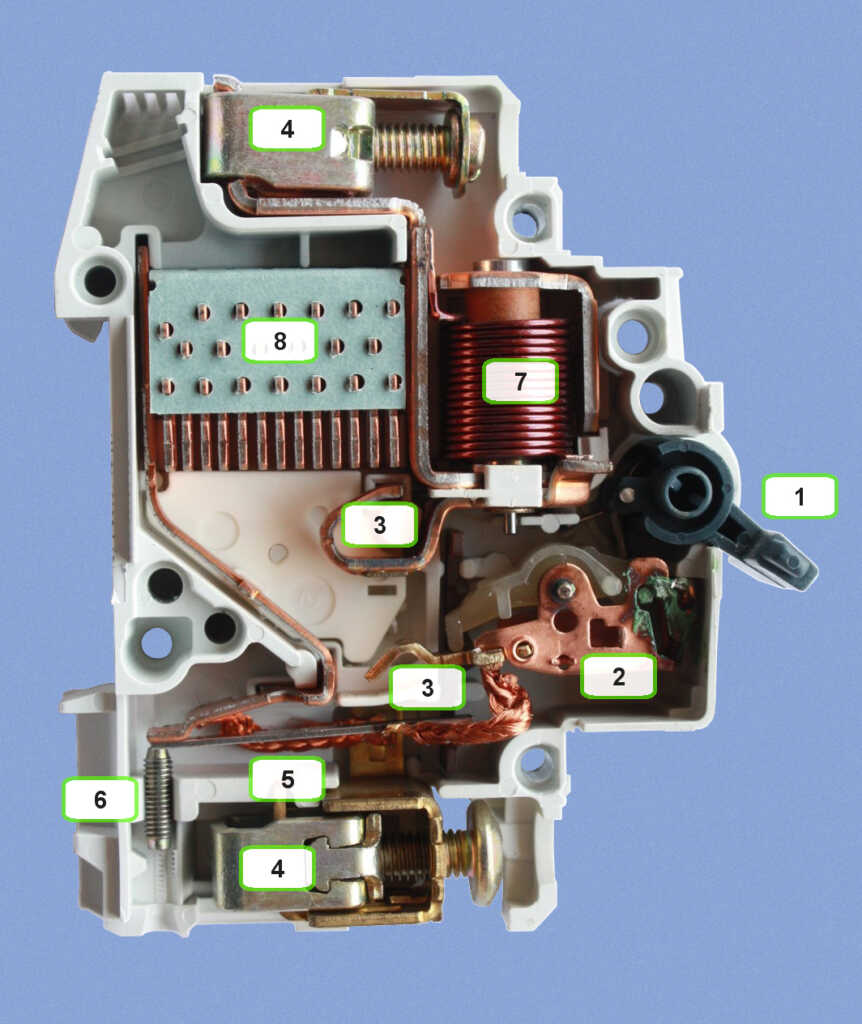
Construction: parts of a miniature circuit breaker
| Part | Function |
|---|---|
| Fixed contact and moving contact | Carry the load current. The faces are silver alloy, which keeps contact resistance low and resists welding and pitting from arcing. |
| Bimetallic strip | The thermal element. Two metals with different expansion rates are bonded together, so the strip curls as load current heats it. Sustained overload makes it curl far enough to release the latch. |
| Solenoid (trip coil) and plunger | The magnetic element. The load current passes through this magnetic coil. A short-circuit current makes the field strong enough to snatch the plunger across and knock the trip bar instantly. |
| Latch and trip mechanism | Holds the contacts closed against a spring. Either element releases the latch, and the spring separates the contacts. The mechanism is trip-free, so the MCB still trips even if you hold the lever in the ON position. |
| Operating lever (toggle) | Manual ON and OFF, and the visual indication. A tripped MCB parks its lever in a distinct middle or down position. |
| Arc chute with splitter plates | A stack of steel plates above the contacts. It receives the arc, splits it and kills it. Described in its own section below. |
| Line and load terminals | Screw terminals, usually with a cage clamp for stranded conductors. Loose terminals are one of the commonest causes of heating in a distribution board. |
| Moulded housing and DIN rail clip | Flame-retardant thermoset body, one module (about 17.5 to 18 mm) wide per pole, clipping onto a 35 mm DIN rail. |
How an MCB trips: the thermal element
The bimetallic strip handles overload. Current flowing through or past the strip heats it, the two bonded metals expand by different amounts, and the strip bends towards the slower-expanding side. Past a certain deflection it pushes the latch and the contacts fly open.
The important property here is that the response is inverse time: the larger the overload, the shorter the time to trip. A small overload may be tolerated for tens of minutes; three times the rated current lasts only a few seconds. Under IS/IEC 60898-1 the two calibration points, tested at a reference ambient of 30 °C, are:
- 1.13 × In is the conventional non-tripping current. The MCB must carry it for the conventional time (1 hour for ratings up to 63 A) without tripping.
- 1.45 × In is the conventional tripping current. Starting from that same condition, the MCB must trip within the conventional time.
So a 16 A MCB is not a device that opens at 16.1 A. It happily carries about 18 A for an hour and only reliably clears at around 23 A. That gap exists because cables also tolerate a modest overload for a while, and because a breaker that nuisance-tripped on every kettle would be replaced with a nail.
Two practical consequences. First, ambient temperature matters: an MCB in a hot, crowded distribution board on a Nagpur afternoon trips earlier than its 30 °C rating suggests, which is why manufacturers publish derating tables. Second, the thermal element is deliberately slow, so it is useless against a short circuit.
How an MCB trips: the magnetic element
For short circuits the MCB uses a solenoid. The load current passes through a coil wound around a spring-loaded plunger. At normal current the magnetic pull is far too weak to move it. At fault current, which can be hundreds or thousands of amperes, the pull becomes large enough to drive the plunger against its spring in a fraction of a cycle. The plunger strikes the trip bar, the latch releases, and the contacts part in a few milliseconds.
The magnetic element is essentially instantaneous and has no deliberate time delay. Whether it responds at 3 times the rated current or at 20 times is what the trip curve letter tells you.
Arc quenching in the arc chute
Opening the contacts is not the same as stopping the current. As the contacts separate, the air between them ionises and an arc bridges the gap, and that arc can carry on conducting quite happily. The arc chute exists to kill it.
- Arc runners guide the arc root away from the contact faces, which protects the silver tips from burning away.
- The magnetic field of the arc itself, plus the shape of the runners, drives the arc upward into a stack of parallel steel splitter plates.
- Each plate cuts the single long arc into several short arcs in series. Every short arc has its own near-electrode voltage drop, so the total arc voltage climbs rapidly above the supply voltage.
- Once the arc needs more voltage than the supply can give, the current is forced to zero. The plates also absorb heat and deionise the gas, so the gap does not re-strike on the next half cycle.
The hot gases vent through slots at the top of the housing, which is why manufacturers specify clearance above an MCB inside an enclosure.
MCB trip curves: B, C, D, K and Z
The trip curve describes the magnetic element only, as a band of current in multiples of the rated current In at which the MCB trips instantaneously. Picking the wrong curve causes either nuisance tripping or, worse, a breaker that never trips on a genuine fault at the far end of a long cable.
| Curve | Instantaneous trip band | Suited to | Example |
|---|---|---|---|
| B | 3 to 5 × In | Resistive and low-inrush loads; long cable runs where fault current is limited | Domestic lighting, fans, sockets, geysers, heaters |
| C | 5 to 10 × In | Mixed and moderately inductive loads | Small motors, air conditioners, fluorescent and LED banks, general commercial boards |
| D | Above 10 up to 20 × In | High inrush that lasts several cycles | Transformers, welding sets, X-ray equipment, large direct-on-line motors, capacitor banks |
| K | 8 to 12 × In | Motor and transformer circuits, under IEC 60947-2 rather than 60898-1 | Industrial motor feeders |
| Z | 2 to 3 × In | Very sensitive circuits where even a small overcurrent means damage | Semiconductor and electronic equipment, instrumentation, control circuits |
Read it with real numbers. A 16 A B-curve MCB trips instantly somewhere between 48 A and 80 A. The same 16 A in C curve waits until 80 A to 160 A, and in D curve until 160 A to 320 A. All three still trip on a steady 23 A overload through the bimetal; the curve letter only changes how fast they react to a sudden surge.
B and C cover almost everything in a house. A student mistake worth avoiding is treating D as “stronger protection”. It is not stronger, it is later, and on a circuit with a low prospective fault current a D-curve device may not reach its magnetic band at all.
Pole configurations: SP, SPN, DP, TP, TPN and FP
| Type | Meaning | What is switched | Used for |
|---|---|---|---|
| SP | Single pole | Phase only; neutral is not brought into the device | Standard outgoing ways in a single-phase board: lights, fans, sockets |
| SPN | Single pole and neutral | Phase is protected and switched; neutral passes through as an uninterrupted link | Circuits where a disconnectable neutral is wanted, two modules wide |
| DP | Double pole | Both phase and neutral have breaking contacts | Single-phase incomers, bathroom geysers, outdoor and wet locations, equipment isolation |
| TP | Triple pole | All three phases | Three-phase motors and three-phase loads with no neutral |
| TPN | Triple pole and neutral | Three phases protected, neutral as a link | Three-phase distribution boards feeding single-phase circuits |
| FP | Four pole | All three phases and the neutral, all with breaking contacts | Three-phase incomers, generator and supply changeover, where the neutral must be fully isolated |
Current ratings and breaking capacity
Two numbers on the face of an MCB do different things and are often confused.
Rated current (In) is the current the MCB carries continuously. Preferred values under IEC 60898-1 run 6, 10, 13, 16, 20, 25, 32, 40, 50 and 63 A, with the standard reaching 125 A; smaller ratings from 0.5 A upward are made for control work. In Indian homes the common set is 6 A for lighting and fan circuits, 16 A for socket and geyser circuits, and 20 A to 32 A for air conditioners and cooking points.
Rated short-circuit capacity (Icn) is the prospective fault current the MCB can interrupt without destroying itself. The standard values you will see marked in a rectangle on the front are 3000, 4500, 6000 and 10000 A, and IEC 60898-1 covers devices up to 25 kA. For Indian domestic and small commercial boards, 6 kA and 10 kA are the usual choices, with 10 kA preferred close to a large distribution transformer where the available fault current is higher.
Retail prices for a branded single-pole MCB were roughly ₹120 to ₹350 in September 2026 listings, with double-pole and four-pole devices costing proportionally more. Treat that as an order of magnitude, not a quotation.
MCB vs fuse vs MCCB vs RCCB
| Device | Protects against | Typical rating | After operating | Standard |
|---|---|---|---|---|
| Fuse | Overload and short circuit | Any, including very high breaking capacity | Element melts, must be replaced | IS 13703 / IEC 60269 |
| MCB | Overload and short circuit | Up to 125 A, Icn up to 25 kA | Reset the lever | IS/IEC 60898-1 |
| MCCB | Overload and short circuit, usually with adjustable settings | Roughly 16 A to 1600 A, far higher breaking capacity | Reset the handle | IS/IEC 60947-2 |
| RCCB | Earth leakage and shock only | Sensitivity 30, 100 or 300 mA | Reset after finding the leakage | IS 12640 (Part 1) |
| RCBO | Overload, short circuit and earth leakage in one device | MCB rating plus a leakage setting | Reset the lever | IS 12640 (Part 2) |
The safety point in that table deserves saying plainly. An MCB will not save you from an electric shock. If you touch a live wire, the current through your body may only be 50 to 200 mA, nowhere near the 80 A or more a 16 A MCB needs before it reacts quickly, and the bimetal will not notice at all. A 30 mA RCCB or RCBO detects the imbalance between line and neutral current and disconnects in well under a tenth of a second. Every Indian household board should have both: an RCCB for people, MCBs for cables.
How to select an MCB rating, with a worked example
The coordination rule used in IS 732:2019 and IEC 60364 is short: Ib ≤ In ≤ Iz. The design current of the load (Ib) must be no more than the MCB rating (In), and the MCB rating must be no more than the current-carrying capacity of the cable it protects (Iz). The MCB defends the cable, so the cable must always be able to carry what the MCB will let through.
Example 1, a kitchen socket circuit. Total connected resistive load 3000 W at 230 V.
- Ib = 3000 ÷ 230 = 13.0 A
- Next standard rating above that: In = 16 A
- 2.5 mm² copper PVC cable in conduit carries about 20 A after derating, so Iz = 20 A
- Check: 13.0 ≤ 16 ≤ 20. It holds. Use a 16 A B-curve or C-curve MCB on 2.5 mm² cable.
Example 2, a 1 HP single-phase water pump. 0.75 kW output, efficiency about 0.70, power factor about 0.80.
- Full load current = 750 ÷ (0.70 × 0.80 × 230) = 5.8 A
- Started direct-on-line, the inrush is roughly 6 to 8 times that, so about 35 to 46 A for a few cycles
- A 6 A B-curve MCB trips instantly at 18 to 30 A, so it would trip every time the pump starts
- A 10 A C-curve MCB trips instantly at 50 to 100 A, above the inrush, and still protects on a real fault. That is the correct choice, and for larger motors the starting current is limited by a DOL starter or a star-delta starter instead.
Never fix a nuisance trip by fitting a bigger MCB. Either the curve is wrong for the load, or the cable is too small for the job, and a larger MCB only means the cable overheats without anything stopping it.
Why does my MCB keep tripping?
| Symptom | Likely cause | What to check |
|---|---|---|
| Trips after some minutes of heavy use | Genuine overload, thermal element acting | Add up the connected load; split the circuit or move the geyser or AC to its own way |
| Trips instantly, every time, even with all appliances unplugged | Short circuit in the fixed wiring | Isolate, megger the circuit, look at junction boxes and any recently drilled wall |
| Trips the moment one particular appliance is switched on | Fault inside that appliance, or its inrush exceeds the curve | Test the appliance on another circuit; check whether a B curve should be a C curve |
| Trips only when a motor starts | Starting current reaching the magnetic band | Move to a C or D curve of the same rating, or add a starter |
| Trips more in summer or in a packed board | High ambient temperature shifting the thermal characteristic | Apply the manufacturer’s derating table; improve board ventilation |
| Warm MCB body, smell of hot plastic, intermittent trips | Loose terminal screw or a burnt contact | Power down, check torque on both terminals, replace the device if the terminals are discoloured |
| RCCB trips but the MCB does not | Earth leakage, not overcurrent | Look for damp walls, a leaking geyser element or damaged insulation, not an MCB problem |
Installation notes for an Indian distribution board
- Order inside the board: incoming isolator or main switch, then the RCCB, then the outgoing MCBs, all on a 35 mm DIN rail with a common phase busbar.
- A typical single-phase house board: 40 A or 63 A double-pole isolator as incomer, a 63 A 30 mA RCCB, then 6 A ways for lights and fans, 16 A ways for socket circuits and the geyser, and a dedicated 20 A or 32 A way per air conditioner.
- Connect supply to the line terminal and the load to the load terminal as marked. Many MCBs are bidirectional, but follow the marking anyway so the next person can trace the board.
- Tighten terminals to the stated torque and re-check after the first few weeks. Loose aluminium conductors in particular creep and heat.
- Match both the rating and the curve when replacing a device, and keep to one manufacturer’s range inside a board so the busbar and the enclosure fit.
- Operate every MCB and press the RCCB test button once every few months. Mechanisms that sit untouched for years can stick.
- Never bridge, tape or wedge an MCB that keeps tripping. It is reporting a fault, not misbehaving.
References
- Bureau of Indian Standards, IS/IEC 60898-1:2002, Circuit-breakers for overcurrent protection for household and similar installations.
- IEC 60898-1:2015, Electrical accessories – Circuit-breakers for overcurrent protection for household and similar installations, Part 1: Circuit-breakers for a.c. operation.
- Bureau of Indian Standards, IS 732:2019, Code of Practice for Electrical Wiring Installations (fourth revision).
- Bureau of Indian Standards, IS 12640 (Part 1):2008 and IS 12640 (Part 2):2016, residual current operated circuit-breakers.
FAQs
What is the full form of MCB?
MCB stands for Miniature Circuit Breaker. It is an automatically operated electrical switch that disconnects a circuit on overload or short circuit and can be reset by hand afterwards. Household MCBs in India follow IS/IEC 60898-1 and are normally rated between 6 A and 63 A.
What is the difference between B, C and D curve MCBs?
The letter gives the current at which the magnetic element trips instantaneously. Type B trips at 3 to 5 times the rated current and suits resistive domestic loads. Type C trips at 5 to 10 times and suits mixed or moderately inductive loads. Type D trips above 10 and up to 20 times and suits transformers, welding sets and high-inrush motors. The thermal overload response is the same for all three.
Does an MCB protect against electric shock?
No. An MCB only responds to overcurrent, and the current through a human body during a shock is far too small to trip it. Shock and earth-leakage protection comes from a 30 mA RCCB or an RCBO, which compares line and neutral current and disconnects when they differ. A proper board uses both devices together.
What is the difference between an MCB and an MCCB?
An MCB is a fixed-setting device up to 125 A built to IS/IEC 60898-1, made for household and similar installations. An MCCB is a moulded case circuit breaker built to IS/IEC 60947-2, made in ratings from about 16 A to 1600 A, with a much higher breaking capacity and usually adjustable overload and short-circuit settings for industrial use.
How do I choose the right MCB rating for my load?
Work out the design current of the load, pick the next standard MCB rating above it, and then confirm that the cable can carry at least that rating. The rule is Ib ≤ In ≤ Iz. For a 3000 W load at 230 V the current is 13 A, so a 16 A MCB on 2.5 mm² copper cable is correct. Choose the curve from the load type, not from how often it trips.