 EngineeringHulk
- Home
- Blog
- Automobile Engineering
- Suspension System in Automobile: Functions, Components and Types
Suspension System in Automobile: Functions, Components and Types
On this page
An automobile suspension system is the set of springs, shock absorbers (dampers) and linkages that connects a vehicle’s body to its wheels. It carries the vehicle’s weight, soaks up road shocks for ride comfort, and keeps the tyres pressed onto the road so the car can steer, brake and corner safely. Car suspension systems fall into three families: dependent (rigid axle), independent (such as the MacPherson strut) and semi-independent (twist beam), plus air and electronically controlled versions.
Functions of a suspension system
- Ride comfort: isolate passengers and cargo from bumps, potholes and vibration.
- Road holding: keep each tyre in contact with the road so it can transmit driving, braking and cornering forces.
- Load support: carry the weight of the body, passengers and cargo, and hold the correct ride height.
- Handling: control body roll in corners, pitch under braking (dive) and acceleration (squat), and hold steering geometry (camber, toe, caster) within limits. How much grip each tyre gives in a corner is covered in our page on cornering power, and how the balance front to rear sets oversteer and understeer.
Comfort and road holding pull in opposite directions: soft springs give a smooth ride but let the body roll and wallow; stiff springs control the body but pass more shock through. Every suspension design is a compromise between the two.
Sprung and unsprung mass
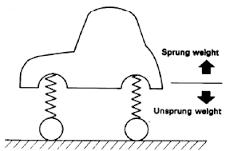
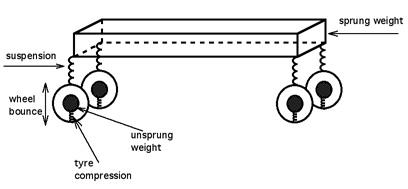
Sprung mass is everything supported by the springs: body, frame, engine, passengers and cargo. Unsprung mass is everything between the springs and the road: wheels, tyres, brakes, hubs, axles and part of the springs, dampers and links.
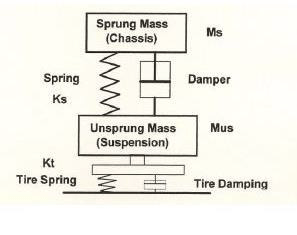
A low ratio of unsprung to sprung mass is better. A light wheel follows bumps quickly and passes less force to the body; a heavy wheel and axle bounces, loses contact with the road and shakes the car. This is one reason independent suspension, alloy wheels and aluminium suspension arms are used.
Components of a suspension system
Springs
Springs store the energy of a bump and release it, so the body moves less than the wheel. Spring stiffness (rate) in N/m is explained in our page on the spring constant.
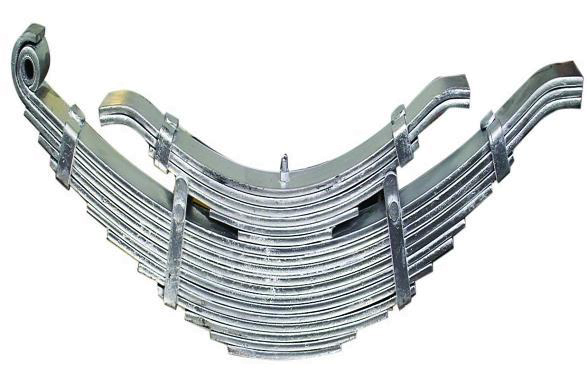
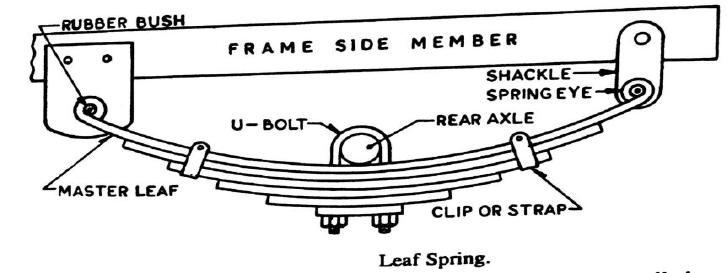
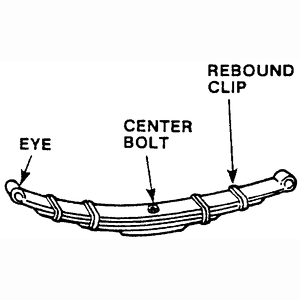
- Leaf spring: a stack of curved steel strips (leaves) clamped at the centre to the axle by U-bolts. The longest, the master leaf, has an eye at each end: one bolted to the frame, the other to a swinging shackle that lets the spring lengthen as it flattens. Leaf springs also locate the axle, so no extra links are needed. Strong and simple; used on trucks, buses, pickups and many light commercial vehicles.

- Coil spring: a steel rod wound into a helix. Stores more energy per kilogram than a leaf spring and has no inter-leaf friction, but cannot locate the wheel, so it needs links. Used on almost all cars.
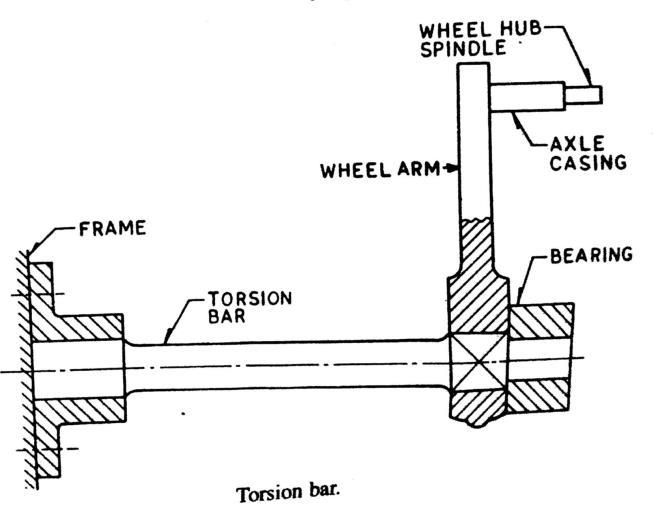
- Torsion bar: a steel bar fixed to the frame at one end and twisted by a lever from the wheel at the other. Compact, and ride height can be adjusted at the anchor. Used on some SUVs and pickups.
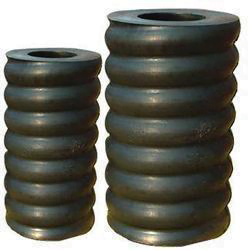
- Rubber spring: rubber blocks in compression or shear. Light and compact, with built-in damping from hysteresis. Used as bump stops, in some commercial vehicle suspensions and, famously, in the original Mini designed with Alex Moulton.
- Air spring: a rubber bellows filled with compressed air. Stiffness rises with load, and ride height can be kept constant by adding or releasing air. Used in buses, trucks and luxury cars.
Shock absorbers (dampers)
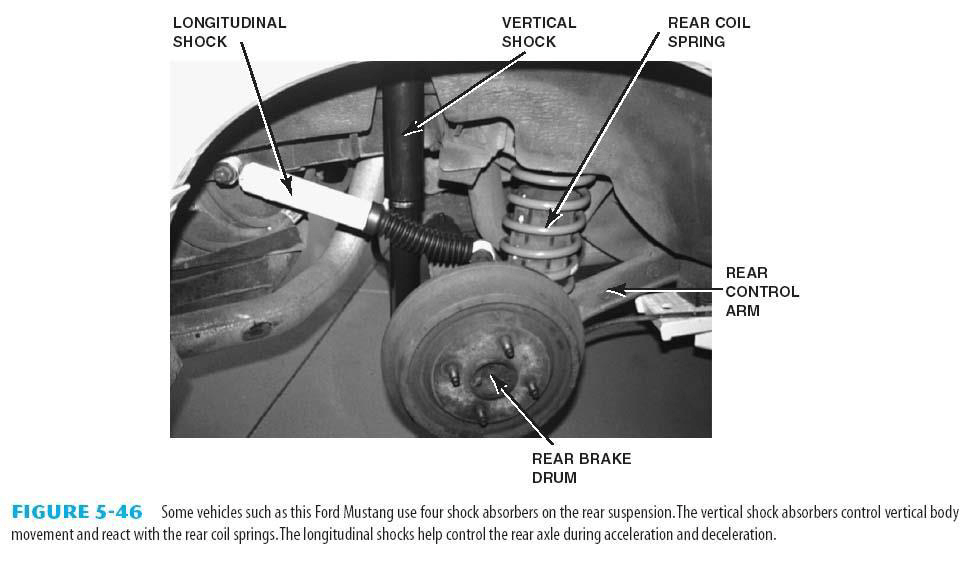
A spring alone would let the body keep bouncing after every bump. The shock absorber turns that motion into heat. Inside, a piston moves through oil and forces it through small valved holes; the resistance rises with speed, so fast movements are damped strongly. Dampers are usually softer in compression (bump) than in extension (rebound).
- Twin-tube: a working cylinder inside a reserve tube that holds extra oil and air or low-pressure gas. Cheaper and common on regular cars.
- Mono-tube: a single cylinder with a floating piston separating the oil from high-pressure nitrogen gas. Resists foaming and fade in hard use, runs cooler; used on performance cars and SUVs.
Anti-roll bar and links
The anti-roll bar (stabiliser or sway bar) is a U-shaped torsion bar joining the left and right wheels. When both wheels rise together it does nothing; when the car rolls in a corner and one side compresses more, the bar twists and resists the roll.

Links, arms and bushes locate the wheel and carry braking, driving and cornering forces to the body. Rubber bushes at their pivots absorb noise and small vibrations; ball joints allow the wheel to steer and move up and down.
Types of suspension systems
1. Dependent (rigid axle) suspension
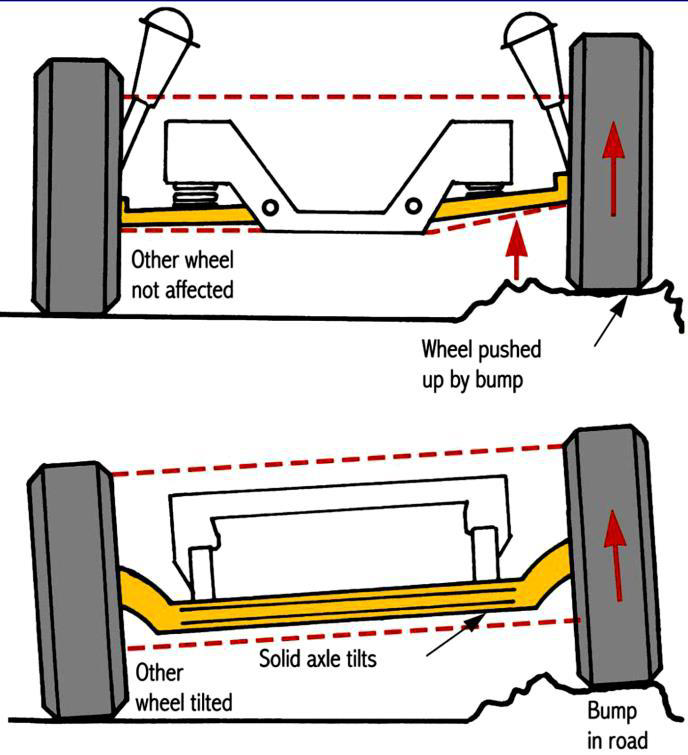
Both wheels are mounted on one solid axle, so a bump under one wheel tilts the other. The classic arrangement is the Hotchkiss drive: a live rear axle hung on two longitudinal leaf springs that both carry the load and locate the axle. It is strong, cheap and keeps ground clearance constant under load, so it remains standard on trucks, buses and many pickups. Its drawbacks are high unsprung mass and poorer ride and grip on rough roads. See our guide to types of axles for live and dead axles.
2. Independent suspension
Each wheel moves on its own, so a bump on one side does not disturb the other. Ride and grip are better and unsprung mass is lower.
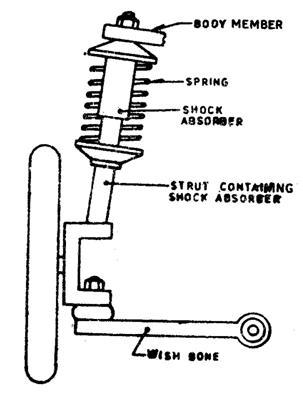
MacPherson strut: the most widely used front suspension on cars. A single lower arm locates the bottom of the wheel, and a strut, a shock absorber with a coil spring around it, forms the upper link and steering pivot. Simple, light, cheap and compact, which leaves room for a transverse engine in front-wheel-drive cars. Camber changes more with wheel travel than in a double wishbone.
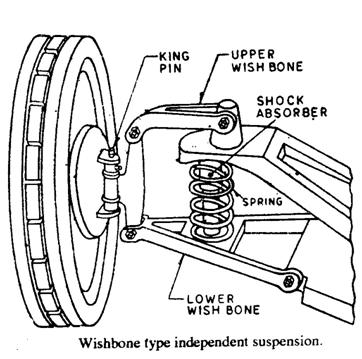
Double wishbone: two A-shaped arms, upper and lower, hold the wheel hub, with a coil spring and damper between them. With a shorter upper arm (short-long arm design) the tyre stays more upright as the body rolls, giving better grip and tyre wear. Used on performance cars, SUVs and pickups at the front.
Multi-link: three or more separate arms, each carrying load mostly along its length, so engineers can tune ride and handling almost independently. Common at the rear of premium cars; costlier and heavier.
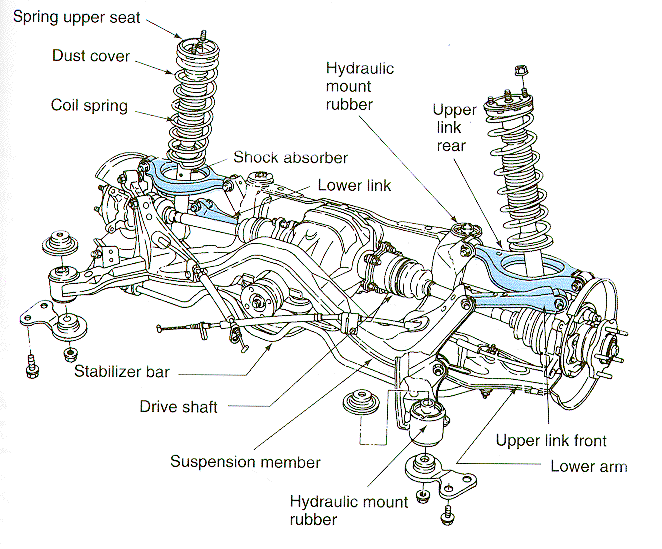
Trailing arm and swing axle: in a trailing arm design, each wheel is carried on an arm pivoted ahead of it; it keeps camber constant and allows a flat boot floor. The swing axle, with the wheel fixed rigidly to a half-shaft pivoting near the centre, is simple but gives large camber changes and is now rare on cars.

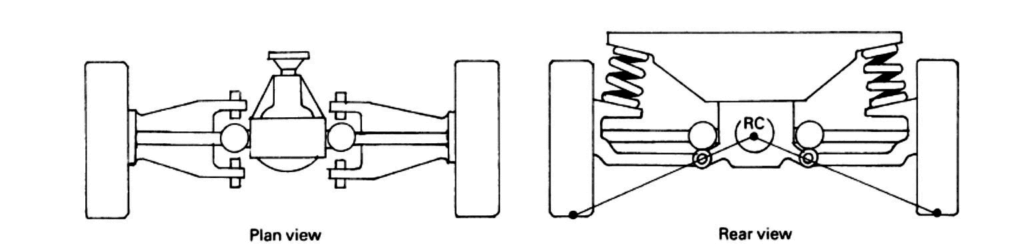
3. Semi-independent (twist beam) suspension
Two trailing arms are joined by a cross beam that can twist. The wheels are partly linked, like a flexible rigid axle. It is cheap, compact and light, leaving space for the fuel tank and boot, so it is the usual rear suspension on small front-wheel-drive hatchbacks and compact cars.
4. Air, hydro-pneumatic, adaptive and active suspension
- Air suspension: air springs with a compressor and valves hold a constant ride height whatever the load; common on buses, trucks and luxury cars.
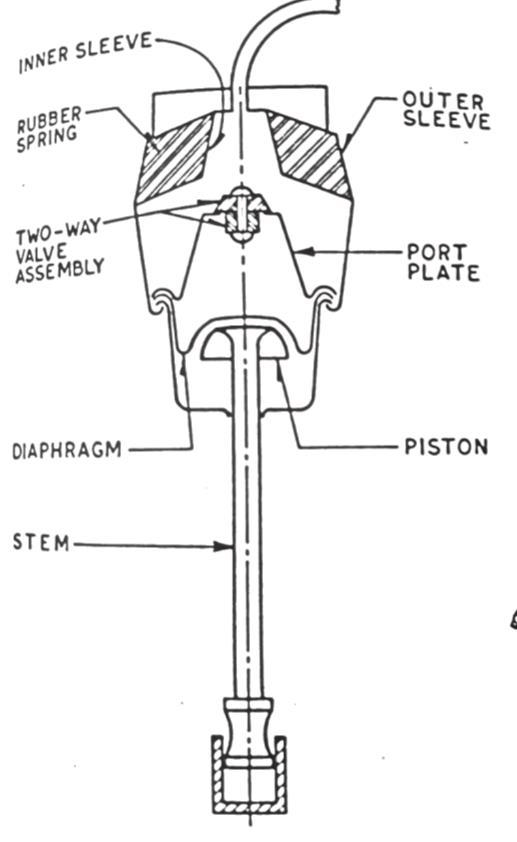
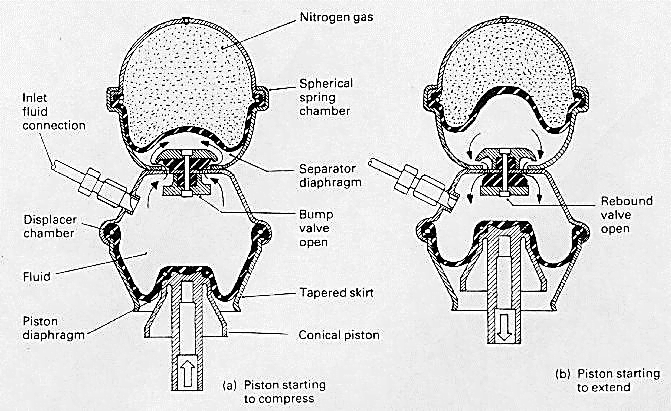
- Hydrolastic and Hydragas: fluid-filled units at each wheel, linked front to rear, that reduce pitching. Hydrolastic used rubber springs; Hydragas used nitrogen gas springs.
- Adaptive (semi-active): dampers whose stiffness is changed electronically in milliseconds, using valves or magnetorheological fluid, based on sensors.
- Active: actuators push and pull each corner to control body motion directly; expensive and found on a few high-end cars.
Comparison of suspension types
| Type | Ride and grip | Cost and space | Load capacity | Typical use |
|---|---|---|---|---|
| Rigid axle with leaf springs | Fair; one wheel affects the other | Cheapest, simple | Very high | Trucks, buses, pickups, LCVs |
| MacPherson strut | Good | Low cost, compact | Moderate | Front of most cars |
| Double wishbone | Very good camber control | Higher cost, more space | Good | Sports cars, SUVs, pickups (front) |
| Multi-link | Best balance of ride and handling | Highest cost | Good | Rear of premium cars |
| Twist beam | Fair to good | Low cost, very compact | Moderate | Rear of small FWD cars |
| Air suspension | Excellent, constant ride height | Expensive, needs compressor | High | Buses, trucks, luxury cars |
Worked example: ride frequency of a car suspension
Treat one corner of the car as a quarter-car: a sprung mass m on a spring of stiffness k (wheel rate). Its undamped natural frequency is:
f = (1 / 2π) √(k / m)
Corner sprung mass m = 350 kg, wheel rate k = 25 kN/m = 25,000 N/m.
- k / m = 25,000 / 350 = 71.43 s-2, √71.43 = 8.452 rad/s
- f = 8.452 / (2π) = 1.35 Hz
Static deflection shortcut. The spring’s static sag is δ = mg / k = 350 x 9.81 / 25,000 = 0.1373 m = 137 mm. Since f = (1 / 2π) √(g / δ), with δ in millimetres this becomes f = 15.76 / √δ Hz. Check: 15.76 / √137.3 = 1.34 Hz, the same answer.
Ordinary passenger cars are usually tuned to a body ride frequency of about 1.0 to 1.5 Hz; sporty cars sit higher, around 1.5 to 2 Hz or more, and very soft luxury cars lower. Our example car is at the comfortable end of normal. To raise it to 1.5 Hz with the same mass, k = 4π2 f2 m = 4π2 x 1.52 x 350 = 31.1 kN/m. The theory of single-degree-of-freedom systems is covered in our vibrations notes.
Signs of worn suspension and basic maintenance
- Bouncing: the car keeps bobbing after a bump or speed breaker; dampers are worn.
- Nose dive and squat: the front dips hard under braking or the rear sinks under acceleration.
- Knocks and clunks over bumps: worn bushes, ball joints, anti-roll bar links or strut mounts.
- Oil on the damper body: a leaking shock absorber.
- Uneven tyre wear or pulling to one side: bent parts or wrong alignment.
- Sagging ride height on one corner: a tired or broken spring.
On Indian roads with frequent potholes and speed breakers, have the suspension inspected at every service, replace dampers in pairs on the same axle, and get wheel alignment checked after replacing any suspension part. Overloading commercial vehicles cracks leaf springs and shortens their life. How the suspension mounts to the body is covered in our page on the chassis frame, and how power reaches the wheels in parts of a car transmission. Automobile engineering lectures are available free on NPTEL.
FAQs
What is a suspension system in an automobile?
It is the system of springs, shock absorbers and links between the body and the wheels. It supports the vehicle’s weight, absorbs road shocks and keeps the tyres in contact with the road.
What are the main types of car suspension systems?
Dependent (rigid axle, usually with leaf springs), independent (MacPherson strut, double wishbone, multi-link, trailing arm) and semi-independent (twist beam). Air, adaptive and active systems are variations on these.
What is the difference between a spring and a shock absorber?
The spring supports the weight and stores bump energy. The shock absorber dissipates that energy as heat so the body stops bouncing. A car needs both.
Which suspension is used in most cars?
Most cars use MacPherson struts at the front. At the rear, small front-wheel-drive cars mostly use a twist beam, while larger and premium cars use multi-link designs.
What is the ideal natural frequency of a car suspension?
Ordinary passenger cars are usually tuned to about 1.0 to 1.5 Hz. A corner mass of 350 kg on a 25 kN/m spring gives f = (1/2π)√(25,000/350) = 1.35 Hz.
Related Topics on EngineeringHulk
Keep reading

Starting System in Automobile Engineering: Components, Circuit and Working
How the engine starting (cranking) system works: battery, switches, relay, solenoid, series-wound starter motor, drive types, a worked example and faults.
Components of the Internal Combustion Engine (IC Engine): Parts, Functions and Materials
Main components of an IC engine with function and material of each: block, head, piston, rings, connecting rod, crankshaft, valves, plus worked examples.
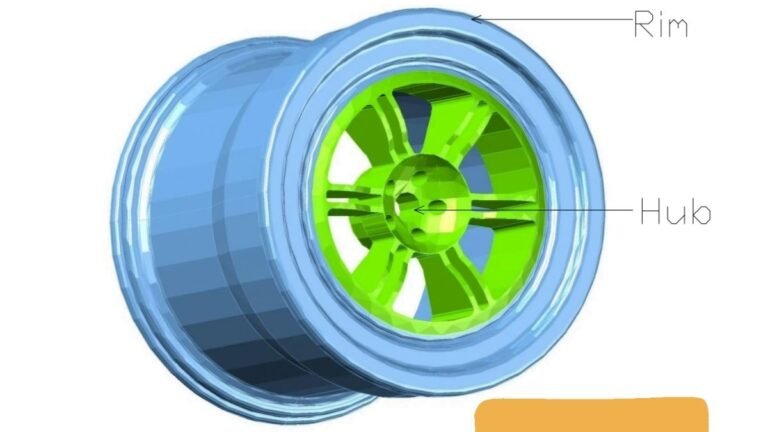
Wheels and Tyres in Automobile Engineering: Difference, Types, Construction and Tyre Size
Difference between wheel and tyre, wheel types, rim terms, tyre construction, radial vs bias ply, and how to read a tyre size like 185/65 R15 88H.
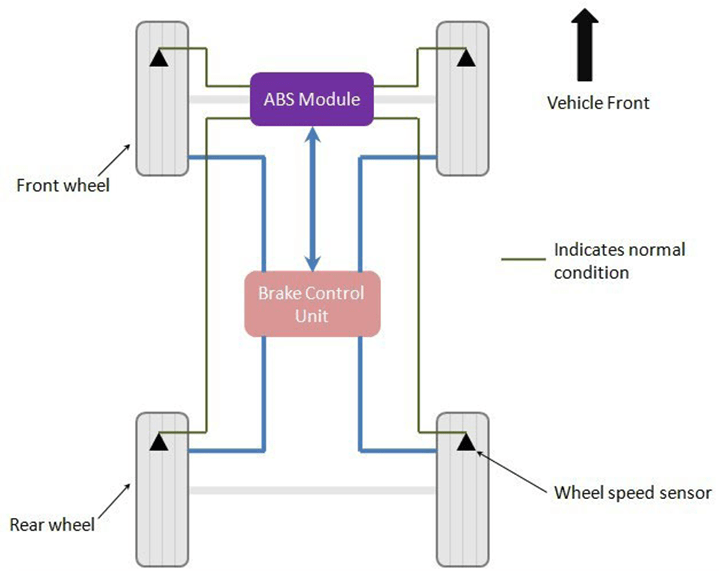
Anti-lock Braking System (ABS): Working, Components and Braking Distance
How an anti-lock braking system works: wheel slip, sensors, ECU and modulator, the build-hold-release cycle, braking distance and the Indian ABS rules.
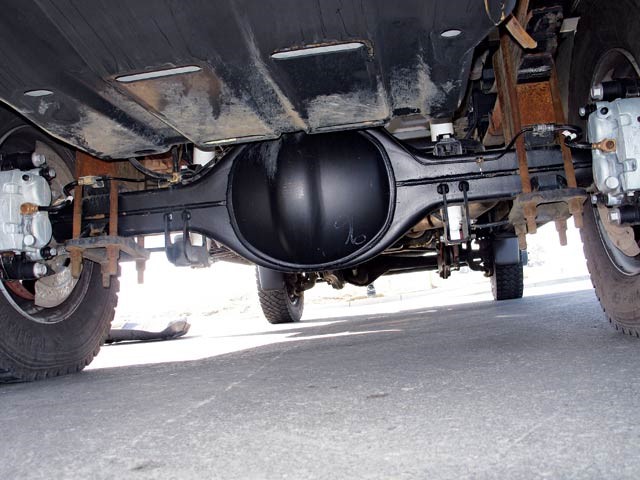
Differential in Automobile Engineering: Rear Differential Working, Parts and Types
How a rear differential works: why the outer wheel travels farther in a turn, crown wheel and pinion, planet gears, types compared, gear ratio and upkeep.
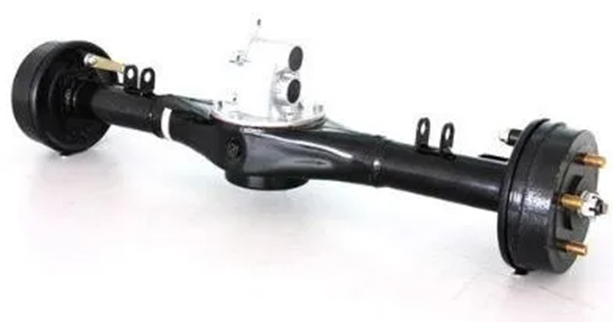
Types of Axles in Automobile Engineering: Front, Stub, Rear and Tandem Axles
Types of axle in automobiles: live and dead front axles, Elliot, reverse Elliot and Lamoine stub axles, semi, 3/4 and full floating rear axle, tandem axle.