 EngineeringHulk
- Home
- Blog
- Mechanical Engineering
- What Is HVAC? Meaning, How It Works, Types and Key Terms
What Is HVAC? Meaning, How It Works, Types and Key Terms
On this page
- What does HVAC mean in engineering? The three functions
- How an HVAC system cools: the vapour-compression cycle in plain words
- Types of HVAC systems
- Key HVAC terms: TR, COP, EER and ISEER
- Worked example 1: rough AC size for a room
- Worked example 2: COP, power and running cost
- Worked example 3: chilled-water flow for a 100 TR chiller
- Ventilation and indoor air quality
- Refrigerants and the HFC phase-down
- India’s AC temperature rules: 24 C default and the proposed 20-28 C band
- Careers: where HVAC engineers work
- FAQs
- Related Topics on EngineeringHulk
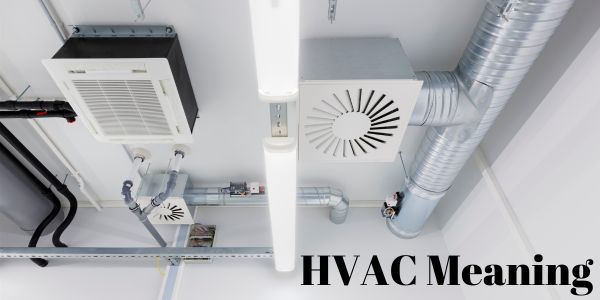
HVAC stands for heating, ventilation and air conditioning: the equipment and ducts that control a building’s temperature, humidity and air quality. In engineering, HVAC is the branch of mechanical engineering that designs these systems, from a 1-ton split AC in a bedroom to a 2,000-ton chilled-water plant serving an airport. Most Indian buildings need far more cooling than heating, so in India “HVAC” usually means air conditioning plus fresh-air ventilation.
What does HVAC mean in engineering? The three functions
- Heating adds heat to a space. Sources are electric resistance heaters, gas or oil boilers, furnaces and heat pumps. In India heating is mostly needed in the north and in hill regions, and a reverse-cycle (heat pump) split AC often does the job.
- Ventilation replaces stale indoor air with filtered outdoor air. It dilutes carbon dioxide, odours, moisture and pollutants. It can be natural (windows, stacks) or mechanical (fans, fresh-air units, exhaust fans in toilets and kitchens).
- Air conditioning removes heat and moisture from the air. Full air conditioning controls four things together: temperature, humidity, air movement and air cleanliness.
The letter often added to the name is R, as in HVAC-R or HVACR, which brings in refrigeration: cold rooms, supermarket display cases and cold chains.
How an HVAC system cools: the vapour-compression cycle in plain words
Almost every AC, from a window unit to a large chiller, uses the vapour-compression refrigeration cycle. A refrigerant circulates in a closed loop and moves heat from inside to outside by boiling at low pressure and condensing at high pressure.
- Compressor: sucks in low-pressure refrigerant vapour and squeezes it into hot, high-pressure vapour. This is the part that uses most of the electricity.
- Condenser: the hot vapour flows through a finned coil in the outdoor unit. A fan blows outdoor air across it, the refrigerant gives up its heat and condenses into a liquid. This is the warm air you feel from an outdoor unit.
- Expansion device: a capillary tube, thermostatic expansion valve or electronic expansion valve drops the pressure of the liquid. Its temperature falls sharply, well below room temperature.
- Evaporator: the cold, low-pressure refrigerant flows through the indoor coil. Room air blown across the coil gives up its heat, the refrigerant boils back into vapour and the air leaves cooler. Moisture in the air condenses on the cold coil and drains away, which is how an AC dehumidifies.
The vapour then returns to the compressor and the loop repeats. A heat pump runs the same cycle with a reversing valve, so the indoor coil becomes the condenser and the room is heated instead.
Types of HVAC systems
| System | Typical capacity | How it works | Typical use |
|---|---|---|---|
| Window AC | 0.75 to 2 TR | All parts in one box fitted in a wall or window | Single rooms, older homes |
| Split AC (wall-mounted) | 0.75 to 2.5 TR | Indoor unit with evaporator, outdoor unit with compressor and condenser, joined by copper pipes | Bedrooms, small offices, shops |
| Ductable / cassette split | About 2 to 20 TR | Larger indoor unit feeds ducts or a ceiling cassette | Showrooms, clinics, restaurants |
| VRF / VRV | About 8 TR to over 60 TR per system | One outdoor unit bank with variable-speed compressors serves many indoor units; refrigerant flow is varied to each zone | Offices, hotels, hospitals, premium flats |
| Packaged unit | About 5 to 50 TR | All refrigeration parts in one cabinet, air ducted to the space; often rooftop mounted | Halls, factories, single-storey commercial buildings |
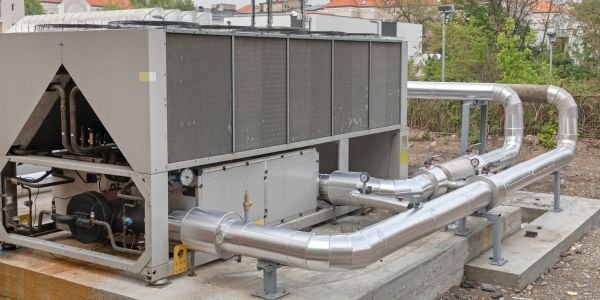
| Central chilled-water plant | About 100 TR to several thousand TR | Chillers cool water to about 7 C; pumps send it to air handling units (AHUs) and fan coil units (FCUs); cooling towers or air-cooled condensers reject the heat | Malls, airports, IT parks, large hospitals |
| Heat pump | From about 1 TR (room units) upward | Vapour-compression cycle run in reverse to heat; can also make hot water | Space heating in cold regions, hotel and hostel hot water |
Capacities are typical market ranges, not hard limits. In a chilled-water plant, an AHU is a large cabinet with filters, a chilled-water coil and a fan that feeds ducts for a whole floor. An FCU is a small coil-and-fan unit for one room. Both need pumps to move the water; see our page on types of pumps for the centrifugal pumps used in these plants.
Key HVAC terms: TR, COP, EER and ISEER
- Ton of refrigeration (TR): 1 TR = 3.517 kW = 12,000 BTU/h of heat removal. It comes from the heat needed to melt one short ton of ice in 24 hours. A “1.5 ton AC” removes about 5.28 kW of heat, not 1.5 tonnes of anything.
- COP (coefficient of performance): cooling output divided by electrical input, both in kW. A COP of 3.5 means 3.5 kW of heat removed for every 1 kW of electricity.
- EER (energy efficiency ratio): the same idea at one rated condition. In SI units EER is in W/W and equals COP; in US units it is BTU/h per watt, and EER (BTU/h per W) = 3.412 x COP.
- ISEER (Indian Seasonal Energy Efficiency Ratio): the total heat an AC removes in a year divided by the total energy it uses, weighted by the range of outdoor temperatures in Indian weather. The Bureau of Energy Efficiency (BEE) uses ISEER for the star label on room ACs. BEE raised the star thresholds from 1 January 2026, so a model that was 5-star under the 2025 table can carry fewer stars now. Compare ISEER on the label, not the number of stars across years.
Worked example 1: rough AC size for a room
This is a rule of thumb for a first guess only. A proper cooling load calculation adds up heat from walls, roof, glass, people, lights and fresh air, and can differ from this by 30 percent or more.
Room: 4 m x 4.5 m = 18 m2 = 18 x 10.764 = 193.8 sq ft.
A common Indian retail rule is about 1 TR per 120 sq ft for an ordinary bedroom. Load = 193.8 / 120 = 1.61 TR.
So a 1.5 TR AC suits this room if it is shaded, on a lower floor and has little glass. On a sun-facing top floor, or with many people or a kitchen next door, move up to 2 TR.
Worked example 2: COP, power and running cost
A 1.5 TR split AC removes 1.5 x 3.517 = 5.28 kW of heat at full load.
- At COP 3.5: input power = 5.2755 / 3.5 = 1.51 kW (EER = 3.5 x 3.412 = 11.9 BTU/h per W).
- At COP 4.5: input power = 5.2755 / 4.5 = 1.17 kW.
- Difference = 1.507 – 1.172 = 0.335 kW.
Over 1,000 full-load hours a year (for example, about 8 hours a day for four summer months), the more efficient unit saves 0.335 x 1,000 = 335 kWh. At an assumed tariff of Rs 8 per unit, that is about Rs 2,680 a year. Check your own electricity tariff; it varies by state and slab.
Worked example 3: chilled-water flow for a 100 TR chiller
Heat removed Q = 100 x 3.517 = 351.7 kW. With the usual 5 C rise in chilled water (7 C supply, 12 C return) and water specific heat 4.186 kJ/kg K:
Mass flow m = Q / (cp x ΔT) = 351.7 / (4.186 x 5) = 16.8 kg/s, about 16.8 litres per second or 60.5 m3/h. That is the flow the chilled-water pump must deliver.
Ventilation and indoor air quality
Cooling alone does not make a healthy room. A sealed, air-conditioned office with no fresh air builds up carbon dioxide from occupants, which causes drowsiness and headaches. Ventilation brings in outdoor air, and filters remove dust and pollen before it reaches people.
ASHRAE Standard 62.1, “Ventilation and Acceptable Indoor Air Quality”, is the most widely used reference for how much outdoor air to supply. It sets a rate per person plus a rate per square metre of floor, depending on the type of space. In India, the National Building Code (NBC 2016, Part 8) covers air conditioning and mechanical ventilation. In polluted Indian cities, designers add higher-grade filters (MERV 13 or better) on fresh-air units, since the outdoor air itself can be dirtier than the air inside.
Refrigerants and the HFC phase-down
Older Indian ACs used R-22, an HCFC that damages the ozone layer. Under the Montreal Protocol it is being phased out, and new room ACs in India have largely moved to R-32 and R-410A, with a few models using R-290 (propane).
R-32 and R-410A do not harm the ozone layer, but they are HFCs with high global warming potential (GWP). Over 100 years, 1 kg of R-410A warms the climate about as much as 2,088 kg of CO2, and 1 kg of R-32 about 675 kg (IPCC AR4 values). The Kigali Amendment to the Montreal Protocol, ratified by India in 2021, phases down HFCs. India is in Article 5 Group 2, with this schedule:
- Baseline: average HFC use in 2024-2026, plus 65 percent of the HCFC baseline
- Freeze at the baseline from 1 January 2028
- Reductions of 10 percent by 2032, 20 percent by 2037, 30 percent by 2042 and 85 percent by 2047
Every kilogram that leaks out counts against this budget, which is why leak control matters. Our guide to the refrigerant leak detector explains how technicians find and measure leaks.
India’s AC temperature rules: 24 C default and the proposed 20-28 C band
Since 1 January 2020, BEE has required every star-labelled room AC sold in India to switch on at a default setting of 24 C. Users can still change it.
In June 2025 the Union Power Minister announced a plan to limit AC set points to 20 C to 28 C for homes, offices and vehicles, so that units could not be set colder than 20 C. The reason given was that each 1 C rise in set point saves roughly 6 percent of AC electricity. At the time of writing we could not find a final notification bringing this band into force, so check the BEE website for its current status before quoting it as law.
Careers: where HVAC engineers work
HVAC is a core specialisation for mechanical engineering graduates. Work falls into a few areas:
- Design consultants: heat load calculation, duct and pipe sizing, equipment selection and drawings for new buildings.
- Contractors: installation, testing and commissioning on site.
- Manufacturers: product design, testing labs, application engineering and sales for AC, chiller and VRF makers.
- Facility management: running and maintaining plants in malls, hospitals, hotels and data centres, where energy use is closely watched.
Refrigeration and air conditioning is a regular subject in B.Tech mechanical courses; free lecture series are available on NPTEL.
FAQs
What is HVAC in simple words?
HVAC stands for heating, ventilation and air conditioning. It is the set of equipment that keeps a building at a comfortable temperature and humidity and supplies clean, fresh air.
What is the difference between HVAC and AC?
An AC only cools and dehumidifies. HVAC is the whole system, which can also heat, bring in and filter outdoor air, and exhaust stale air. A split AC is one piece of HVAC equipment.
How many kW is 1 ton of AC?
One ton of refrigeration is 3.517 kW of cooling, or 12,000 BTU/h. It measures heat removed, not electricity used. A 1.5 ton AC with COP 3.5 draws about 1.5 kW of power.
What is ISEER in an AC?
ISEER is the Indian Seasonal Energy Efficiency Ratio: yearly cooling delivered divided by yearly energy used, based on Indian temperature conditions. BEE star labels on room ACs are based on it, and a higher ISEER means lower bills.
Why is the default AC temperature 24 C in India?
BEE made 24 C the default setting on star-labelled room ACs from 1 January 2020 to cut electricity use. Each degree warmer saves roughly 6 percent of AC energy, and 24 C is comfortable for most people with a fan running.
Related Topics on EngineeringHulk
Keep reading

What Is Annealing and How It Works: Stages, Types and Temperatures
Annealing softens metal by heating, soaking and slow cooling. See the three stages, recrystallisation temperature, steel annealing types and temperatures.
What Is Graphene? Structure, Properties, Production and Uses
Graphene is one layer of sp2 carbon atoms in a honeycomb lattice. Its structure in numbers, measured properties, how it is made and where it is used.
Moment of a Force: Formula, Types, Couples and Solved Examples
The moment of a force is its turning effect about a point, equal to force times perpendicular distance. Formula, sign rule, couples and solved examples.

Strain Formula: Definition, Types, Units and Solved Examples
Strain formula: strain = change in length / original length. Units, tensile, shear and volumetric strain, true strain, thermal strain and solved examples.

LASER Full Form, Working Principle, Types and Properties
LASER full form, how stimulated emission and population inversion work, the 3 parts of a laser, types with wavelengths, photon energy and laser classes.
Boiler Classification: Types of Boilers With Examples
Types of boilers classified by tube contents, axis, firing, circulation, pressure, tubes, use, fuel and heat source, with a master table of named boilers.