Cornering power is the sideways (cornering) force a tyre produces for each degree of slip angle, measured in newtons per degree. It is the slope of the cornering force versus slip angle curve at small slip angles, and in most texts it means the same thing as cornering stiffness, Cα. A typical passenger car tyre carrying about 4 kN makes several hundred to about a thousand newtons of side force per degree. Some authors divide this figure by the load on the tyre, so check which definition a source uses. This page explains slip angle, the cornering force curve, what raises or lowers cornering power, and works through the force and speed numbers for a car on a curve.
Why a rolling tyre needs a slip angle
A car cannot turn unless its tyres push sideways on the road. A tyre makes that sideways push by twisting slightly. As the tread enters the contact patch it grips the road, and the wheel rim keeps moving along the direction it is pointing. The tread is dragged sideways and the sidewall and tread elements bend. The result is that the wheel travels along a path at a small angle to the direction it is pointing.
That angle is the slip angle, α: the angle between the direction the wheel is pointing and the direction it is actually moving. The bent tread elements act like springs, and their combined pull is the cornering force (lateral force, Fy). No slip angle, no cornering force. In ordinary driving slip angles are only a degree or two, and the tread is not actually sliding over most of the contact patch; the word “slip” refers to the direction mismatch, not a skid.
The cornering force vs slip angle curve
If you plot cornering force against slip angle for a tyre at a fixed load, the curve has three parts:
- Linear region, from 0 to about 2 to 4 degrees for a car tyre. Force rises in proportion to slip angle. The tread in the contact patch is almost all gripping.
- Transition region. The rear of the contact patch starts to slide, so the curve bends over and each extra degree adds less force.
- Peak and saturation, typically around 6 to 10 degrees for road tyres. The whole patch is close to sliding, the force stops rising and may fall a little. Beyond this the tyre is skidding sideways.
The slope of the linear part is the cornering stiffness:
Fy = Cα × α (valid for small α)
The height of the peak is set by the friction coefficient between tyre and road times the load: Fy,max ≈ μ × Fz. Cornering stiffness decides how the car responds in normal driving; the peak decides how fast it can corner before it slides.
Cornering power and cornering stiffness: the two usages
Sources use these words in slightly different ways, which confuses many students:
| Term | Definition | Units |
|---|---|---|
| Cornering stiffness, Cα | Slope of the Fy vs α curve at small slip angles | N/deg or N/rad (1 N/deg = 57.3 N/rad) |
| Cornering power (usual meaning, older British term) | Cornering force per degree of slip angle; the same quantity as cornering stiffness | N/deg |
| Cornering power (load-normalised usage), or cornering coefficient | Cornering stiffness divided by the vertical load on the tyre | N per N per degree, written 1/deg |
The normalised version is useful because cornering stiffness rises with load. Dividing by load lets you compare tyres of different sizes, or the same tyre at different loads. For example, a tyre with Cα = 900 N/deg carrying 4,000 N has a load-normalised value of 900 ÷ 4,000 = 0.225 per degree. When an exam or a book asks for cornering power, look at the units given: N/deg means the stiffness, 1/deg means the normalised figure.
What affects cornering power
| Factor | Effect on cornering stiffness | Why |
|---|---|---|
| Vertical load | Rises with load, but less than in proportion, and flattens off at high load | A bigger contact patch, but each extra newton of load adds less stiffness |
| Inflation pressure | Usually rises with pressure up to a point | A stiffer carcass and sidewall; very high pressure shortens the patch and the gain stops |
| Construction: radial vs bias ply | Radial tyres are generally higher | The steel belt keeps the tread flat and stiff while the sidewall flexes |
| Aspect ratio | Lower profile (for example 45 series vs 70 series) gives higher stiffness | A shorter sidewall twists less |
| Width and rim width | Wider tyres on suitable rims are usually higher | A wider, stiffer contact patch and better sidewall support |
| Camber | Adds camber thrust; negative camber on the outer wheel adds side force | A leaning tyre pushes towards the side it leans to, even at zero slip angle |
| Tread depth and compound | Worn tyres are often stiffer in the linear range, but lose wet grip | Shorter tread blocks bend less |
| Driving or braking force | Reduces available side force | The tyre shares one friction limit between longitudinal and lateral force |
The load effect matters most for handling. When a car corners, weight moves to the outer tyres. Because stiffness rises less than in proportion to load, the pair of tyres on one axle gives less total cornering stiffness when load is shifted from the inner to the outer tyre. That is how anti-roll bars tune handling: a stiffer bar at one end moves more load across that axle and reduces its grip. The suspension system page covers anti-roll bars and springs, and tyre sizes and types are covered in tyres and vehicle performance.
Worked example 1: cornering force from cornering stiffness
A tyre has a cornering stiffness of Cα = 900 N/deg (an illustrative value for a passenger car tyre carrying about 4 kN).
- At α = 2°: Fy = 900 × 2 = 1,800 N
- In N/rad: Cα = 900 × 57.3 = 51,570 N/rad (57.3 degrees per radian)
- Load-normalised: 900 ÷ 4,000 = 0.225 per degree
The linear formula would give 900 × 10 = 9,000 N at 10 degrees, but a 4 kN tyre on a dry road with μ of about 1 can make only about 4 kN. The straight-line relation only holds for small slip angles.
Worked example 2: a car on a curve
A 1,200 kg car drives round a flat curve of radius R = 50 m at 54 km/h. Each of its four tyres has Cα = 900 N/deg.
- Speed: v = 54 ÷ 3.6 = 15 m/s
- Lateral acceleration: a = v2 ÷ R = 152 ÷ 50 = 225 ÷ 50 = 4.5 m/s2, which is 4.5 ÷ 9.81 = 0.46 g
- Total cornering force needed: F = m × a = 1,200 × 4.5 = 5,400 N
- Average per tyre, ignoring load transfer: 5,400 ÷ 4 = 1,350 N
- Slip angle needed: α = 1,350 ÷ 900 = 1.5°, well inside the linear region
How fast before it slides? On a flat road the tyres can supply at most a lateral acceleration of about μg, so the limiting speed is vmax = √(μgR).
- Dry road, μ = 0.8: vmax = √(0.8 × 9.81 × 50) = √392.4 = 19.8 m/s = 71 km/h
- Wet road, μ = 0.5: vmax = √(0.5 × 9.81 × 50) = √245.3 = 15.7 m/s = 56 km/h
So at 54 km/h the car is comfortable on a dry road but close to its limit in the wet. In practice load transfer, camber and uneven grip between front and rear lower these limits a little. The μ values are typical assumptions, not measured figures.
Cornering power and understeer or oversteer
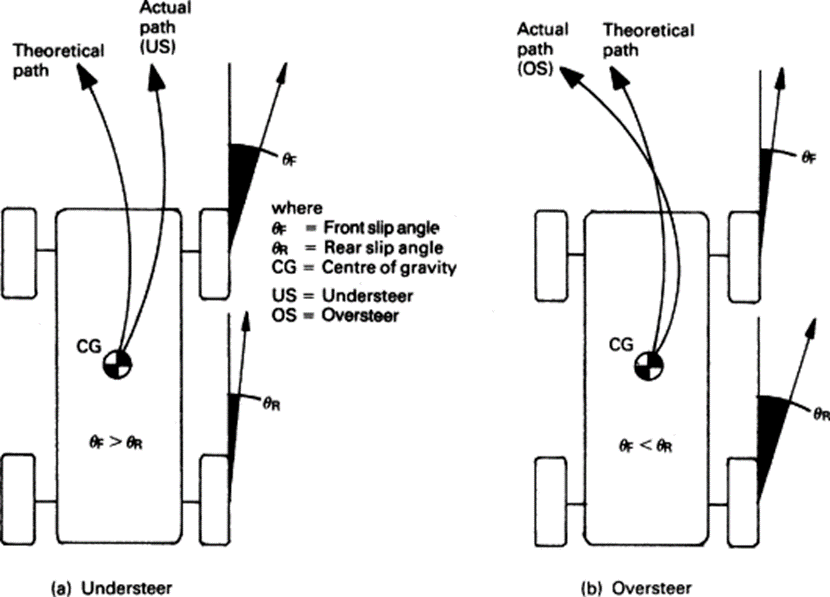
Whether a car understeers or oversteers depends on how the front and rear slip angles compare, and that depends on each axle’s load divided by its cornering stiffness. The understeer gradient is:
K = Wf/Cf − Wr/Cr
where W is the axle load and C the axle cornering stiffness. K is positive for understeer and negative for oversteer. A nose-heavy car with the same tyres front and rear therefore tends to understeer. Designers use different tyre sizes or pressures front and rear to tune K. The oversteer and understeer page works through K, characteristic speed and critical speed with numbers, and steering geometry explains how camber and toe settings feed into it.
How cornering stiffness is measured
Tyre makers and vehicle labs measure it on a flat-track tyre tester: the tyre runs on a moving steel belt covered with an abrasive road-like surface, and a rig sets its load, slip angle, camber and inflation while load cells record the forces and moments. Drum machines and trailers or trucks that tow a test wheel along a real road are also used. The results are fitted to tyre models, such as Pacejka’s “magic formula”, for vehicle simulation.
Vehicle dynamics is part of the automobile engineering elective in many B.Tech mechanical programmes, and NPTEL has free vehicle dynamics lectures that cover tyre cornering behaviour.
FAQs
What is cornering power?
Cornering power is the cornering force a tyre produces per degree of slip angle, in N/deg, at small slip angles. Some authors divide it by the tyre load to give a figure per degree that compares tyres of different sizes.
What is cornering stiffness?
Cornering stiffness is the slope of the lateral force versus slip angle curve at small slip angles, Fy = Cα × α. It is given in N/deg or N/rad and is the same quantity as cornering power in its usual meaning.
What is a slip angle?
It is the angle between the direction a wheel is pointing and the direction it is actually travelling. A tyre must run at a slip angle to produce cornering force.
What increases a tyre’s cornering power?
Radial construction, a lower aspect ratio, a wider tread on the right rim, correct or slightly higher inflation pressure, and more vertical load, though stiffness rises less than in proportion to load.
What is the difference between cornering force and cornering power?
Cornering force is the actual side force in newtons at a given slip angle. Cornering power is the rate at which that force grows per degree of slip angle.