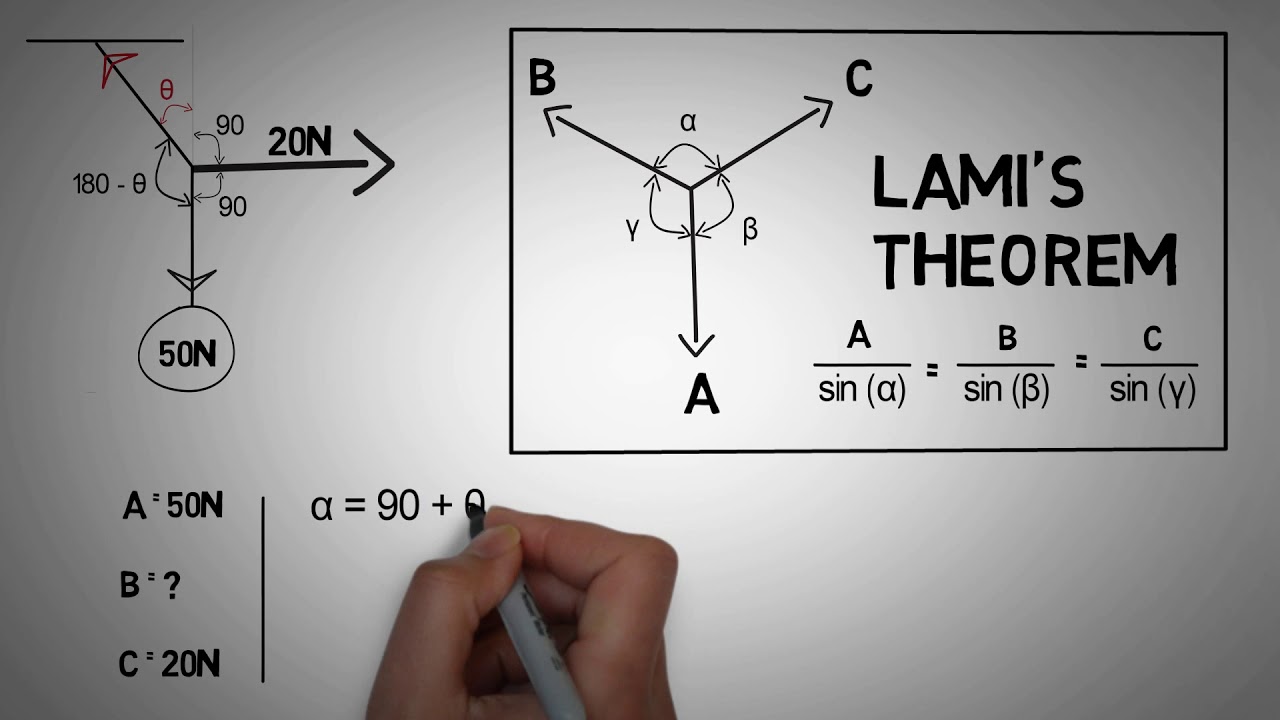
Lami’s theorem states that if three coplanar, concurrent forces act on a body and keep it in equilibrium, each force is proportional to the sine of the angle between the other two forces. For forces P, Q and R, with α the angle between Q and R, β the angle between R and P, and γ the angle between P and Q:
P / sin α = Q / sin β = R / sin γ
The theorem is named after the French mathematician Bernard Lamy, who published it in 1687. Engineering students use it in Engineering Mechanics to find tensions in strings and reactions in simple structures when exactly three forces meet at a point.
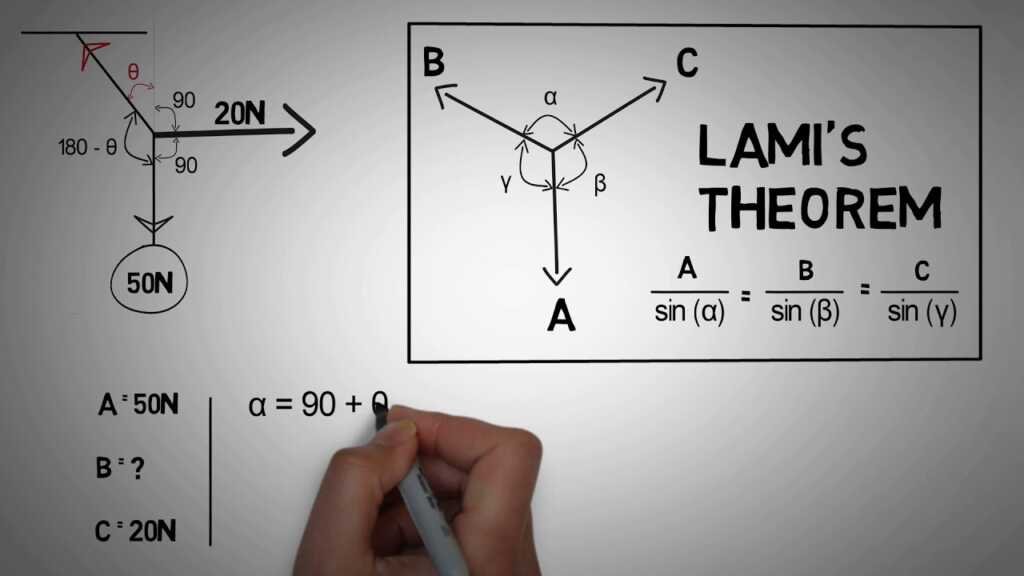
Conditions for using Lami’s theorem
Check all four before you apply the formula:
- There are exactly three forces.
- The forces are coplanar (in one plane).
- They are concurrent (their lines of action meet at one point).
- The body is in equilibrium (at rest or moving with constant velocity).
If there are four or more forces, or they do not meet at a point, use the equilibrium equations ΣFx = 0, ΣFy = 0 and ΣM = 0 instead.
Proof of Lami’s theorem
Because the three forces are in equilibrium, they can be drawn head-to-tail to form a closed triangle, called the triangle of forces. The sides of this triangle are proportional to P, Q and R.
The angle inside the triangle opposite side P is not α itself but (180° − α), because the triangle is built from the force arrows placed end to end. Similarly the other interior angles are (180° − β) and (180° − γ).
Apply the sine rule to the triangle:
P / sin(180° − α) = Q / sin(180° − β) = R / sin(180° − γ)
Since sin(180° − θ) = sin θ, this becomes P / sin α = Q / sin β = R / sin γ, which is Lami’s theorem.
Solved example: weight hanging from two strings
A 100 N lamp hangs from two strings. String A makes 30° with the horizontal and string B makes 60° with the horizontal, on opposite sides. Find the tensions TA and TB.
Step 1: find the angles between the forces.
- Between TA and TB: 180° − 30° − 60° = 90°.
- Between TB and the weight W (acting straight down): 90° + 60° = 150°.
- Between TA and W: 90° + 30° = 120°.
Check: 90° + 150° + 120° = 360°, as it must be.
Step 2: apply Lami’s theorem. Each force is divided by the sine of the angle between the other two:
TA / sin 150° = TB / sin 120° = W / sin 90°
TA / 0.5 = TB / 0.866 = 100 / 1
Step 3: solve. TA = 100 × 0.5 = 50 N and TB = 100 × 0.866 = 86.6 N.
Check with components: horizontally, 50 cos 30° = 43.3 N and 86.6 cos 60° = 43.3 N, which balance. Vertically, 50 sin 30° + 86.6 sin 60° = 25 + 75 = 100 N, which balances the weight. Notice that the steeper string carries more of the load.
Where Lami’s theorem is used
- Tensions in cables and strings holding a suspended load.
- Forces in a simple jib crane or a bracket supporting a weight.
- Reactions on a sphere resting between two smooth inclined planes or against a wall.
- Forces in the two members of a simple two-bar truss meeting at a loaded joint.
Common mistakes
- Using the angle a force makes with the horizontal instead of the angle between the other two forces.
- Applying it when there are more than three forces or when the forces are not concurrent.
- Using the interior angles of the force triangle directly without converting.
- Forgetting that the three angles between the forces must add up to 360°.
Frequently asked questions
What is Lami’s theorem?
Lami’s theorem says that when three coplanar, concurrent forces keep a body in equilibrium, each force divided by the sine of the angle between the other two is the same for all three forces.
What is the formula of Lami’s theorem?
P / sin α = Q / sin β = R / sin γ, where α, β and γ are the angles opposite to P, Q and R respectively, measured between the other two forces.
How is Lami’s theorem proved?
Draw the three forces as a closed triangle of forces and apply the sine rule. Because each interior angle is 180° minus the angle between the forces, and sin(180° − θ) = sin θ, the sine rule gives Lami’s theorem.
Can Lami’s theorem be used for four forces?
No. It applies only to exactly three concurrent forces in equilibrium. For more forces, resolve them into components and use ΣFx = 0 and ΣFy = 0.
References
- S. S. Bhavikatti, Engineering Mechanics, chapter on equilibrium of concurrent force systems.
- R. C. Hibbeler, Engineering Mechanics: Statics, equilibrium of a particle.