
A chassis frame is the load-bearing structure of a vehicle. It carries the engine or motor, the transmission, the body, the suspension, the steering, the fuel or battery mass and the payload, and it has to resist bending, torsion, lateral and impact loads without permanent deformation. The main types of chassis are the ladder frame, the monocoque (unibody), the backbone chassis, the tubular space frame, the perimeter frame, the X-frame, the platform chassis and the skateboard platform used by dedicated electric vehicles.
Almost every car sold in India today is a monocoque. Ladder frames survive where the vehicle has to tow, carry heavy loads or be re-bodied, which is why a Mahindra Thar and a Tata truck still use one while a Tata Punch does not.
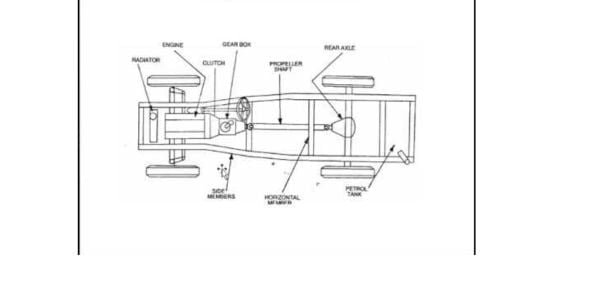
What does a chassis frame actually carry?
The frame is the part every other part hangs off. Loads reach it from the road through the suspension mounts, from the drivetrain through the engine and gearbox mounts, and from the occupants and cargo through the floor. Design starts by listing the load cases, because each one asks for a different thing from the structure.
| Load case | Where it comes from | What the frame must do |
|---|---|---|
| Vertical bending | Kerb weight, passengers and payload acting downward between the axles | Resist sagging in the middle. Dynamic road input is usually taken as 2.5 to 3 times the static load for a pothole strike, so the frame is sized well above its parked weight. |
| Torsion (twist) | One wheel dropping into a hole or riding a kerb while the diagonally opposite wheel is loaded | Resist twisting about the longitudinal axis. This is normally the governing case for ride and handling, and the hardest one for an open-section frame. |
| Lateral loads | Cornering forces at the tyre contact patch, kerb strikes, crosswind | Keep the suspension pick-up points in place so wheel alignment does not change while cornering. |
| Longitudinal loads | Acceleration, braking torque reaction, towing, trailer drawbar pull | Carry push and pull along the rails and feed brake and drive torque into the structure. |
| Impact loads | Front, rear, side and pole crash | Absorb energy in controlled zones while the passenger cell holds its shape. |
| Fatigue | Millions of small road-input cycles over the vehicle’s life | Avoid cracks at welds, holes and section changes, where stress concentrates. |
Two of these fight each other. Crash performance wants parts of the structure to fold; ride, handling and durability want the structure to stay stiff. Modern design solves this by making the passenger cell very stiff and the ends deliberately soft in a controlled way.
Chassis, frame and body: what is the difference?
The three words get mixed up constantly, so here is the split as engineers use it.
- Frame is the bare structural member set, such as the two side rails and the cross members of a truck. It is a component you can lift on its own.
- Chassis is the frame plus everything that makes it a rolling, running unit without a body: engine or motor, transmission, axles, suspension system, wheels, brakes, steering, fuel system and wiring. A truck maker can legally sell this alone; in India it is called a drive-away chassis and goes to a bodybuilder.
- Body is the enclosure: floor, roof, pillars, doors, panels, glass, seats and trim.
The catch is that in a monocoque there is no separate frame at all. The body is the structure, so “chassis” in a modern car is used loosely to mean the body shell plus the running gear. That is why a query like “chassis and frame” has two correct answers depending on which construction you are talking about.
Types of chassis: comparison table
Start here, then read the sections below for the detail on each type.
| Type of chassis | Construction | Weight | Torsional rigidity | Typical vehicles |
|---|---|---|---|---|
| Ladder frame | Two C- or box-section side rails joined by cross members; body bolted on through rubber mounts | Heaviest for a given size | Low (the open C-section twists easily) | Trucks, buses, pickups, body-on-frame SUVs |
| Monocoque / unibody | Stamped sheet panels spot-welded and bonded into one stressed shell | Lightest in production cars | High | Nearly all modern cars, hatchbacks, crossovers |
| Backbone | One strong central tube from front to rear carrying the drivetrain; body adds little strength | Light | Good in torsion, weak in side impact | Lotus Elan, some sports cars, many motorcycles |
| Tubular space frame | Small-diameter tubes triangulated into a 3D truss, panels non-stressed | Very light for its stiffness | Very high per kilogram | Race cars, student formula cars, low-volume sports cars |
| Perimeter frame | Ladder variant with the rails routed out to the sill line and kicked up over the axles | Heavy | Moderate, better side impact than a ladder | Older full-size sedans built body-on-frame |
| X-frame | Side rails swept inward to cross in an X at the centre of the vehicle | Heavy | Better torsion than a plain ladder | 1950s and 60s American cars; obsolete |
| Platform chassis | Structural floor pan with integrated members; separate body bolted or welded to it | Medium | Moderate to high | Original VW Beetle, Citroen 2CV |
| Skateboard (EV) | Flat structural battery pack between front and rear drive modules; body sits on top | Heavy overall, but efficient structurally | High, the pack acts as a stiff closed box | Dedicated battery electric vehicles |
1. Ladder frame chassis
The oldest layout and still the simplest. Two long side rails run the length of the vehicle, joined at intervals by cross members, so the plan view looks like a ladder. Rails are usually rolled or pressed steel in a C-channel section, sometimes boxed in the middle where bending is worst, and the depth of the rail is varied along its length to follow the bending moment diagram. Cross members are riveted or welded in, and the body sits on top on rubber mounts that isolate road noise.
Why it is still used: the rails are straight, the section is constant, and the whole thing can be built cheaply in low volume. The body is separate, so one chassis can carry a pickup bed, a tipper, a tanker or a bus body. Repair after damage is a matter of straightening or replacing a rail. Towing and payload capacity are high because load goes straight into a deep beam.
Where it falls down: an open C-section has almost no torsional stiffness. The frame twists, the body shakes on its mounts, and ride and steering precision suffer. It is heavy, it sits high, which raises the centre of gravity, and crash energy management is harder because the rigid rails run through the whole vehicle. Hence its retreat to trucks, buses and off-road SUVs.

2. Monocoque or unibody chassis
Monocoque means “single shell”. Instead of a frame carrying a body, the body panels are formed into closed sections and welded together so the shell itself takes every load. The floor pan, sills, A-B-C pillars, roof rails, bulkhead and wheel arches all work as structure. A production car body-in-white is assembled from several hundred stampings joined by several thousand spot welds, plus structural adhesive and laser-welded seams at the critical joints.
Why it dominates: a closed box is far stiffer in torsion than an open channel of the same mass, so the same rigidity arrives at much lower weight. Lower weight means better fuel economy, better braking and better handling. The floor sits lower, the car is easier to get into, and interior space improves because there is no frame under the floor.
Crash structure: this is where monocoque construction really wins. The shell is tuned zone by zone. The front and rear rails and the bumper beam are designed as crumple zones that fold in an accordion pattern at a controlled force level, converting kinetic energy into plastic deformation over a longer stroke. The passenger cell around them uses ultra-high-strength and hot-stamped steel that is meant not to deform at all. Deceleration of the occupants is spread over more time, so peak force on the body drops.
The downside: repairability. Damage to a monocoque travels through the shell, so a bad accident can distort the floor pan and pillars. Repair needs a jig, measured pull, sectioning at manufacturer-approved points and correct welding, and hot-stamped members generally cannot be straightened and heated; they must be replaced. Severe damage can write a car off that a ladder-frame vehicle would have survived commercially.
3. Backbone chassis
A single strong tube, usually rectangular in section, runs down the centre of the vehicle from the front suspension to the rear. The drive shaft passes inside it, and the engine, gearbox, final drive and suspension bolt to structures at each end. The body is dropped over the top and carries little load.
It is light, it is torsionally good for its weight, and it allows a very low, simple two-seat body. Its weaknesses are side-impact protection, since there is no structure out at the sill line, and cost of making the central tube. It shows up in small sports cars and, in a different form, in many motorcycle frames.
4. Tubular space frame chassis
Many small-diameter steel or alloy tubes are welded into a three-dimensional truss. If the truss is properly triangulated, every tube sees mainly tension or compression rather than bending, which is the most efficient way to use material. The result is very high stiffness for very low mass.
Panels bolted onto it are non-stressed skins. The costs are labour, since each tube is cut, notched, jigged and welded by hand, and packaging, because tubes cut across the cabin where doors and seats want to be. It is the standard choice for racing cars, student formula vehicles and low-volume specials, not for mass production.
5. Perimeter frame
A perimeter frame is a ladder frame with the side rails pushed outward to run alongside the passenger compartment at sill level, and kicked up and over the front and rear axles. Moving the rails outboard lowers the floor between them and puts steel where a side impact arrives. It was the standard American full-size car frame for decades. It remains heavy and it is still weaker in torsion than a unibody, which is why it disappeared along with body-on-frame cars.
6. X-frame
Here the side rails sweep inward and meet in a narrow X at the centre of the car. The idea was to improve torsional stiffness over a plain ladder and to lower the floor and roof line. It did the first reasonably well, but the narrow centre section left the doors with nothing outboard to brace against in a side impact. Once side-impact standards arrived, the X-frame was abandoned. Treat it as history, not as a current option.
7. Platform chassis
A platform chassis turns the floor pan itself into the main structure, with pressed-in longitudinal and transverse members, and then bolts or welds a separate body on top. It sits between the ladder and the monocoque: stiffer and lighter than a ladder, simpler and easier to re-body than a full unibody. The original Volkswagen Beetle is the textbook example, with its pan and central tunnel carrying everything and the body unbolting from it.
The word “platform” is also used in a second, commercial sense today, meaning a shared set of floor, suspension and hard points from which several models are built. Do not confuse that meaning with the construction type.
8. Skateboard chassis for electric vehicles
A dedicated battery electric vehicle does not need an engine bay, a gearbox tunnel or a propeller shaft, so the structure was redrawn around the battery. The pack becomes a flat, sealed box that fills the floor between the axles, with a motor and suspension module at one or both ends. The pack casing is structural: its side rails, cross beams and top and bottom plates form a large closed section that carries bending and torsion, and it also has to survive side-pole intrusion without crushing cells.
The gains are real. The centre of gravity drops close to the road, weight distribution moves toward even front-to-rear, the cabin floor is flat, and one platform can take several different body styles. The costs are mass, since the pack is the heaviest single item in the vehicle, and repair complexity, because damage to the floor is now damage to a high-voltage component. Since almost every purpose-built EV now uses this layout, it belongs in any current list of chassis types, alongside the traditional ones.
Chassis frame materials
| Material | Typical use | Why it is chosen |
|---|---|---|
| Mild (low-carbon) steel | Truck frame rails, non-critical panels, brackets | Cheap, deep-drawable, easy to weld and to straighten after damage. Low strength means thicker sections and more weight. |
| HSLA steel | Frame rails, floor members, seat cross members | Micro-alloyed with niobium, vanadium or titanium for a fine grain. Yield strength of roughly 300-550 MPa lets a thinner gauge carry the same load, cutting weight while keeping formability and weldability. |
| Dual-phase and TRIP steels | Crumple zone rails, bumper beams | High work hardening, so they absorb a lot of energy as they fold. Good for parts meant to deform in a controlled way. |
| Boron steel (hot-stamped) | B-pillar, roof rail, side-intrusion beams, tunnel, front bumper beam | Blanks are heated near 900 degrees C, formed and quenched in the die. Tensile strength after press hardening is around 1,500 MPa, so these parts resist intrusion instead of folding. They form the survival cell and are usually replaced, not repaired. |
| Aluminium alloys | Premium body shells, subframes, crash boxes, battery trays, castings | Density about 2.7 g/cm3 against 7.85 for steel. Its elastic modulus is only about a third of steel’s, so sections are made larger or thicker; the net saving is still significant. Costs more, needs rivets, adhesive or specialised welding. |
| Carbon fibre composite | Monocoque tubs in supercars and racing cars | The highest stiffness and strength per kilogram available. Very expensive, slow to lay up and cure, and damage cannot be hammered out, so structural repair is limited. |
| Magnesium alloys | Small die castings such as cross-car beams and seat frames | Lighter than aluminium, but corrosion and cost restrict it to specific parts. |
Real vehicles mix these. A single modern body shell will contain mild steel, several high-strength grades, hot-stamped boron parts at the pillars and aluminium in the bumper beam and closures, with each grade placed exactly where its property earns its cost.
Torsional rigidity: the number that matters
Torsional rigidity is how much torque, in newton-metres, the structure needs to twist one degree about its longitudinal axis. It is quoted in Nm/degree, and higher is better.
Why it matters: the suspension can only do its job if it is bolted to something that does not move. If the shell twists while a wheel loads up, part of your carefully designed wheel travel is happening in the bodywork instead of at the damper, the geometry shifts, the steering response gets vague, doors and glass creak, and the body panels fatigue at their joints. A stiff shell also makes suspension tuning repeatable, because a change at the damper actually reaches the tyre.
As rough orders of magnitude from published test work, a bare ladder frame sits in the low thousands of Nm/degree, a modern steel monocoque car is usually somewhere in the region of ten thousand to the mid twenty-thousands, and carbon-tub supercars go higher still. Treat any single published figure with care: the value depends heavily on the test method, on where the torque is applied and measured, and on whether glass, doors and the roof are fitted. Convertibles lose a large fraction of their rigidity when the roof is removed, which is why they get extra bracing under the floor and behind the seats.
How chassis frames are manufactured
- Press forming and stamping. Sheet blanks are drawn, trimmed and pierced into channels and panels on a line of presses. Most unibody parts are made this way.
- Roll forming. Long constant-section rails are produced continuously through a set of rollers, which suits truck frame rails.
- Hydroforming. A tube is placed in a die and expanded by internal fluid pressure into a closed section with varying shape. It produces stiff, joint-free rails with fewer welds.
- Riveting and bolting. Truck cross members are commonly riveted to the rails, which handles fatigue well and allows a rail to be replaced.
- Resistance spot welding. The main joining method for a unibody, supplemented by MIG and laser welding at high-load joints and by structural adhesive along flanges, which raises stiffness and spreads load away from individual welds.
- Hot stamping (press hardening). Used for boron steel safety parts, as described above.
- High-pressure die casting. Large aluminium castings now replace clusters of stampings in some EV floors, cutting part count and assembly time.
Chassis types in the Indian market
India is one of the clearest places to see both constructions side by side, because ladder-frame vehicles remain commercially important here.
- Body-on-frame: Mahindra Thar, Bolero and Scorpio-N, Maruti Suzuki Jimny, Toyota Fortuner and Innova Crysta, Force Gurkha, and every goods carrier from a Tata Ace upward.
- Monocoque: all mainstream hatchbacks and sedans, plus crossovers and SUVs such as the Tata Nexon, Harrier and Safari, Mahindra XUV700 and XUV 3XO, and Hyundai Creta.
- A direct comparison: when Toyota replaced the ladder-frame Innova Crysta with the monocoque Innova Hycross, the new vehicle came out around 200 kg lighter and moved to front-wheel drive, while the Crysta stayed on sale for buyers who want the rugged, re-bodyable ladder platform.
For commercial vehicles, the chassis is sold to a bodybuilder as a running unit and bodied afterwards. Bus bodies built this way must conform to the AIS-052 bus body code, and vehicle construction generally falls under the Central Motor Vehicles Rules. Automobile engineering syllabi under the AICTE model curriculum cover frame types, load analysis and materials in the vehicle structures unit, so this is examinable material, not background reading.
Which type of chassis should a vehicle use?
- Heavy payload, towing, or one chassis for many bodies: ladder frame. Nothing else is as easy to re-body or repair.
- Passenger car, priority on weight, refinement and crash performance: monocoque. This is why it took over.
- Serious off-road use with frequent chassis flex and rough terrain: ladder frame, for damage tolerance and ground clearance, accepting the ride penalty.
- Racing or very low volume, stiffness per kilogram above all: tubular space frame, or a carbon monocoque if the budget allows.
- Battery electric vehicle designed from scratch: a skateboard platform with a structural pack.
Student tip for a viva: if you are asked why monocoque construction is lighter, do not say “because there is no frame”. Say that a closed section resists torsion far better than an open channel of the same mass, so the same rigidity is reached with less material. That is the actual mechanics of it.
References
- AICTE Model Curriculum for Automobile Engineering, vehicle structures unit.
- Published work on high-strength low-alloy (HSLA) steels in automotive structures, Taylor and Francis.
- Automotive Industry Standard AIS-052, Code of Practice for Bus Body Design and Approval.
FAQs
What are the main types of chassis?
Ladder frame, monocoque (unibody), backbone, tubular space frame, perimeter frame, X-frame, platform chassis, and the skateboard platform used by dedicated electric vehicles. Ladder frames dominate trucks, buses and off-road SUVs; monocoque construction is used in almost every modern passenger car.
What is the difference between a chassis and a frame?
The frame is the bare structural member set, such as the side rails and cross members. The chassis is that frame plus the engine or motor, transmission, axles, suspension, brakes, steering and wiring, in other words a complete rolling unit without a body. In a monocoque vehicle there is no separate frame, because the body shell is the structure.
Why is monocoque construction better than a ladder frame for cars?
The shell forms closed box sections, which are far stiffer in torsion than the open C-channel of a ladder frame at the same weight. That gives lower mass, a lower floor and centre of gravity, better handling and much better control over crash energy, since crumple zones and a stiff passenger cell can be designed into the same shell.
Which materials are used for chassis frames?
Mild steel for truck rails and brackets, HSLA steel for weight-saving structural members, dual-phase steel in crumple zones, hot-stamped boron steel at roughly 1,500 MPa for the B-pillar and side-intrusion members, aluminium alloys in premium shells and battery trays, and carbon fibre composite for supercar and racing tubs.
What is torsional rigidity and why does it matter?
It is the torque in newton-metres needed to twist the structure by one degree about its longitudinal axis. A stiff structure keeps the suspension mounting points in position, so wheel travel happens at the damper rather than in the bodywork. That means sharper steering, repeatable suspension tuning, fewer rattles and less fatigue cracking.