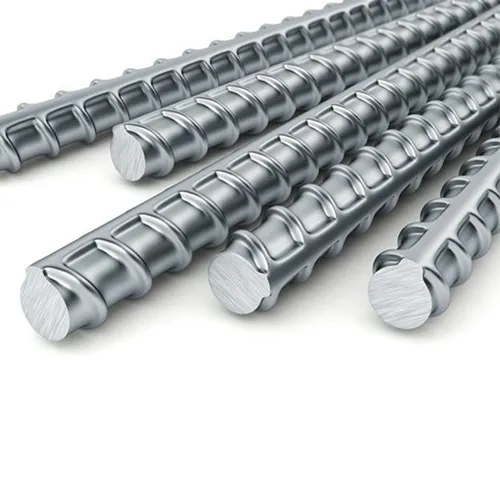
TMT stands for Thermo-Mechanically Treated. A TMT bar is a steel reinforcement bar that is hot-rolled and then quenched with water jets, so it ends up with a hard, strong outer skin and a softer, ductile core. TMT bars are the standard reinforcement for RCC work in India and are made to IS 1786 in grades such as Fe 415, Fe 500, Fe 500D and Fe 550D.
If you searched “TMT full form” from a hospital report, you probably want the other meaning: in medicine, TMT is the Treadmill Test, a heart stress test. The rest of this page is about TMT steel.
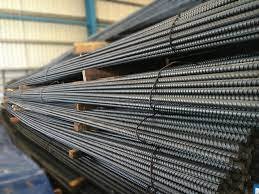
What does thermo-mechanical treatment actually do?
The name describes the two things that happen to the bar at the end of the rolling mill: it is shaped mechanically (rolling) and treated thermally (rapid cooling) in one continuous line. The process is often sold under names such as Tempcore or Thermex, but the physics is the same in every plant.
- Hot rolling. A steel billet is heated to roughly 1,100 to 1,200 °C and rolled down to the final bar diameter, with the ribs pressed onto the surface in the last stand.
- Quenching. As the red-hot bar leaves the last stand it passes through a box of high-pressure water sprays for a second or two. Only the surface cools fast enough to turn into martensite, a very hard and strong structure. The core is still hot.
- Self-tempering. Once the bar leaves the water, heat flowing out from the hot core warms the martensite skin again. This tempers it, so the rim stays strong but loses the brittleness of raw martensite.
- Atmospheric cooling. The bar cools slowly on the cooling bed. The core transforms into ferrite and pearlite, which is soft and ductile.
The result is a composite section: a tempered-martensite ring that gives the bar its yield strength, around a ferrite-pearlite core that lets it stretch and bend without snapping. You can often see this ring as a darker band if a TMT bar is cut, polished and etched.
TMT bar grades under IS 1786
The grade number is the minimum yield strength (0.2% proof stress) in N/mm². So an Fe 500 bar must not yield below 500 N/mm². Grades with a “D” suffix have tighter chemistry and higher elongation, which makes them more ductile; “S” grades are made for special structural uses. The table shows the main requirements of IS 1786:2008.
| Grade | Min. yield strength (N/mm²) | Min. tensile strength (N/mm²) | Min. elongation (%) | Typical use |
|---|---|---|---|---|
| Fe 415 | 415 | 485 | 14.5 | Small houses, low-rise work (now less common) |
| Fe 415D | 415 | 500 | 18.0 | Where high ductility matters |
| Fe 500 | 500 | 545 | 12.0 | General residential and commercial RCC |
| Fe 500D | 500 | 565 | 16.0 | Houses and buildings in seismic zones; the most specified grade today |
| Fe 550 | 550 | 585 | 10.0 | Heavily loaded members, industrial structures |
| Fe 550D | 550 | 600 | 14.5 | High-rise buildings, bridges, heavy infrastructure |
| Fe 600 | 600 | 660 | 10.0 | Special high-strength applications |
IS 1786 also says the tensile strength must exceed the actual yield strength by a set margin (for example 8% for Fe 500 and 10% for Fe 500D). That gap is what lets a bar keep carrying load after it starts to yield, which is why engineers care about the tensile-to-yield ratio and not just the yield figure.
Which TMT grade is best?
There is no single best grade; the right one is the grade your structural drawings specify. As a rule of thumb:
- Fe 500D is the usual choice for houses and multi-storey buildings, especially in earthquake zones III to V, because it combines good strength with high elongation.
- Fe 550D is used where members carry large loads and the designer wants to save steel weight, such as high-rise columns and bridge decks.
- Fe 415 is still permitted but has largely been replaced by Fe 500 grades, which give more strength for the same bar size.
Higher strength is not automatically better. A stronger, less ductile bar can crack a structure in a brittle way during an earthquake, which is exactly what the D grades are designed to avoid.
Standard sizes and weight per metre
TMT bars are commonly sold in 8, 10, 12, 16, 20, 25 and 32 mm diameters, usually in 12 m lengths. Site engineers estimate their weight with a simple formula:
Weight (kg per metre) = d² ÷ 162, where d is the bar diameter in mm.
| Diameter (mm) | Weight (kg/m) | Weight of one 12 m bar (kg) |
|---|---|---|
| 8 | 0.395 | 4.74 |
| 10 | 0.617 | 7.41 |
| 12 | 0.889 | 10.67 |
| 16 | 1.580 | 18.96 |
| 20 | 2.469 | 29.63 |
| 25 | 3.858 | 46.30 |
| 32 | 6.321 | 75.85 |
Worked example: how much does 50 m of 16 mm TMT bar weigh? Weight per metre = 16² ÷ 162 = 256 ÷ 162 = 1.58 kg/m. For 50 m, 1.58 × 50 = 79 kg. The 162 comes from the density of steel (7,850 kg/m³) and the area of a circle; it is accurate to within about 0.1%.
TMT bars vs older CTD (Tor) bars
Before TMT bars became common in the 1990s, Indian sites used cold twisted deformed (CTD) bars, often called Tor steel. CTD bars got their strength by being twisted cold after rolling. TMT replaced them for three practical reasons:
- Ductility: twisting locks residual stress into CTD bars, so they are less ductile and can crack when bent tightly. TMT bars bend more safely.
- Weldability: TMT bars have lower carbon content and can be welded without losing much strength.
- Corrosion: the twisted surface of CTD bars holds stress at the ribs, where rust starts easily. TMT bars have no such torsional stress.
Advantages and limitations
Advantages: high yield strength, so fewer or thinner bars are needed; good elongation for earthquake-resistant design; ribs that give a strong bond with concrete; easy bending and cutting on site; weldable.
Limitations: ordinary TMT bars are not rust-proof. Corrosion resistance depends mainly on concrete cover and good concreting, not on the bar itself. For coastal or chemical environments, designers specify corrosion-resistant steel (CRS) bars, epoxy coating or extra cover. Very high grades also need care in bending and welding.
How to check TMT bars on site
- Look for the BIS (ISI) mark, the grade (for example “500D”) and the manufacturer’s name embossed on the bar.
- Ask for the mill test certificate for each lot; it lists yield strength, tensile strength and elongation.
- Check that the ribs are uniform and there are no cracks, laps or heavy rust scale.
- Weigh a sample length and compare it with the d²/162 value; IS 1786 allows only a small tolerance, so a much lighter bar is under-size.
- Do a bend test on a sample if in doubt: a good bar should bend around a mandrel without cracking.
Frequently asked questions
What is the full form of TMT?
In steel and construction, TMT stands for Thermo-Mechanically Treated. In medicine the same letters mean Treadmill Test, a cardiac stress test.
What does Fe 500D mean on a TMT bar?
Fe is the chemical symbol for iron, 500 is the minimum yield strength in N/mm², and D means a ductile grade with higher minimum elongation (16%) and tighter limits on carbon, sulphur and phosphorus.
Are TMT bars and TMT steel the same thing?
Yes. TMT steel is the material and TMT bars are the finished reinforcement bars made from it. People use the two terms interchangeably.
How do I calculate the weight of a TMT bar?
Use weight per metre = d² ÷ 162, with d in millimetres. A 12 mm bar weighs 144 ÷ 162 = 0.889 kg per metre.
Do TMT bars rust?
Yes, ordinary TMT bars can rust if left exposed. In a structure they are protected by the alkaline concrete cover, so proper cover depth and good compaction are what prevent corrosion.
References
- Bureau of Indian Standards, IS 1786:2008 – High Strength Deformed Steel Bars and Wires for Concrete Reinforcement.
- Research on martensite formation in quenched and self-tempered rebars (ScienceDirect)