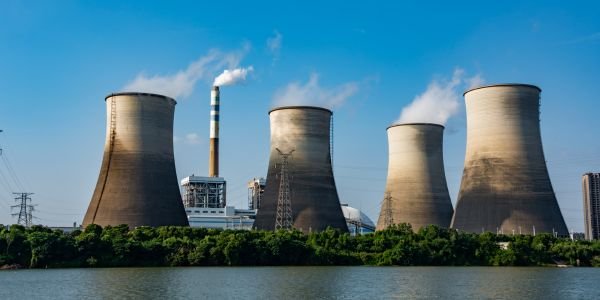
Site selection for a thermal power plant is decided mainly by two bulk flows: coal coming in and water for cooling. A 1000 MW coal plant burning Indian coal needs about 15,000 tonnes of coal and roughly 72,000 cubic metres of water every day, and throws out about 6,000 tonnes of ash. The best site is the one that moves those three quantities most cheaply, and then satisfies land, environmental and grid conditions. This article takes the factors in the order they actually drive the decision, with the numbers worked out.
Factors governing the selection of site for a thermal power plant
Most textbooks list the factors as a flat checklist. In practice they have very different weights. For a coal-fired station the usual order is:
- Coal supply and transport: the largest daily mass flow and a big share of generation cost.
- Cooling water: a fixed daily requirement, now capped by law.
- Ash disposal: thousands of tonnes a day with Indian coal, needing land and a utilisation plan.
- Land: flat, stable, cheap ground, large enough for the plant, coal yard and ash dyke.
- Environmental clearance and emission norms: air, water, forest and population constraints.
- Transmission and load centre: how far the power has to travel to consumers.
- Other factors: road access for construction, labour, foundations, flood level.
1. Coal supply: how much coal does the site have to receive?
Start with the heat rate. A modern supercritical unit has a gross heat rate of about 2,250 kcal/kWh, which corresponds to an efficiency of 860 / 2,250 = 38%. Indian thermal coal has a gross calorific value (GCV) of roughly 3,500-4,000 kcal/kg; take 3,600 kcal/kg, the figure the Central Electricity Authority (CEA) used in its land-requirement report.
Worked example: 1000 MW plant at full load
- Coal per kWh = 2,250 / 3,600 = 0.625 kg/kWh
- Energy per day = 1,000 MW x 24 h = 24,000 MWh = 24 million kWh
- Coal per day = 0.625 x 24,000,000 = 15,000,000 kg = 15,000 tonnes/day
- A standard Indian Railways coal rake of 58 BOXN wagons carries about 3,800 tonnes, so the plant needs about 4 full rakes every day
- Over a year at 90% plant load factor: 0.625 x 1,000,000 kW x 8,760 h x 0.9 = about 4.9 million tonnes of coal
Four trains a day, every day, for 25 years or more is why coal logistics come first. Coal is a low-value, high-bulk cargo, so freight over a long rail haul can add a large share to its delivered price.
Pithead site or load-centre site?
A pithead plant sits next to the coal mine and sends electricity instead of coal. Coal moves a few kilometres by conveyor or merry-go-round rail, so fuel cost is lowest, but the power must travel hundreds of kilometres on high-voltage lines, and the mining belts of Jharkhand, Chhattisgarh, Odisha and Singrauli are often short of water.
A load-centre plant sits near the cities and industries it supplies. Transmission is short, but coal has to be railed in over long distances, and rail congestion becomes a supply risk.
The general rule is: it is usually cheaper to transmit electricity than to haul low-grade coal, because Indian coal carries 30-45% ash that is freighted and then disposed of at the far end. That is why most large Indian stations cluster in the coalfields.
2. Cooling water: how much water does a thermal plant need?
Only about 38% of the heat in the coal becomes electricity. Roughly 10% more leaves up the chimney and through other losses, and the rest is rejected in the condenser. For our 1000 MW plant:
- Heat input = 1,000 / 0.382 = about 2,616 MW (thermal)
- Stack and other losses, about 10% = about 262 MW
- Heat rejected in the condenser = 2,616 – 1,000 – 262 = about 1,355 MW
There are two ways to carry this heat away, and they lead to very different sites.
Once-through cooling draws water from a river, lake or sea, passes it through the condenser once and returns it warmer. For a 10 °C rise, flow = 1,355,000 kW / (4.18 kJ/kg·K x 10 K) = about 32,400 kg/s, or about 32 m3/s (2.8 million m3 a day). Very little is consumed, but the site must sit on a very large water body, and the warm discharge is regulated.
Cooling towers recirculate the same water and reject heat by evaporating part of it. Evaporation needed = 1,355,000 kW / about 2,400 kJ/kg = 564 kg/s, or about 2.0 m3 per MWh. Blowdown, ash handling and other uses bring the total make-up to around 3 m3/MWh, which is exactly where the law now sits.
Indian water-consumption norms
The Ministry of Environment, Forest and Climate Change (MoEFCC) notified water norms for thermal plants on 7 December 2015, amended on 28 June 2018:
- Existing plants with once-through cooling had to install cooling towers and bring specific water consumption down to 3.5 m3/MWh.
- Existing cooling-tower plants also had to come down to a maximum of 3.5 m3/MWh.
- Plants installed after 1 January 2017 must meet 3.0 m3/MWh (the 2015 text said 2.5; the 2018 amendment relaxed it) and achieve zero liquid discharge.
- Plants using sea water are exempt from these consumption limits.
At 3.0 m3/MWh, a new 1000 MW inland plant needs 3.0 x 1,000 = 3,000 m3 per hour, or 72,000 m3 a day. The site needs an assured allocation of that much water from the state, usually from a river barrage or reservoir, including in a dry year.
3. Ash disposal: the factor that makes Indian coal different
Indian power-station coal typically carries 30-45% ash; CEA planned with 40% for most units. Imported coal is usually below 10%.
- Ash per day at 40% = 0.40 x 15,000 = 6,000 tonnes/day
- Ash per year at 90% load factor = 0.40 x 4.93 million = about 2 million tonnes, matching CEA’s rule of thumb of about 2 million tonnes a year per 1000 MW
About 80% of this is fly ash, caught in the electrostatic precipitators; the rest is bottom ash. Whatever is not used goes as slurry to an ash dyke, so the site needs land for a dyke, a pipeline corridor to it, and ground where seepage will not reach drinking-water aquifers.
The Fly Ash Utilisation Notification of 31 December 2021 requires every coal and lignite plant to use 100% of the ash it produces each year, measured over a three-year cycle, with utilisation never below 80% in any year. Unused ash attracts a charge of Rs 1,000 per tonne, and old “legacy” ash in ponds must be used up over ten years from 1 April 2022. For site selection this means nearness to cement plants, brick kilns, road and embankment projects and low-lying land to be filled is now a real advantage, not an afterthought.
4. Land: how much space does a coal plant need?
A coal station needs far more land than its boiler and turbine buildings suggest. In CEA’s 2007 report on land requirements, a 2 x 500 MW station was allotted about 1,420 acres in total, of which the ash dyke with its green belt took about 500 acres. The rest covers the main plant and its green belt, coal yard and handling plant, water reservoir and cooling towers, switchyard, construction and storage areas, and a township. The report itself notes that the ash-dyke area shrinks as more ash is put to use.
The ground should be flat, above the highest recorded flood level, able to take heavy boiler and chimney foundations, and preferably barren or single-crop land, because acquiring fertile farmland and relocating villages is slow and contested.
5. Environment and emission norms
A coal plant releases fly ash particles, SO2, NOx, CO2 and warm water. The site is screened for distance from towns, forests, sanctuaries and ecologically sensitive areas, and it needs an Environmental Clearance based on an impact study and public hearing. Tall chimneys (CPCB asks for at least 275 m on units above 500 MW) help disperse gases, but prevailing wind should not carry the plume straight into a city.
The 2015 emission notification set limits on particulate matter, SO2, NOx and mercury, which in practice meant fitting flue gas desulphurisation (FGD) units. Few plants met the deadlines, and on 11 July 2025 MoEFCC reworked the SO2 part by plant category:
- Category A (within 10 km of the National Capital Region or cities of over a million people): must meet SO2 limits by the end of 2027.
- Category B (near critically polluted areas or non-attainment cities): applicability decided case by case on review.
- Category C (all others, reported as about 78% of coal capacity): exempted from the SO2 standards.
So location now changes the emission-control bill directly: a plant sited near a big city must budget for FGD, while a remote plant may not.
6. Transmission and distance from the load centre
Every site must connect to the grid through a substation and high-voltage lines. Long lines add capital cost, transmission losses and right-of-way problems. Pithead clusters such as Singrauli and Korba depend on long high-voltage corridors to carry their power to distant states; a load-centre plant avoids most of this but pays in coal freight.
Pithead vs coastal site: two Indian examples
The two ends of the choice are well illustrated by India’s Ultra Mega Power Projects.
| Point | Pithead site (Sasan, Madhya Pradesh) | Coastal site (Mundra, Gujarat) |
|---|---|---|
| Capacity | 3,960 MW, supercritical | 4,000 MW, supercritical |
| Coal source | Captive mines next to the plant (Moher, Moher-Amlori Extension, Chhatrasal) | Imported coal, mainly from Indonesia, landed at a port |
| Coal per day for 1000 MW (worked above) | About 15,000 t at 3,600 kcal/kg | About 9,000 t at 6,000 kcal/kg (2,250 / 6,000 = 0.375 kg/kWh) |
| Ash per day for 1000 MW | About 6,000 t at 40% ash | About 900 t at 10% ash |
| Cooling water | Fresh water, limited by the norms | Sea water, exempt from the consumption limit; Mundra uses once-through sea-water cooling |
| Main risk | Water scarcity, long transmission to load | Imported-coal price and exchange rate, marine impact of warm-water discharge |
The coastal plant receives 40% less coal by mass and handles about one-seventh of the ash, but it exposes the owner to international coal prices, the risk that squeezed several imported-coal plants in the 2010s when Indonesian coal became dearer than their tariffs assumed. Its sea-water outfall has also drawn scrutiny for effects on fishing and coastal ecology.
Site selection checklist for a thermal power plant
| Factor | What to check | Typical figure for 1000 MW (Indian coal) |
|---|---|---|
| Coal supply | Distance to mine or port, rail capacity, coal linkage | 15,000 t/day; about 4 rakes/day |
| Cooling water | Assured allocation in a dry year; sea or fresh | 72,000 m3/day at 3.0 m3/MWh |
| Ash disposal | Dyke land, ash users nearby, groundwater safety | 6,000 t/day; about 2 Mt/year |
| Land | Flat, above flood level, low-value, few families displaced | Around 1,400 acres (CEA 2007, 2 x 500 MW) |
| Environment | Distance from cities, forests, sensitive areas; wind direction | SO2 category A, B or C decides FGD need |
| Grid | Nearest 400/765 kV substation, line route | Shorter is cheaper and loses less |
| Other | Road access, labour, soil bearing capacity, flood and seismic data | Site-specific |
A nuclear station is sited by a very different logic, where fuel transport hardly matters and safety zones dominate; see site selection for a nuclear power plant. For the boilers used in these stations, see boiler classification.
FAQs
What is the most important factor in site selection for a thermal power plant?
Coal supply and transport. A 1000 MW plant on Indian coal burns about 15,000 tonnes a day, so the cost and reliability of moving that coal usually outweigh every other factor, followed closely by an assured supply of cooling water.
Why are most Indian thermal power plants built near coal mines?
Indian coal has a low calorific value and 30-45% ash, so hauling it long distances means paying freight on material that ends up as waste. Transmitting electricity from a pithead plant is usually cheaper than railing that coal to a city.
How much water does a thermal power plant use?
Under MoEFCC norms, a new cooling-tower plant installed after 1 January 2017 may use at most 3.0 m3 per MWh, or about 72,000 m3 a day for 1000 MW. Existing plants are capped at 3.5 m3/MWh. Sea-water plants are exempt.
How much ash does a 1000 MW coal plant produce?
With 40% ash Indian coal, about 6,000 tonnes a day, or about 2 million tonnes a year at high load. With 10% ash imported coal the figure falls to about 900 tonnes a day.
What is a pithead power plant?
A pithead power plant is built at or next to a coal mine, so coal travels only a short distance by conveyor or dedicated rail and the output is sent to consumers over transmission lines. Sasan in Madhya Pradesh is an example.