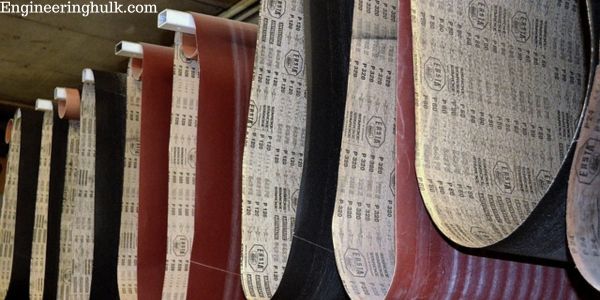
Emery paper grades are grit numbers that tell you how coarse or fine the abrasive is: the higher the number, the finer the finish. Grades around P40–P80 remove rust and heavy material, P120–P240 are for general smoothing, P320–P600 prepare surfaces for paint or finishing, and P800–P2000 are used for polishing. In India the sheets are often simply called “emery paper” or “emery sheet” with the grade printed on the back, for example 80, 120, 220 or 400.
Emery paper grade chart
| Category | Grit grade | Typical use |
|---|---|---|
| Extra coarse | P24 – P36 | Heavy stock removal, paint and scale stripping |
| Coarse | P40 – P80 | Rust removal, removing weld spatter, shaping |
| Medium | P100 – P180 | General smoothing of metal and wood, removing file marks |
| Fine | P220 – P320 | Final sanding before paint, light deburring |
| Very fine | P360 – P600 | Sanding between paint coats, smooth metal finish |
| Extra fine | P800 – P1200 | Wet sanding, pre-polishing, metallographic specimens |
| Ultra fine | P1500 – P3000 | Polishing car paint, mirror-like finishes before buffing |
The “P” prefix is the FEPA (European) grading used on most coated abrasives. The number is roughly related to how many openings per inch the sieve had that sorted the abrasive grains, which is why finer grits have higher numbers.
What is emery paper made of?
True emery is a natural dark rock made mainly of corundum (aluminium oxide) mixed with magnetite or hematite. Most sheets sold today as “emery paper” actually use synthetic abrasives, because they are harder and more uniform:
- Natural emery: black, mild cutting action; used for light polishing and cleaning metal.
- Aluminium oxide: tough, long-lasting and the most common choice for metal and wood.
- Silicon carbide: very hard and sharp; used on waterproof “wet and dry” paper for paint, glass, stone and non-ferrous metals.
- Garnet: softer natural abrasive, mainly for woodworking.
Types of emery paper
- Dry emery paper: paper backing, used dry. Cheap, but clogs faster.
- Waterproof (wet and dry) paper: silicon carbide on a waterproof backing. Water or oil washes away the dust, so the paper cuts cleanly and lasts longer.
- Emery cloth: abrasive on a cotton or polyester cloth backing. Flexible and tear-resistant, ideal for pipes, shafts and curved metal parts.
- Emery rolls and discs: for hand use on cylindrical parts or on angle grinders and sanders.
Which emery paper grade should you use?
| Job | Start with | Finish with |
|---|---|---|
| Removing heavy rust from iron | P60 – P80 | P150 |
| Cleaning copper pipe before soldering | P120 (emery cloth) | P180 |
| Preparing mild steel for painting | P120 | P240 |
| Smoothing a machined or filed surface | P180 | P400 |
| Wet sanding car paint defects | P1500 | P2000 – P3000, then polish |
| Metallography specimen preparation | P220 | P1200, then diamond or alumina polishing |
How to use emery paper properly
- Start with the coarsest grade that removes the defect, not coarser than needed.
- Work in one direction, then change to the next finer grade and sand at 90° to the previous scratches. When the old scratches are gone, move up again.
- Do not skip more than one grade at a time (for example 120 → 180 → 240), or deep scratches will remain.
- Use a sanding block on flat surfaces for even pressure.
- For wet and dry paper, keep the surface wet and rinse the sheet often.
- Wear a mask when sanding dry; metal and paint dust should not be inhaled.
Emery paper vs sandpaper
Both are coated abrasives. “Sandpaper” is the general term and is often used for woodwork, while “emery paper” usually refers to darker abrasive sheets made for metal. In shops the two names are used interchangeably; what matters is the abrasive type, grit number and backing.
Frequently asked questions
Which emery paper grade is the finest?
Common sheets go up to P2000 or P3000. The higher the grit number, the finer the abrasive and the smoother the finish.
Which emery paper is best for rust removal?
Use a coarse grade such as P60 or P80 for heavy rust, then finish with P120 to P150 for a smoother surface.
What is the difference between 80 and 120 grit emery paper?
80 grit has larger abrasive grains and removes material quickly but leaves deeper scratches. 120 grit is finer, removes less and leaves a smoother surface.
Can emery paper be used wet?
Only waterproof “wet and dry” paper, usually silicon carbide, should be used with water or oil. Ordinary paper-backed sheets fall apart when wet.
References
- FEPA (Federation of European Producers of Abrasives) P-grade standard for coated abrasives.
- Silicon carbide – properties