 EngineeringHulk
- Home
- Blog
- Automobile Engineering
- Mechanical Brakes: Types, Working, Advantages and Disadvantages
Mechanical Brakes: Types, Working, Advantages and Disadvantages
On this page
A mechanical brake is a friction brake in which the driver’s effort reaches the friction surfaces only through levers, rods and cables, with no fluid in between. The main types of mechanical brakes are drum (internal expanding shoe) brakes, band brakes, block or shoe brakes, and cable-operated disc brakes. Cars stopped using a mechanical braking system for their service brakes decades ago, but it survives in the parking (hand) brake, rear drum brakes on many Indian two-wheelers, bicycles and small machines.
How a mechanical braking system works
Every friction brake turns kinetic energy into heat by pressing a stationary lining on a rotating drum or disc. What makes it “mechanical” is the actuation path:
- The rider or driver pulls a lever or presses a pedal. The lever ratio (often 4:1 to 6:1) multiplies the input force.
- A rod or a Bowden cable (steel inner wire in a flexible sheath) carries the force to the wheel.
- At the wheel, a cam, wedge or lever converts that pull into shoe or pad movement.
- Return springs pull the shoes away from the drum when the lever is released.
In a hydraulic brake that middle link is a column of brake fluid instead; the hydraulic brake system and the master cylinder have their own pages.
Where mechanical brakes are still used
- Parking brake on cars. A hand lever or foot pedal pulls cables to the rear drums, to a small “drum-in-hat” drum inside a rear disc, or to a screw mechanism in the rear caliper. Being independent of the fluid circuit, it still holds if that circuit fails.
- Two-wheelers. Many Indian commuter motorcycles and scooters use a rod-operated rear drum and a cable-operated front drum. On scooters, the combined braking system (CBS) is often a mechanical equaliser that lets one lever pull both drum cables.
- Bicycles, small vehicles and machines: rim and cable disc brakes on cycles; band and block brakes on hoists, winches and cranes.
Types of mechanical brakes
1. Drum brakes (internal expanding shoe)
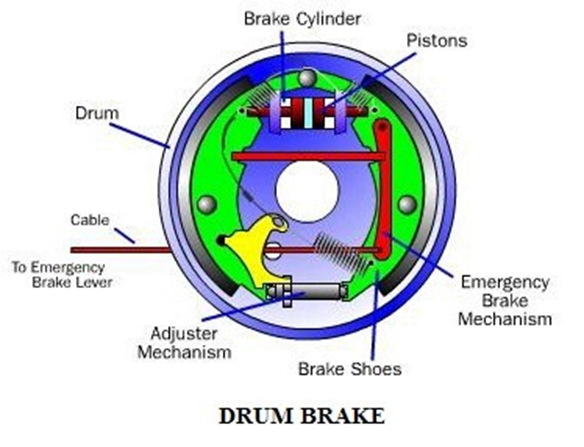
Two curved shoes lined with friction material sit inside a drum that turns with the wheel. In a mechanical drum brake an S-cam or flat cam between the shoe tips turns when the lever pulls, forcing both shoes outward against the drum. The other ends pivot on an anchor pin. How the shoes are arranged decides how much braking you get for a given pull:
- Leading-trailing shoe. The leading shoe’s tip is pushed in the direction of drum rotation, so friction drags it harder into the drum. This self-energising action gives it more braking torque than the trailing shoe, which friction tends to push away. It brakes equally in forward and reverse, so it suits rear wheels and parking brakes.
- Two-leading-shoe. Each shoe has its own cam or anchor so both are leading in forward motion. Much stronger going forward, weaker in reverse, since both become trailing shoes. It was common on older motorcycle front drums.
- Servo (duo-servo) action. A floating adjuster links the shoes, so drag on the primary shoe pushes the secondary shoe into the drum and the force builds on itself. Very high gain for little effort, used in drum-in-hat parking brakes, but sensitive to changes in lining friction.
2. Band brakes
A flexible steel band lined with friction material wraps around part of a drum. Pulling one end of the band with a lever tightens it. Because friction builds up around the wrap, the tension at the two ends differs by the factor T1/T2 = eμθ, where T1 is the tight side, T2 the slack side, μ the friction coefficient and θ the angle of wrap in radians. Braking torque is (T1 − T2) × r.
- Simple band brake: one end of the band is fixed at the lever fulcrum and the other is attached to the lever. It works well in one direction of rotation only.
- Differential band brake: the two band ends are attached to the lever at distances a and b on opposite sides of the fulcrum, so moving the lever pulls one end and lets the other off. Effort can be made very small, and with the slack side at b, if b ≤ a·eμθ the brake becomes self-locking (it grips with no effort), which is used as a backstop in hoists and conveyors.
3. Block (shoe) brakes
A single wooden, cast iron or lined block is pressed against the outside of a wheel or drum by a lever. Braking torque is μ × N × r, where N is the normal force on the block. The block pushes sideways on the shaft, so heavy-duty versions use two opposed blocks (double-block brakes) in cranes and elevators.
4. Mechanically actuated disc brakes
A cable turns a lever on the caliper, and a ball-ramp or screw inside pushes one pad against the disc; the other pad is fixed or on a floating caliper. You find them on bicycles, some small scooters and ATVs, and as the parking mechanism built into the rear calipers of many cars. Pad wear shows up as extra lever travel, since there is no hydraulic self-adjustment.
Whatever the type, the lining itself is a composite of fibres, fillers, binders and friction modifiers, much like the materials covered in clutch friction materials.
Worked example: simple band brake torque
Problem. A simple band brake acts on a drum of 400 mm diameter. The band wraps 270° of the drum and μ = 0.3. The lever is 500 mm long, one band end is fixed at the fulcrum, and the other end is attached 100 mm from the fulcrum. A force of 200 N is applied at the lever end. Find the braking torque for both directions of drum rotation.
Step 1: tension ratio. θ = 270° × π/180 = 4.712 rad. μθ = 0.3 × 4.712 = 1.414, so eμθ = 4.111.
Step 2: rotation such that the lever end is the slack side. Moments about the fulcrum: T2 × 100 = 200 × 500, so T2 = 1000 N. Then T1 = 4.111 × 1000 = 4111 N.
Braking torque = (4111 − 1000) × 0.2 m = 622 N·m.
Step 3: reverse rotation, lever end becomes the tight side. Now T1 = 1000 N and T2 = 1000/4.111 = 243 N.
Braking torque = (1000 − 243) × 0.2 = 151 N·m.
The same 200 N gives about 4.1 times more torque in one direction than the other, so a simple band brake is fitted with the lever end on the slack side for the normal direction of rotation.
Mechanical vs hydraulic brakes
| Point | Mechanical (rods, cables) | Hydraulic (brake fluid) |
|---|---|---|
| Force at each wheel | Unequal unless linkages are perfectly adjusted | Equal pressure to all wheels on a circuit (Pascal’s law) |
| Losses | Pivot and cable friction, cable stretch | Small; seal friction and hose swell |
| Adjustment | Frequent, as cables stretch and linings wear | Disc calipers self-adjust |
| Routing | Needs straight runs or sheathed cables | Pipes and hoses go anywhere, including moving suspension |
| Failure mode | Survives a fluid leak; fails if a cable snaps or seizes | Needs sealed, air-free fluid; dual circuits give backup |
| Cost and simplicity | Cheap, simple, no fluid to change | More parts, fluid needs periodic replacement |
| Use today | Parking brakes, two-wheeler drums, bicycles | Service brakes on all cars, many motorcycles |
Cars moved to hydraulics mainly for balanced braking in hard stops, and fluid pressure also made anti-lock braking (ABS) possible.
Maintenance of mechanical brakes
- Cable adjustment. Cables stretch and linings wear, so free play grows. Set it with the barrel adjuster at the lever or the wing nut on the brake rod to the free play in the owner’s manual (for two-wheeler levers and pedals usually a figure in the 10 to 30 mm range). A car hand brake should hold within the number of clicks the manufacturer specifies.
- Lubrication. Dry or rusted cables and cam pivots make brakes stick on after release. Lubricate them; replace frayed or kinked cables.
- Shoe wear. Many two-wheeler drums have a wear pointer on the cam lever; when it passes the mark at full application, replace the shoes, in pairs, before the lining wears to the metal and scores the drum.
- Drum and springs. Check the drum for scoring or ovality; weak return springs let shoes drag and overheat the drum.
References
- NPTEL – Online Engineering Courses, machine design and automobile engineering lectures on brakes.
- Research paper on the brake drum, Mathematical Problems in Engineering (2018).
FAQs
What is a mechanical brake?
A mechanical brake is a friction brake operated purely through mechanical linkages (levers, rods and cables) with no hydraulic fluid. The linkage presses shoes, pads, a band or a block against a rotating drum or disc, turning kinetic energy into heat.
What are the types of mechanical brakes?
Drum brakes (leading-trailing shoe, two-leading-shoe and servo types), band brakes (simple and differential), block or shoe brakes, and cable-operated disc brakes.
Why were mechanical brakes replaced by hydraulic brakes in cars?
Hydraulic brakes send equal pressure to every wheel on a circuit, lose little force in transmission, route easily to moving wheels and need less adjustment. Mechanical linkages lose force to friction and cable stretch and drift out of balance as they wear.
Related Topics on EngineeringHulk
Keep reading

What Is a Clutch? Parts, Working and Types of Clutches
A clutch connects and disconnects the engine from the gearbox. Clutch parts, how it works, 8 types (single-plate, multi-plate, cone, centrifugal) and faults.
Lead Acid Battery in Automobiles: Construction, Working and Types
Lead acid battery construction explained part by part: plates, grids, separators, electrolyte, cell chemistry, SMF/AGM/EFB types, ratings and a worked example.
Differential in Automobile Engineering: Rear Differential Working, Parts and Types
How a rear differential works: why the outer wheel travels farther in a turn, crown wheel and pinion, planet gears, types compared, gear ratio and upkeep.

Propeller Shaft and Universal Joints: Construction, Working and Types
How a propeller shaft carries drive through changing angle, length and torque, why the tube is hollow, and how Hooke joints differ from CV joints.

Synchromesh Gear Box: Construction, Working, Types and Common Faults
How a synchromesh gear box works: synchroniser hub, sleeve, baulk ring and cone, the blocking action, cone types, power flow and common gearbox faults.
Benson Boiler: Construction, Working, Advantages and Disadvantages
Benson boiler construction and working: drumless once-through boiler above 221 bar, parts in flow order, worked heat-duty example, pros, cons and diagram.