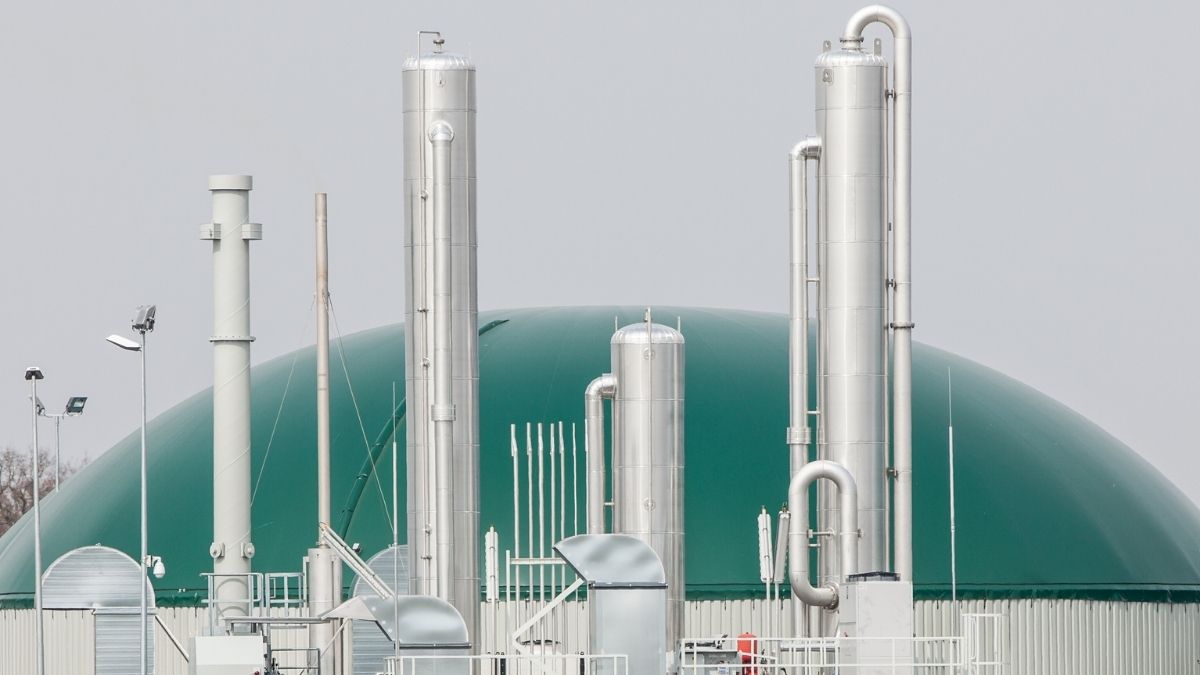
A family-size biogas plant in India is built as either a floating drum (KVIC) plant, with a brick masonry digester and a movable mild steel or FRP gas holder, or a fixed dome (Deenbandhu) plant, built entirely of brick masonry and cement with a fixed dome that stores the gas. The main biogas plant construction materials are burnt bricks, cement mortar and plaster with a waterproofing layer, concrete for the foundation, mild steel or FRP/HDPE for the drum, and GI or PVC pipes for slurry and gas. Every plant has the same five parts: a mixing tank, an inlet pipe, the digester, a gas holder or dome, and an outlet (slurry) chamber, plus the gas pipeline with a valve.
This page covers how those plants are built and sized. For the biology of digestion and the types of plant in general, see biogas generation plants; for first filling and start-up, see filling a biogas digester for starting.
Parts of a biogas plant
| Part | What it does | Usual construction |
|---|---|---|
| Inlet (mixing) tank | Dung and water are mixed into an even slurry and stones and straw removed | Small brick or concrete tank above ground level, cement plastered, sometimes with a hand-operated mixer |
| Inlet pipe | Carries slurry from the mixing tank to the bottom of the digester | PVC, asbestos-cement or concrete pipe, sloping down into the digester |
| Digester | Airtight, watertight chamber where bacteria break the slurry down without oxygen | Underground cylinder (KVIC) or shallow bowl (Deenbandhu) of brick masonry in cement mortar on a concrete base |
| Gas holder / dome | Collects and stores the gas | KVIC: inverted mild steel, FRP or HDPE drum floating on the slurry. Deenbandhu: fixed masonry dome |
| Outlet / slurry displacement chamber | Receives digested slurry; in a fixed dome plant it also sets the gas pressure | Brick masonry chamber with a covered top and an overflow to compost pits |
| Gas outlet pipe and valve | Takes gas to the kitchen | GI pipe from the dome or drum top with a gate valve, then GI or PVC line with a water drain (moisture trap) at the lowest point |
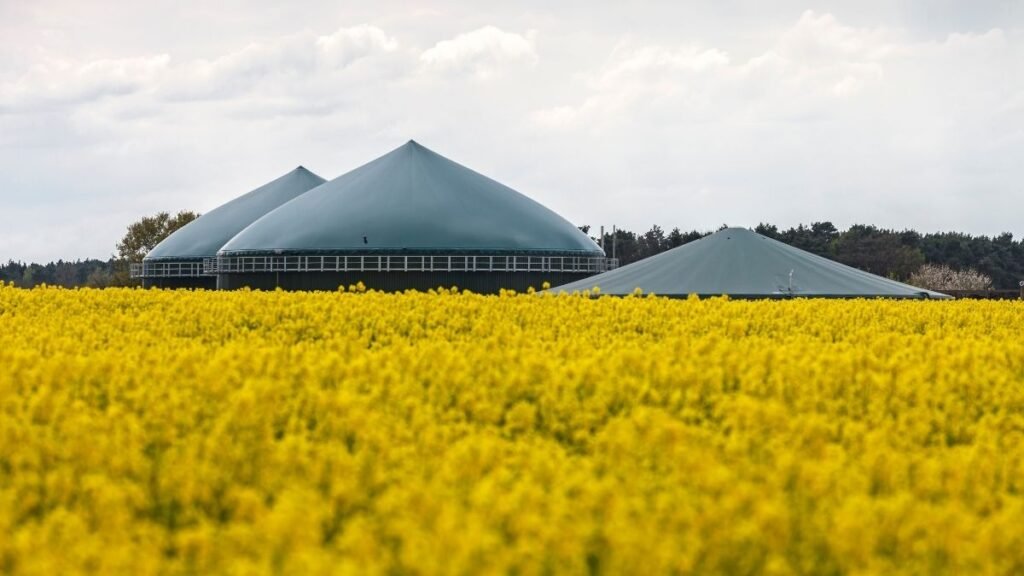
The photo shows large farm-scale digesters with flexible membrane roofs, a design common in Europe. The household plants described below are much smaller and mostly underground, but the parts do the same jobs.
Floating drum biogas plant (KVIC model)
The Khadi and Village Industries Commission (KVIC) floating drum plant is the older of the two standard Indian designs. The Bureau of Indian Standards code of practice for floating gas holder plants is IS 9478:1989.
How it is built
- Digester: a vertical cylindrical pit, deeper than it is wide, lined with brick masonry in cement mortar on a concrete foundation. The inside is plastered and made watertight. Larger digesters have a central partition wall so fresh slurry does not flow straight from inlet to outlet without being digested.
- Ledge and guide: a ledge near the top of the masonry supports the drum when it is empty, and a central guide pipe fixed in the digester keeps the drum vertical as it rises and falls.
- Gas holder: an inverted drum of mild steel sheet, stiffened with angle sections, sitting in the slurry. It is painted inside and out with an anti-corrosion primer and paint. MNRE-approved variants use FRP (fibre-reinforced plastic, to IS 12986:1990) or HDPE drums, which do not rust.
- Inlet and outlet: pipes enter near the bottom of the digester on opposite sides, and discharge to a mixing tank and an outlet tank at ground level.
How it works
As gas forms, the drum rises; as gas is used, it sinks. The weight of the drum sets the gas pressure, so it stays nearly constant, and the height of the drum shows at a glance how much gas is stored. The weak point is the steel drum: it rusts and needs repainting, and eventually replacing.
Fixed dome biogas plant (Deenbandhu and Janata models)
The fixed dome plant has no moving parts. The Janata model was the first Indian fixed dome design; the Deenbandhu model replaced it with a cheaper shape that uses less masonry, and it is now the fixed dome design MNRE lists for brick construction, alongside a ferro-cement Deenbandhu version and a prefabricated RCC dome.
How it is built
- Digester and dome: the digester is a shallow bowl, and the gas storage is a dome built of brick masonry on top of it, curved so that it works in compression like an arch. The two form one sealed chamber.
- Waterproofing: the inside of the dome, which holds the gas, is plastered in several layers of cement mortar with a waterproofing compound, often finished with neat cement slurry. This plaster is what keeps the plant gas-tight.
- Outlet displacement chamber: a larger masonry chamber than in the KVIC plant, because it has to hold the slurry that the gas pushes out.
- Gas outlet: a GI pipe set into the crown of the dome, with a gate valve.
- Earth cover: the dome is backfilled with compacted soil, which balances the internal gas pressure and keeps the temperature steady.
How it works
As gas collects under the dome, it pushes slurry out of the digester into the outlet chamber and up the inlet pipe. When gas is drawn off, the slurry flows back. The difference in slurry levels sets the pressure, so it is high when the dome is full and falls as gas is used. Burners must cope with this varying pressure.
Floating drum vs fixed dome: comparison
| Point | Floating drum (KVIC) | Fixed dome (Deenbandhu) |
|---|---|---|
| Gas holder | Movable steel, FRP or HDPE drum | Fixed brick masonry dome |
| Gas pressure | Nearly constant | Varies as gas is stored and used |
| Main materials | Brick masonry digester plus steel or plastic drum | Brick, cement, sand, aggregate only |
| Capital cost | Higher (drum) | Lower |
| Life and upkeep | Steel drum needs repainting and eventual replacement | No moving parts; long life if the dome stays gas-tight |
| Gas-tightness | Easy: the slurry seals the drum | Depends on masonry and plaster quality; leaks are hard to find |
| Space | Deep pit, smaller footprint | Shallower, wider footprint; land above can be used |
| Skill needed | Welder or supplier for drum, mason for pit | Trained mason, careful supervision of dome work |
Site selection
- Close to the cattle shed and the kitchen, so dung is carried a short way and the gas pipe is short.
- Water nearby for mixing the slurry every day.
- Open, sunny spot: digestion slows sharply in cold soil, so avoid shade from buildings and large trees, whose roots can also crack masonry.
- Firm, well-drained soil with a low water table. A high water table pushes the digester upward and makes construction difficult.
- Well away from drinking water wells and hand pumps, so that slurry cannot seep into them.
- Space for the slurry pits or compost area next to the outlet.
Worked example: sizing a biogas plant
A farm has 10 cattle. Assumptions (typical textbook values, not measured for this farm):
- Fresh dung per animal: 10 kg/day
- Dung mixed with water 1:1 by weight
- Hydraulic retention time (how long the slurry stays in the digester): 40 days
- Gas yield: 0.036 to 0.04 m3 per kg of fresh dung
- Cooking need: 0.2 to 0.3 m3 of gas per person per day
Step 1: daily slurry. Dung = 10 x 10 = 100 kg/day. With 100 kg of water, slurry = 200 kg/day. Taking slurry density as roughly that of water, that is about 0.2 m3/day.
Step 2: digester volume. V = daily slurry x retention time = 0.2 x 40 = 8 m3 of slurry volume, plus the gas storage space above it.
Step 3: gas output. 100 kg x 0.036 = 3.6 m3/day, up to 100 x 0.04 = 4.0 m3/day. So this farm suits a plant rated at about 3.5 to 4 m3 of gas per day. Indian plants are sold and subsidised by this gas rating (MNRE’s programme covers 1 to 25 m3/day), not by digester volume.
Step 4: people served. 3.6 / 0.3 = 12 people at the low end; 4.0 / 0.2 = 20 people at the high end. At a middle figure of 0.25 m3 per person, 3.6 to 4.0 m3 cooks for about 14 to 16 people, a large joint family.
In colder regions the retention time is set longer, so the digester has to be bigger for the same dung. Always size from the dung actually available, not from the number of people: a plant that is too big for its feed gives little gas and tempts owners to add too little water.
Construction steps (fixed dome plant)
- Mark the layout and dig the pit to the design depth, keeping the sides stable.
- Lay a concrete foundation on firm, compacted ground.
- Build the digester wall in brick masonry with cement mortar, fixing the inlet and outlet openings at the right levels.
- Build the dome course by course, keeping the curve true with a guide.
- Set the gas outlet pipe into the crown while the masonry is being built, not afterwards.
- Plaster the inside in layers with a waterproofing compound, and cure the work with water for several days.
- Build the outlet chamber and the mixing tank, backfill and compact soil over the dome.
- Test for leaks before feeding: fill with water and watch the level, and after first gas, check joints with soap solution.
Common construction faults
- Gas leaking through the dome: the most common fault in fixed dome plants. Porous bricks, lean mortar, poor curing or skipped plaster coats let gas escape, so the plant seems to make little gas.
- Cracks: from settlement on soft ground, backfill that was not compacted, tree roots, or a dome that was not built to a true curve.
- Leaking gas pipe joints and valves: check every joint with soap solution, never a flame.
- Water in the gas line: no drain at the lowest point, so condensate blocks the pipe and the flame flickers.
- Wrong levels: inlet or outlet set too high or too low, causing slurry to enter the gas pipe or scum to build up.
- Rusted drum (KVIC): paint not maintained, leading to holes in the gas holder.
Maintenance
- Feed the plant daily with the right mix of dung and water; remove sand and straw in the mixing tank.
- Drain the moisture trap in the gas line regularly.
- Repaint a steel drum inside and out every year or two, and rotate it to break the scum layer.
- Keep the outlet clear and use the digested slurry as manure.
- Check the valve, pipes and burner for leaks with soap solution. Burners should be ISI-marked to IS 8749.
- Never enter an emptied digester until it has been fully ventilated: the gas is flammable and suffocating.
For where biogas sits among other routes from organic matter to energy, see biomass conversion technologies and biomass energy. Current subsidy details are published by the Ministry of New & Renewable Energy (MNRE); for the global picture, see IEA – Bioenergy.
FAQs
What materials are used to construct a biogas plant?
Burnt bricks, cement, sand and aggregate for the digester, dome and tanks; concrete for the foundation; waterproof cement plaster for gas-tightness; a mild steel drum with anti-corrosion paint, or an FRP or HDPE drum, for a floating drum plant; and GI or PVC pipes with a gate valve for the gas line.
What is the difference between KVIC and Deenbandhu biogas plants?
The KVIC plant has a floating steel or plastic drum that rises with the gas and gives nearly constant pressure. The Deenbandhu plant stores the gas in a fixed brick dome, costs less and has no moving parts, but its pressure varies and it must be built carefully to stay gas-tight.
How much biogas does 100 kg of cow dung give?
About 3.6 to 4 m3 per day, taking a typical yield of 0.036 to 0.04 m3 per kg of fresh dung. That is enough for cooking for roughly 12 to 20 people, depending on use.
How is the digester volume of a biogas plant calculated?
Digester volume = daily slurry volume x retention time. For 100 kg of dung plus 100 kg of water (about 0.2 m3/day) and a 40-day retention time, the digester needs about 8 m3.
Why does a fixed dome biogas plant leak gas?
Usually because the dome masonry or plaster is porous or cracked: poor bricks, lean mortar, too few plaster coats, poor curing, or settlement of the ground. Leaks are hard to find because the dome is buried, so quality control during construction matters most.