Construction Materials Formula Sheet
All Key Values, Limits & Formulas for GATE CE — Cement, Concrete, Aggregates, Steel, Timber & Bitumen
Last Updated: April 2026 | GATE CE 2025–2027
📌 How to Use This Sheet
- All construction materials formulas for GATE CE, ESE, and university exams are organised topic-by-topic.
- IS code numbers are given in brackets for each formula/limit where applicable.
- Memorise the key limits: FI <35%, EI <45%, AIV <30%, brick WA <20%, ductility ≥75cm, flash point >220°C.
- E = 200 GPa for ALL steel grades — do not change this for different grades.
- Target mean strength: f’ck = fck + 1.65σ — the most frequently tested concrete formula in GATE.
- Bogue formulas: start with C4AF = 3.04F and C3A = 2.65A − 1.69F, then compute C3S.
1. Cement
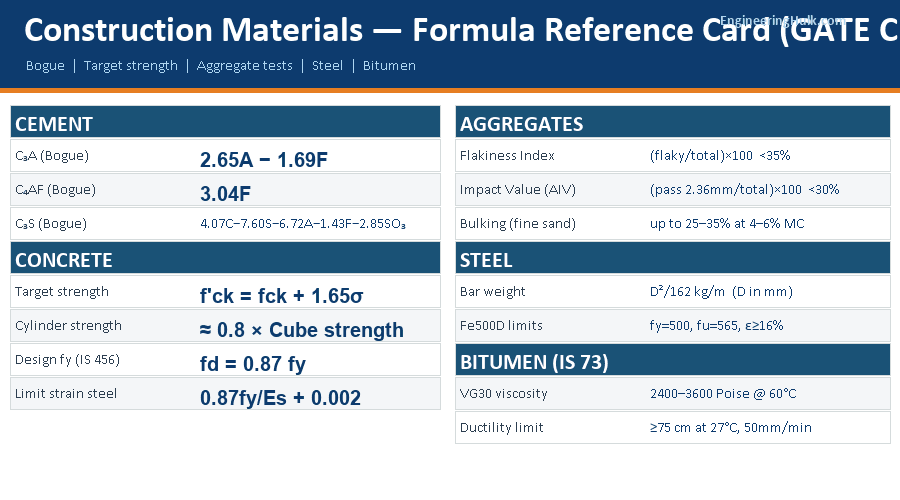
Bogue Compound Calculation
C3S = 4.07C − 7.60S − 6.72A − 1.43F − 2.85SO₃
C2S = 2.87S − 0.754(C3S)
C3A = 2.65A − 1.69F
C4AF = 3.04F
(C=CaO, S=SiO₂, A=Al₂O₃, F=Fe₂O₃, all in % by mass)
Physical & Test Limits (IS 269)
Specific gravity = 3.15 | Bulk density (loose) ≈ 1440 kg/m³
Normal consistency: plunger penetration = 33–35 mm in 40 mm pat
Setting time tests use 0.85P water (P = normal consistency %)
Initial setting time ≥ 30 min (OPC) | Final setting time ≤ 600 min (OPC)
Le Chatelier soundness ≤ 10 mm | Autoclave ≤ 0.8%
Blaine fineness ≥ 225 m²/kg (OPC 33/43/53) | ≥ 300 m²/kg (PPC)
OPC grades: 33 / 43 / 53 MPa at 28 days (mortar cubes 1:3)
2. Concrete Technology
Mix Design (IS 10262-2019)
Target mean strength: f’ck = fck + 1.65σ
σ: M10–M15 = 3.5 MPa; M20–M25 = 4.0 MPa; M30–M35 = 5.0 MPa; M40–M50 = 6.0 MPa
Cement content = Water content / w/c ratio
Absolute volume method: 1 = Vc + Vw + VCA + VFA + Vair
Workability Tests
Slump: 0–25mm (stiff) | 25–75mm (low) | 75–100mm (medium) | 100–175mm (high)
Compaction Factor (CF) = Wpartial/Wfull: 0.78 low | 0.85 medium | 0.92 high
VB time: 35s (low) → 3s (high workability)
Strength Relationships
Cylinder strength ≈ 0.80 × Cube strength (150mm cube)
7-day strength ≈ 65% of 28-day (OPC); ≈ 55% (PPC)
UPV: >4500 m/s (excellent) | 3500–4500 (good) | <3000 (poor)
IS 456 max w/c: 0.55 (Mild) | 0.50 (Moderate) | 0.45 (Severe) | 0.40 (Very Severe) | 0.35 (Extreme)
3. Aggregates
Aggregate Test Formulas (IS 2386)
Flakiness Index: FI = (Mass of flaky particles / Total mass) × 100 [Limit: <35%]
Elongation Index: EI = (Mass of elongated particles / Total mass) × 100 [Limit: <45%]
AIV: = (W₂/W₁) × 100 [<20% strong; <30% highways; >35% weak; >45% unacceptable]
ACV: = (W₂/W₁) × 100 [<30% general; <45% acceptable; >45% poor]
Water absorption: = [(W₂−W₁)/W₁] × 100 [CA: <2%; FA: <3%]
FM: = Σ(cumulative % retained on 150μm, 300μm, 600μm, 1.18mm, 2.36mm, 4.75mm sieves) / 100
Bulking of sand: max 25–35% (fine sand), 15–25% (coarse) at ~4–6% MC
IS 383 Grading Zones (% passing 600μm)
Zone I: 15–34% | Zone II: 35–59% | Zone III: 60–79% | Zone IV: 80–100%
Zone II preferred for structural concrete. Zone IV: avoid for high-grade concrete.
4. Bricks & Stones
Brick water absorption: WA = [(W₂−W₁)/W₁] × 100 [1st/2nd: ≤20%; 3rd: ≤25%]
Brick compressive strength: CS = Load / Loaded area (MPa)
1st class: ≥10.5 MPa | 2nd class: ≥7 MPa | 3rd class: ≥3.5 MPa
Standard brick size: 190×90×90mm (modular IS 1077)
Efflorescence: Nil or Slight acceptable; Moderate, Heavy, Serious — reject
5. Steel & Reinforcement
Steel Properties (All Grades)
E = 200,000 MPa = 200 GPa (constant for all grades)
G = 77,000 MPa = 77 GPa
ρ = 7850 kg/m³ | ν = 0.3 | α = 12×10⁻⁶/°C
Bar weight: w = D²/162 kg/m (D in mm)
Bar area: A = πD²/4 mm² (D in mm)
Design yield strength (IS 456): fd = 0.87 fy
Limiting strain in tension steel: εsu = 0.87fy/Es + 0.002
IS 1786 Grades
Fe415: fy=415, fu=485, ε≥14.5%, CE≤0.42%
Fe500: fy=500, fu=545, ε≥12.0%, CE≤0.42%
Fe500D: fy=500, fu=565, ε≥16.0%, CE≤0.42% (seismic zones)
Fe550: fy=550, fu=585, ε≥10.0%, CE≤0.45%
Fe600: fy=600, fu=660, ε≥10.0%, CE≤0.47%
Mild steel (IS 432) Fe250: fy=250, fu=410, ε≥23%
6. Timber
Moisture Content: MC = (Wwet − Wdry) / Wdry × 100%
Fibre Saturation Point (FSP): ~30% MC
Below FSP: strength and E increase as MC decreases; above FSP: properties unchanged by MC.
Target MC for structural use: 12–15% (air-dry: 15–20%; kiln-dry: 8–12%)
Plywood: always odd number of veneers; exterior grade uses WBP (phenol-formaldehyde) glue.
7. Bitumen
VG Grades (IS 73:2013)
VG10: viscosity 800–1200 P @ 60°C | approx 80/100 penetration | cold regions, spray work
VG30: viscosity 2400–3600 P @ 60°C | approx 60/70 penetration | standard India roads
VG40: viscosity 3200–4800 P @ 60°C | approx 30/40 penetration | heavy traffic, hot climate
Specific gravity: petroleum bitumen = 1.01–1.05; coal tar = 1.20–1.25
Bitumen Test Conditions & Limits
Penetration test: 100g load, 5 sec, 25°C | result in 0.1mm | lower = harder
Softening point (Ring & Ball): VG30 ≥ 47°C | VG40 ≥ 55°C
Ductility: pull at 50mm/min, 27°C | paving bitumen ≥ 75 cm
Flash point: > 220°C | Fire point: > 280°C (IS 73)
Solubility in CS₂: ≥ 99% (IS 73)
PMB: SBS/EVA polymer 3–5%; CRMB: crumb rubber 15–20% (IS 15462)
8. Quick IS Code Reference
| IS Code | Subject |
|---|---|
| IS 269 | Ordinary Portland Cement (OPC 33/43/53) |
| IS 1489 Part 1 | Portland Pozzolana Cement (PPC — fly ash) |
| IS 455 | Portland Slag Cement (PSC) |
| IS 12330 | Sulphate Resistant Portland Cement (SRC) |
| IS 8041 | Rapid Hardening Portland Cement (RHC) |
| IS 4031 | Methods of physical tests for hydraulic cement |
| IS 383 | Coarse and Fine Aggregates for concrete (including grading zones) |
| IS 2386 | Methods of test for aggregates (FI, EI, AIV, ACV, SG, etc.) |
| IS 1077 | Common burnt clay building bricks specification |
| IS 3495 | Methods of tests for burnt clay building bricks |
| IS 432 Part 1 | Mild steel and medium tensile steel bars (Fe250) |
| IS 1786 | High yield strength deformed steel bars/TMT (Fe415 to Fe600) |
| IS 2062 | Hot rolled medium and high tensile structural steel (E250–E450) |
| IS 10262 | Concrete mix design guidelines (2019 edition) |
| IS 9103 | Admixtures for concrete |
| IS 73 | Paving bitumen (VG grades, 2013 edition) |
| IS 15462 | Polymer and rubber modified bitumen (PMB/CRMB) |
| IS 1203 | Penetration test for bitumen |
| IS 1208 | Ductility test for bitumen |
| IS 1205 | Softening point test (Ring & Ball) for bitumen |
Frequently Asked Questions
What is the formula for target mean strength in IS 10262?
f’ck = fck + 1.65σ. For M25 (σ=4): f’ck = 31.6 MPa. For M30 (σ=5): f’ck = 38.25 MPa. For M40 (σ=6): f’ck = 49.9 MPa.
What is the formula for steel bar weight per unit length?
w = D²/162 kg/m (D in mm). For 12mm: 144/162 = 0.888 kg/m. For 16mm: 256/162 = 1.58 kg/m. For 20mm: 400/162 = 2.47 kg/m.
What are the Bogue compound formulas?
C3S = 4.07C − 7.60S − 6.72A − 1.43F − 2.85SO₃; C2S = 2.87S − 0.754(C3S); C3A = 2.65A − 1.69F; C4AF = 3.04F. All oxides in % by mass.
What is the aggregate impact value formula?
AIV = (W₂/W₁) × 100%, where W₂ = fraction passing 2.36mm after 15 blows. <20% strong; <30% satisfactory; >35% weak. ACV same formula but from slow compression to 400 kN.