Steel & Reinforcement for Civil Engineering
TMT Bars, IS 1786, Mild Steel IS 432, Structural Steel IS 2062 & Stress-Strain Behaviour
Last Updated: April 2026 | GATE CE 2025–2027
📌 Key Takeaways
- Modulus of elasticity E = 200 GPa (2×10⁵ MPa) for ALL grades of steel — constant regardless of grade.
- Fe415: fy = 415 MPa; Fe500: fy = 500 MPa; Fe550: fy = 550 MPa; Fe600: fy = 600 MPa (IS 1786).
- Mild steel (IS 432): Fe250, fy = 250 MPa, fu = 410 MPa — has a clear yield point and plateau.
- Density = 7850 kg/m³; thermal expansion = 12×10⁻⁶/°C (same as concrete — no differential thermal stress).
- TMT process: quenching forms hard martensite rim; self-tempering makes it tough; soft ductile core remains.
- Structural steel (IS 2062): E250 (fy = 250 MPa), E300, E350, E410.
- Carbon equivalent (CE) controls weldability: CE ≤ 0.42 for Fe415/Fe500 (IS 1786).
1. Classification of Steel for Construction
| Category | IS Code | Grades | Use |
|---|---|---|---|
| Mild steel bars | IS 432 Part 1 | Fe250 (Grade I: fy=250, fu=410 MPa) | Stirrups, ties, nominal reinforcement in old designs |
| HYSD bars (cold-twisted) | IS 1786 (old CTD) | Fe415 (415/485 MPa) | Now largely replaced by TMT; still specified in existing structures |
| TMT bars | IS 1786 | Fe415, Fe415D, Fe500, Fe500D, Fe550, Fe550D, Fe600 | Primary reinforcement in all modern RCC construction |
| Structural steel | IS 2062 | E250, E300, E350, E410, E450 | Steel frames, trusses, girders, columns, industrial structures |
| Stainless steel bars | IS 16651 | Various grades | Marine structures, chemical plants, aggressive environments |
2. Mild Steel (IS 432)
Mild steel (plain carbon steel with 0.15–0.30% carbon) is characterised by its clear and distinct yield point — the stress-strain curve shows a definite upper yield point, a lower yield point, and a yield plateau before strain hardening. This makes it very ductile and easy to bend, weld, and work.
Fe250 (Grade I, IS 432): fy = 250 MPa | fu = 410 MPa | Elongation ≥ 23% (at fracture, GL = 5.65√A)
Diameter range: 6–50 mm (round bars); also available as flat and square bars
Young’s modulus: E = 200,000 MPa = 200 GPa
Specific gravity: 7.85 (density 7850 kg/m³)
Mild steel is no longer the preferred reinforcement for structural concrete. Its low yield strength means larger bar diameters are needed, increasing congestion in the section. It is still used for stirrups (links) in some designs and for lightly loaded secondary reinforcement.
3. HYSD & TMT Bars (IS 1786)
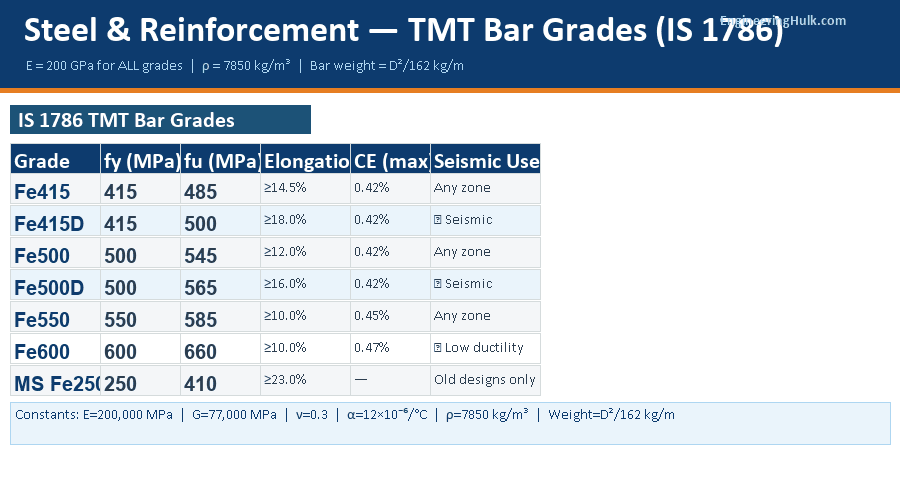
| Grade | Min. fy (MPa) | Min. fu (MPa) | Min. Elongation | fu/fy Ratio |
|---|---|---|---|---|
| Fe415 | 415 | 485 | 14.5% | ≥ 1.08 |
| Fe415D (ductile) | 415 | 500 | 18.0% | ≥ 1.12 |
| Fe500 | 500 | 545 | 12.0% | ≥ 1.08 |
| Fe500D (ductile) | 500 | 565 | 16.0% | ≥ 1.10 |
| Fe550 | 550 | 585 | 10.0% | ≥ 1.06 |
| Fe550D | 550 | 600 | 14.5% | ≥ 1.08 |
| Fe600 | 600 | 660 | 10.0% | ≥ 1.06 |
The ‘D’ suffix denotes ductile grade — mandated for use in seismic zones III, IV, and V (IS 13920). Ductile grades have higher elongation and a higher fu/fy ratio, ensuring the steel can undergo large plastic deformation without fracture — crucial for energy dissipation during earthquakes.
Yield strength for HYSD/TMT bars is defined as the 0.2% proof stress (0.2% offset method) because these bars lack a distinct yield plateau. The 0.2% proof stress is the stress at which a line parallel to the elastic portion of the stress-strain curve, offset by 0.2% strain, intersects the stress-strain curve.
4. TMT Manufacturing Process
The Thermo-Mechanical Treatment process produces bars with a unique microstructure: a hard outer rim (case) around a soft inner core.
- Hot rolling: Billets heated to ~1200°C and rolled to the final bar diameter at the rolling mill. The bar exits the last rolling stand at ~1000°C.
- Quenching: The hot bar immediately passes through a water quenching box. The outer surface cools rapidly to below 200°C, forming a martensitic case (hard, high strength).
- Self-tempering: The bar exits the quenching zone. The hot core conducts heat back to the case, reheating it to 450–600°C. This converts the brittle martensite to tempered martensite — tough and ductile.
- Atmospheric cooling: The bar cools on a cooling bed. The core transforms from austenite to a fine pearlite/ferrite microstructure (soft and ductile).
Advantages of TMT over old CTD (cold-twisted deformed) bars: Better ductility, better weldability (lower carbon equivalent), better bond (surface ribs similar to CTD), no residual stresses from twisting, higher elongation — superior in seismic and fire situations.
5. Structural Steel (IS 2062)
| Grade | fy (MPa) ≤20mm | fu (MPa) | Elongation | Typical Use |
|---|---|---|---|---|
| E250 (Grade A/B/C) | 250 | 410–540 | ≥23% | General structural work; most common |
| E300 | 300 | 440–570 | ≥22% | Heavier structural members |
| E350 | 350 | 490–630 | ≥22% | High-strength applications, bridges |
| E410 | 410 | 540–670 | ≥20% | Heavy sections, industrial frames |
| E450 | 450 | 570–720 | ≥20% | Special high-strength structures |
Structural steel sections available in India (IS 808): ISMB (Medium Weight Beam), ISLB (Light Beam), ISWB (Wide Flange Beam), ISHB (H-Beam/Column), ISMC (Channel), ISA (Angle), ISJB (Junior Beam). Hollow sections: SHS (Square Hollow Section), RHS (Rectangular), CHS (Circular).
6. Mechanical Properties of Steel
Key Physical Constants for Steel (All Grades)
Young’s Modulus: E = 200 GPa = 2×10⁵ MPa
Shear Modulus: G = 77 GPa = 0.77×10⁵ MPa
Poisson’s Ratio: ν = 0.3
Density: ρ = 7850 kg/m³
Thermal expansion: α = 12×10⁻⁶/°C (same as concrete)
G = E / [2(1+ν)] = 200,000 / [2×1.3] = 76,923 ≈ 77,000 MPa ✓
7. Stress-Strain Behaviour
The stress-strain curve defines the material’s response to load and has critical implications for structural design.
Mild steel (Fe250) curve: (1) Linear elastic region up to proportionality limit (~200 MPa). (2) Elastic limit (slight non-linearity). (3) Upper yield point (stress spike). (4) Lower yield point (stress drops, ≈250 MPa for Fe250). (5) Yield plateau (constant stress, strain increases — 10–15× elastic strain). (6) Strain hardening. (7) Ultimate point (peak, ~410 MPa). (8) Fracture (necking).
HYSD/TMT bars: No distinct yield point. The curve is elastic up to about 70% of yield strength, then gradually non-linear. Yield strength = 0.2% proof stress. No yield plateau — strain hardening begins immediately. This is why older IS 456 design used the 0.87fy design factor with an effective strain of 0.87fy/E + 0.002.
Design yield strength (IS 456): fd = 0.87 fy
Limiting strain in steel at ultimate (IS 456): εsu = 0.87fy/Es + 0.002 (for Fe415/Fe500)
For Fe415: εsu = 0.87×415/200,000 + 0.002 = 0.001802 + 0.002 = 0.003802
For Fe500: εsu = 0.87×500/200,000 + 0.002 = 0.002175 + 0.002 = 0.004175
8. Weldability & Carbon Equivalent
Carbon Equivalent (IIW Formula)
CE = C + Mn/6 + (Cr+Mo+V)/5 + (Ni+Cu)/15 (all in % by mass)
IS 1786 limits: Fe415: CE ≤ 0.42%; Fe500: CE ≤ 0.42%; Fe550: CE ≤ 0.45%; Fe600: CE ≤ 0.47%
IS 2062 E250 Grade A: CE ≤ 0.42%; Grade B (impact tested): CE ≤ 0.41%
CE ≤ 0.42: weldable without preheating; CE 0.42–0.60: preheating required; CE > 0.60: difficult to weld
TMT bars have lower CE than older CTD bars because the TMT process doesn’t require carbon to be added for strength — the microstructure (martensite) provides strength without high carbon content. This makes TMT bars directly weldable, unlike CTD bars which sometimes needed special electrodes and preheating.
9. Worked Examples (GATE CE Level)
Example 1 — Limiting Strain in Tension Steel (GATE 2020 type)
Calculate the limiting strain in Fe500 steel at the ultimate limit state (IS 456:2000).
Solution:
εsu = 0.87 × fy/Es + 0.002 = 0.87 × 500/200,000 + 0.002 = 0.002175 + 0.002 = 0.004175
Example 2 — Weight of Steel Bar
Find the mass per unit length of a 20 mm diameter TMT bar.
Solution:
Cross-sectional area = π/4 × 20² = 314.16 mm²
Mass/length = A × ρ = 314.16 mm² × 7850 kg/m³ = 314.16 × 10⁻⁶ m² × 7850 = 2.466 kg/m
Quick formula: D²/162 kg/m (D in mm) = 400/162 = 2.469 kg/m ✓
Example 3 — Select Steel Grade for Seismic Zone
A building is to be constructed in seismic Zone V. What grade of reinforcement should be specified for primary reinforcement per IS 13920-2016?
Answer: IS 13920-2016 mandates Fe415D or Fe500D (ductile grade) for all primary longitudinal and transverse reinforcement in seismic zones III, IV, and V. The ‘D’ suffix ensures: higher elongation (≥16% for Fe500D vs 12% for Fe500), higher fu/fy ratio (≥1.10), and controlled yield strength to avoid over-strength effects in capacity design.
Common Mistakes
- Assuming E varies with steel grade: E = 200 GPa for ALL steel grades — mild steel, Fe415, Fe500, structural steel. Grade affects yield strength, not stiffness. This is frequently tested in GATE as a conceptual question.
- Confusing 0.2% proof stress with yield stress: For mild steel, yield stress = lower yield point (clearly defined). For HYSD/TMT bars, there is no distinct yield point — the 0.2% offset method gives the proof stress, which IS codes call the yield strength.
- Using Fe600 in seismic zones without ‘D’ suffix: Fe600 has low ductility (10% elongation). In seismic zones III–V, IS 13920 requires ‘D’ grade. Fe550D or Fe500D are the practical choices — not Fe600 (which has no ‘D’ variant in IS 1786).
- Forgetting to add 0.002 in εsu formula: εsu = 0.87fy/Es + 0.002. The 0.002 accounts for the inelastic strain corresponding to the 0.2% proof stress definition. Omitting it underestimates the limiting strain and gives incorrect neutral axis depth in doubly reinforced beam design.
- Misquoting steel density: 7850 kg/m³, NOT 7800 or 7900. The quick formula for bar weight D²/162 (kg/m) works only with this density and gives exact results.
Frequently Asked Questions
What is the difference between Fe415 and Fe500 TMT bars?
Fe415: fy=415 MPa, fu=485 MPa, elongation 14.5%. Fe500: fy=500 MPa, fu=545 MPa, elongation 12%. Higher grade → less steel needed but less ductile. For seismic zones, use Fe415D or Fe500D (ductile grades with higher elongation).
What is the TMT process?
Hot-rolled bar is quenched in water → martensitic hard outer ring forms. Self-tempering from hot core converts martensite to tempered martensite (tough). Core cools to fine pearlite (ductile). Result: strong case + ductile core. Better weldability than CTD bars.
What are the mechanical properties of steel?
E = 200 GPa (ALL grades). ρ = 7850 kg/m³. Poisson’s ratio = 0.3. G = 77 GPa. Thermal expansion = 12×10⁻⁶/°C (same as concrete — no differential thermal stress).
What is carbon equivalent and why does it matter?
CE = C + Mn/6 + (Cr+Mo+V)/5 + (Ni+Cu)/15. Controls weldability. CE ≤ 0.42 for Fe415/Fe500 — weldable without preheating. TMT bars have lower CE than old CTD bars because strength comes from microstructure, not high carbon.