Timber, Bitumen & Paints
Wood Defects, Seasoning, Preservation, VG Grades, Bitumen Tests & Paint Types
Last Updated: April 2026 | GATE CE 2025–2027
📌 Key Takeaways
- Timber: Hardwood (broad-leaved: teak, sal, oak) vs Softwood (coniferous: pine, deodar, fir) — structural timber uses both.
- Seasoning removes moisture to 12–15% MC; prevents warping, fungal attack, and dimensional changes in service.
- Main timber defects: knots (reduce strength), shakes (cracks between rings), honeycombing (rapid drying).
- Bitumen VG grades (IS 73): VG10 (cold regions), VG30 (most common in India), VG40 (heavy traffic, hot regions).
- Penetration test: 100g needle, 5 sec, 25°C — result in 0.1 mm units; lower penetration = harder bitumen.
- Ductility ≥ 75 cm (paving bitumen); Softening point ≥ 47°C (VG30).
- Flash point > 220°C; Fire point > 280°C — safety during hot mixing and application.
1. Timber Classification
| Feature | Softwood (Coniferous) | Hardwood (Deciduous/Broad-leaved) |
|---|---|---|
| Tree type | Cone-bearing (gymnosperms): pine, deodar, fir, spruce, cedar | Broad-leaved (angiosperms): teak, sal, oak, rosewood, mahogany |
| Growth | Fast-growing, straight grain, abundant | Slow-growing, often cross-grained, less abundant |
| Density | Lower (350–700 kg/m³) | Higher (500–1100 kg/m³) |
| Durability | Lower (need preservation for outdoor use) | Higher (teak is naturally durable due to silica and oils) |
| Common use | Door/window frames, formwork, roof purlins (when treated) | Structural beams, flooring, furniture, railway sleepers |
Indian timber IS classification (IS 399): Group A (Hardwood — high strength), Group B (Medium hardwood), Group C (Softwood). Structural timber design uses these groups in IS 883 for permissible stresses in timber structures.
2. Defects in Timber
| Defect | Type | Description & Effect |
|---|---|---|
| Knots | Natural | Branch stubs embedded in wood. Live knots are tight; dead knots can fall out. Severely reduce tensile strength along grain; also reduce bending strength and stiffness. |
| Shakes | Natural | Separation of wood along the grain. Cup shake = between growth rings (circular). Heart shake = radiating from centre. Ring shake and star shake. Reduce shear strength parallel to grain. |
| Rind galls | Natural | Irregular curved swellings caused by old wounds or mechanical damage during growth. Create weak spots. |
| Upsets (Ruptures) | Natural | Compressed grain fibers from felling impact; look like fine cracks perpendicular to grain. Serious defect — indicates internal crushing. |
| Diagonal grain | Conversion | Grain runs at angle to edge (sawing fault or natural). Severely reduces strength — 45° diagonal grain can reduce bending strength by 50%. |
| Honeycombing | Seasoning | Internal checks (cracks) caused by rapid drying of thick timber; core shrinks while surface is already set. Invisible externally — dangerous in structural members. |
| Case hardening | Seasoning | Surface dries and becomes hard before the core has dried; interior in tension. Bowed sections when re-sawn. Fix by steaming (conditioning). |
| Rot (decay) | Biological | Fungal attack on cell wall cellulose/lignin; timber becomes soft, crumbly. White rot breaks down lignin; brown rot breaks down cellulose. Needs moisture >20% to develop. |
3. Seasoning of Timber
Seasoning is the controlled removal of moisture from green (freshly cut) timber to reach a stable equilibrium moisture content (EMC) suitable for the intended service environment. Unseasoned timber shrinks, warps, splits, and is attacked by fungi.
Moisture Content (MC): MC = (Wwet − Wdry) / Wdry × 100%
Green timber: MC = 50–100%. Air-dry: 15–20%. Kiln-dry: 8–12%. Oven-dry (0% MC): used as reference for MC calculation.
Fibre Saturation Point (FSP): ~30% MC — below FSP, mechanical properties improve as MC decreases; above FSP, properties are constant.
| Method | Duration | Final MC | Pros & Cons |
|---|---|---|---|
| Air seasoning | 6 months–5 years | 15–20% (climate-dependent) | No energy cost, gentle process; very slow, weather-dependent, large storage space needed |
| Kiln seasoning | 2–6 weeks | 8–12% (controlled) | Fast, uniform, kills fungi and insects, precise MC control; capital-intensive, energy cost |
| Water seasoning | 2–4 weeks in river | Preliminary; needs air/kiln after | Removes sap (reduces fungal food); but timber remains wet — only a preliminary step |
| Chemical seasoning | Hours | Variable | Urea/salt solutions reduce drying stress; rapid but chemical treatment can affect surface properties |
4. Timber Preservation
Preservation extends timber life by making it resistant to fungi, insects (termites, beetles), and marine borers.
| Preservative | Type | Method | Application |
|---|---|---|---|
| Creosote (coal tar distillate) | Oil-type | Pressure impregnation or hot-and-cold bath | Railway sleepers, telegraph poles, marine piles — outdoor where appearance unimportant |
| CCA (Copper-Chrome-Arsenic) | Water-borne salt | Pressure impregnation; fixes into cell wall | Outdoor structures, playground equipment, utility poles; water-borne (no smell) |
| Coal tar | Oil-type | Surface brush application | Cheap; underground timber, temporary structures; stains surfaces, not decorative |
| Sodium fluoride | Water-borne | Surface brush or diffusion | Interior furniture — colourless, paintable; limited durability outdoors |
| Zinc/copper naphthenate | Organic solvent | Brush, dip, spray | Colourless; joinery, indoor furniture, parquet flooring |
5. Engineered Wood Products
- Plywood: Odd number (3, 5, 7+) of thin veneers glued with adjacent grain directions perpendicular. Balanced construction prevents warping. Exterior grade uses phenol-formaldehyde (WBP) glue; interior grade uses urea-formaldehyde. Much stronger and more dimensionally stable than solid wood of the same thickness.
- Particle Board: Wood particles/chips bonded with resin under pressure. Low density, cheap, poor screw-holding, not moisture-resistant. Use: furniture, flooring substrate, interior partitions.
- MDF (Medium-Density Fibreboard): Wood fibres bonded with resin. Smooth surface, no grain, easy to machine. Heavier than particle board. Use: furniture, shelving, mouldings.
- LVL (Laminated Veneer Lumber): Veneers glued with parallel grain — high strength beams, columns, headers. F-grade (structural grade) used in construction.
- Glulam (Glued Laminated Timber): Sawn lumber laminations glued with structural adhesive; can be curved. Very high strength-to-weight ratio; used for large-span beams, arches, bridges.
6. Bitumen — Introduction & Types
Bitumen is a dark, viscous, thermoplastic material composed of high molecular weight hydrocarbons, obtained as a residue from fractional distillation of crude petroleum. It binds aggregate particles together in asphalt concrete (bituminous concrete) and provides waterproofing in roofing and damp-proofing.
| Type | Source | Properties | Use |
|---|---|---|---|
| Petroleum bitumen | Petroleum refining residue | Thermoplastic, adhesive, waterproof, chemically inert | Road pavements (main use), waterproofing, roofing |
| Coal tar | Destructive distillation of coal | Pungent smell, more brittle at low temp, better chemical resistance | Limited road use, industrial flooring, older damp-proofing |
| Cutback bitumen | Bitumen dissolved in petroleum solvent | Lower viscosity at room temp; solvent evaporates after application | Tack coat, prime coat, cold weather road work |
| Bitumen emulsion | Bitumen dispersed in water with emulsifier | Can be applied cold; water evaporates leaving bitumen film | Surface dressing, slurry seal, cold mix paving |
7. VG Grades (IS 73:2013)
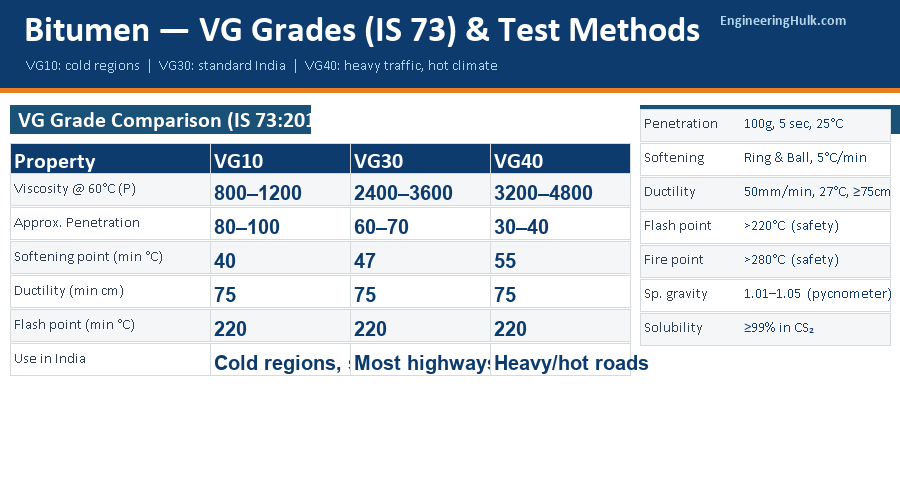
India replaced the old penetration-based grading (80/100, 60/70, 30/40) with Viscosity Grade (VG) classification in IS 73:2013, based on absolute viscosity at 60°C in Poise.
| Grade | Absolute Viscosity at 60°C (Poise) | Approx. Penetration (0.1mm) | Use |
|---|---|---|---|
| VG10 | 800–1200 | 80–100 (soft) | Very cold regions (Himalayan areas), spray applications (surface dressing), cold mix |
| VG30 | 2400–3600 | 50–70 (medium) | Most road construction in India — plains and moderate climate zones |
| VG40 | 3200–4800 | 30–40 (stiff) | Heavy traffic roads, high-temperature regions (Rajasthan, Gujarat), airport pavements |
The shift from penetration to viscosity grading better reflects the material’s performance at service temperature. Viscosity at 60°C corresponds to the approximate road surface temperature in Indian summers — the critical temperature for rutting resistance. VG30 is the most widely specified grade in Indian national highway contracts.
8. Tests on Bitumen (IS Standards)
| Test | IS Code | Procedure | Result & Limits |
|---|---|---|---|
| Penetration test | IS 1203 | 100g needle applied for 5 sec at 25°C on bitumen sample; depth of penetration measured | Result in 0.1mm units. VG30 = 45–80 (approx). Lower = harder. |
| Softening point (Ring & Ball) | IS 1205 | Steel ball (3.5g) placed on bitumen disc in a ring; temperature raised in water bath at 5°C/min; temp at which bitumen softens enough for ball to fall 25mm | VG30: ≥47°C. Higher SP = more heat-resistant. Important for rutting resistance. |
| Ductility test | IS 1208 | Briquette pulled at 50mm/min at 27°C; distance at break | Paving bitumen ≥75 cm. Measures elongation/adhesion. Low ductility = brittle = prone to cracking. |
| Flash & Fire point | IS 1209 | Cleveland Open Cup. Flash point = temp at which vapour flashes momentarily. Fire point = temp at which sustained combustion occurs. | Flash point >220°C; Fire point >280°C (IS 73). Critical for safe heating during mixing. |
| Viscosity (absolute) | IS 1206 | Capillary viscometer at 60°C; time for bitumen to flow; multiply by calibration constant | VG10: 800–1200 P; VG30: 2400–3600 P; VG40: 3200–4800 P. |
| Specific gravity | IS 1202 | Pycnometer; weight in air and water | 1.01–1.05 for petroleum bitumen; 1.20–1.25 for coal tar. |
| Solubility test | IS 1212 | Dissolve in carbon disulphide; insoluble residue = mineral matter | Purity: ≥99% soluble (IS 73) |
9. Modified Bitumen
Modified bitumen has improved performance compared to conventional bitumen — higher softening point (better rutting resistance), lower brittleness temperature (better cracking resistance), better adhesion.
- PMB (Polymer-Modified Bitumen): SBS (Styrene-Butadiene-Styrene, thermoplastic elastomer) or EVA (Ethylene Vinyl Acetate, thermoplastic) added at 3–5% by mass. SBS gives elastic recovery (stretches and returns); EVA improves high-temperature viscosity. PMB is specified for high-traffic highways, urban expressways, and airport runways.
- CRMB (Crumb Rubber Modified Bitumen): Recycled tyre rubber (crumb rubber) blended with bitumen at 15–20% by mass (wet process). Improves rutting resistance and fatigue life. IS 15462 governs CRMB. Also reduces solid waste from used tyres — environmental benefit.
- Natural rubber modified bitumen: Used in Malaysia and some Indian projects; good adhesion and flexibility but expensive.
10. Paints & Protective Coatings
A paint consists of: (1) Pigment — provides colour and opacity (titanium dioxide for white). (2) Vehicle (binder) — film-forming material that holds the pigment (linseed oil, alkyd resin, latex). (3) Solvent/thinner — adjusts viscosity for application (water, mineral spirits, toluene). (4) Driers — catalysts to speed up curing (cobalt/lead naphthenate). (5) Extenders — cheap fillers to reduce cost and improve body (chalk, barytes).
| Paint Type | Binder | Use |
|---|---|---|
| Oil paint (distemper) | Linseed oil + white lead | Interior walls; cheap; not washable; not for metal |
| Enamel paint | Alkyd resin + enamel | Wood and metal; hard, washable, glossy; kitchen, bathrooms, hospital |
| Emulsion paint (latex) | Acrylic/vinyl polymer in water | Interior/exterior masonry; washable, low VOC; quick drying |
| Epoxy paint | Epoxy resin + hardener (2-component) | Industrial floors, tanks, marine; excellent chemical resistance |
| Bituminous paint | Bitumen in solvent | Corrosion protection for buried steel pipes, foundations |
| Zinc-rich primer | Zinc dust + epoxy/chlorinated rubber | Sacrificial protection for structural steel before top coat |
11. Worked Examples (GATE CE Level)
Example 1 — Bitumen Grade Selection (GATE 2021 type)
A national highway is being designed in the Rajasthan desert where summer road surface temperatures can exceed 65°C and the road carries heavy freight traffic. Which VG grade bitumen should be specified and why?
Answer: Specify VG40 (IS 73). Reasons: (1) Highest softening point (≥55°C for VG40 vs ≥47°C for VG30) — resists rutting at high pavement temperatures. (2) Highest viscosity (3200–4800 P at 60°C) — maintains stiffness under heavy loads. VG30 would soften at extreme summer temperatures and allow wheel-track rutting in the mix.
Example 2 — Moisture Content of Timber
A timber sample has wet weight = 850 g and oven-dry weight = 620 g. Find the moisture content.
Solution:
MC = (850 − 620)/620 × 100 = 230/620 × 100 = 37.1%
This is above the FSP (~30%), so the timber needs seasoning before use in structural work. Kiln seasoning to 12% MC is recommended.
Example 3 — Flash Point Safety Check
A bitumen sample is heated to 180°C during mixing. Is it safe? What is the minimum safe heating temperature limit?
Answer: IS 73 requires flash point > 220°C for paving bitumen. Heating to 180°C is well below the flash point — it is safe for mixing. However, bitumen should generally not be heated above 165–170°C during production (to prevent hardening and loss of volatiles). The maximum safe working temperature for bitumen handling is typically 160°C in the field; the flash point (220°C+) is a safety limit that must never be approached.
Common Mistakes
- Confusing penetration grade and VG grade: Penetration grades (80/100, 60/70) are old IS 73 grades. VG grades (VG10/VG30/VG40) are the current IS 73:2013 system. VG10 ≈ 80/100 pen (soft), VG40 ≈ 30/40 pen (stiff). Don’t mix up the numbering — higher VG number = higher viscosity = stiffer bitumen.
- Confusing penetration test load and time: Penetration test: 100 g total load, 5 seconds, 25°C. Students sometimes remember 150g or 10 seconds — these are wrong. The needle diameter is 1 mm.
- Stating flash point is a bitumen quality indicator: Flash point measures safety during heating — it is NOT a measure of bitumen quality for pavement performance. The limit is a minimum safety threshold, not a performance indicator.
- Saying hardwood is always stronger than softwood: The terms hardwood/softwood are botanical, not based on mechanical properties. Balsa wood is a hardwood but is softer than most softwoods. Strength depends on density and grain structure, not botanical classification.
- Ignoring Fibre Saturation Point in moisture-strength relationships: Timber strength increases as MC decreases ONLY below FSP (~30%). Above FSP, additional moisture has no effect on mechanical properties. Many students assume strength decreases linearly with all moisture content increases.
Frequently Asked Questions
What are the tests on bitumen for road construction?
Penetration test (100g, 5s, 25°C — hardness); Softening point, Ring & Ball (VG30 ≥47°C — rutting resistance); Ductility (pull at 50mm/min, 27°C — ≥75cm for paving); Flash point (>220°C) & Fire point (>280°C) — safety; Viscosity at 60°C (VG classification); Specific gravity (1.01–1.05); Solubility (≥99% in CS₂).
What is the difference between VG10, VG30 and VG40?
VG = Viscosity Grade (absolute viscosity at 60°C in Poise). VG10: 800–1200 P (soft, cold regions); VG30: 2400–3600 P (standard Indian highways); VG40: 3200–4800 P (heavy traffic, hot regions). Higher VG → stiffer → better rutting resistance.
What are the main defects in timber?
Natural: knots (reduce strength), shakes (cracks between rings), upsets (compression failure). Seasoning: honeycombing (internal cracks from rapid drying), case hardening (surface stiff, core wet). Biological: rot (fungal), insect attack. Conversion: diagonal grain (very harmful to bending strength).
What is the difference between air seasoning and kiln seasoning?
Air seasoning: 1–5 years, MC 15–20%, no energy cost, weather-dependent. Kiln seasoning: 2–6 weeks, MC 8–12% (controlled), kills fungi/insects, uniform — but capital and energy-intensive. Kiln seasoning is preferred for structural timber.