Concrete Technology & Mix Design
Workability Tests, Abrams’ Law, IS 10262-2019 Mix Design, Admixtures & Durability
Last Updated: April 2026 | GATE CE 2025–2027
📌 Key Takeaways
- Workability: slump (0–175 mm), compaction factor (0.78–0.95), VB time (3–35 sec), flow table.
- Abrams’ law: concrete strength is inversely proportional to w/c ratio — lower w/c → higher strength.
- Target mean strength: f’ck = fck + 1.65σ (IS 10262; σ = 4 MPa for M25 with good control).
- IS 456:2000 specifies minimum cement content, maximum w/c ratio, and minimum cover for different exposure conditions.
- 28-day cube strength → cylinder strength = 0.8 × cube; standard cube = 150 mm × 150 mm × 150 mm.
- Superplasticizers reduce water by 20–30% without reducing workability — key for high-strength and self-compacting concrete.
- Durability threats: carbonation, chloride-induced corrosion, sulphate attack, alkali-silica reaction (ASR).
1. Workability & Tests
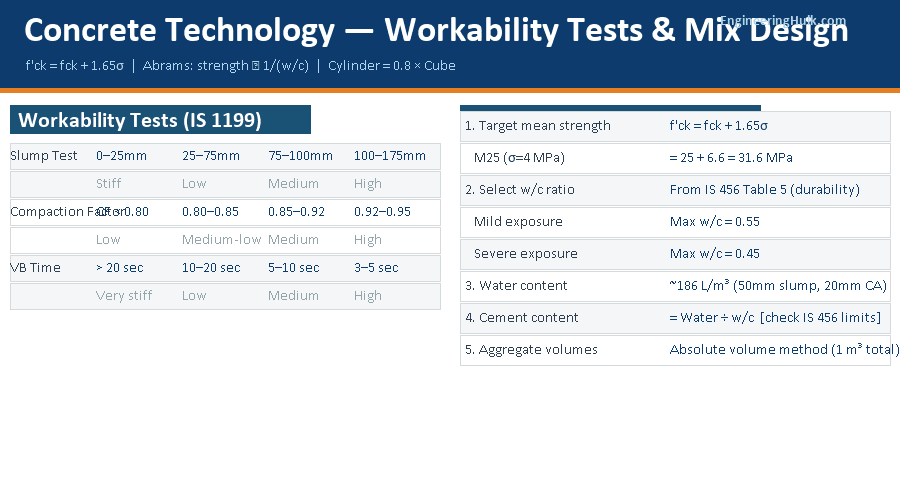
Workability is the ease with which concrete can be mixed, transported, placed, compacted, and finished without segregation or bleeding. It depends on water content, cement content, aggregate shape/size/grading, admixtures, and temperature.
| Test | Apparatus | Results & Interpretation | IS Code |
|---|---|---|---|
| Slump test | Slump cone (30cm tall), tamping rod | 0–25mm stiff; 25–75mm low; 75–100mm medium; 100–175mm high; >175mm = collapse/segregation | IS 1199 |
| Compaction factor (CF) | Two hoppers + cylinder, weighing | CF = W₂/W₁ (partially/fully compacted); 0.78 low; 0.85 medium; 0.92 high | IS 1199 |
| VB test (Vee-Bee) | VB consistometer, vibrating table | Time for glass disc to fully contact concrete surface; 35s = low; 3s = high workability | IS 1199 |
| Flow table test | Flow table, cone, lifting jig | Diameter of spread in %: <115% stiff; 115–125% low; 125–135% medium; 135–145% high | IS 9103 |
Slump types: True slump (uniform subsidence) indicates good workability. Shear slump (one side slips) indicates poor cohesion and possible segregation. Collapse slump indicates excessive water — test is invalid, concrete likely too wet.
Factors affecting workability: More water → more workable but lower strength. More cement paste → more workable. Angular aggregates → less workable. Coarser aggregates → more workable than fine for same w/c. Higher temperature → faster stiffening, lower workability.
2. Water-Cement Ratio & Strength
Abrams’ Law
fc = A / B(w/c)
Where A ≈ 97 MPa (empirical, depends on cement type), B ≈ 4 (empirical)
Practical rule: Lowering w/c by 0.1 increases 28-day strength by ~6–8 MPa.
Minimum w/c for complete hydration = 0.23 (theoretical).
Minimum w/c for workability = 0.40 (practical minimum for hand-compacted concrete).
IS 456 maximum w/c: Mild exposure 0.55 | Moderate 0.50 | Severe 0.45 | Very Severe 0.40 | Extreme 0.35
The w/c ratio is the most important single parameter controlling concrete strength, durability, and permeability. Every additional litre of water per m³ of concrete increases the porosity and reduces long-term strength. Free water in excess of hydration requirements evaporates leaving behind a network of capillary pores — these pores govern permeability and are the pathway for aggressive agents (chlorides, sulphates, CO₂).
3. IS 10262-2019 Mix Design
Target Mean Strength
f’ck = fck + 1.65 × σ
fck = characteristic strength (grade of concrete, MPa)
σ = standard deviation from IS 10262 Table 1
Typical σ values: M10–M15 = 3.5 MPa; M20–M25 = 4.0 MPa; M30–M35 = 5.0 MPa; M40–M50 = 6.0 MPa
For M25: f’ck = 25 + 1.65×4.0 = 31.6 MPa
IS 10262-2019 Mix Design Steps:
- Determine target mean strength (f’ck).
- Select w/c ratio from durability requirements (IS 456 Table 5) or from strength (IS 10262 Fig 1).
- Estimate water content for required workability (IS 10262 Table 2; typically 186 L/m³ for 50 mm slump with 20 mm CA).
- Calculate cement content = Water content / w/c ratio. Check against minimum and maximum limits.
- Estimate volume of coarse aggregate per unit volume of concrete (IS 10262 Table 3 — based on CA size and zone of FA).
- Compute fine aggregate content by absolute volume method: 1 m³ = Volume of cement + water + CA + FA + air.
- Trial mixes to verify target strength and workability.
4. Compressive Strength Testing
Standard cubes: 150 mm × 150 mm × 150 mm (IS 516). Cured at 27°C ± 2°C in water. Tested at 7 days and 28 days. The 7-day strength is approximately 65–70% of 28-day strength for OPC. For PPC: 7-day ≈ 55% of 28-day (slower early strength due to pozzolanic reaction).
Cube vs Cylinder Strength
Cylinder strength (150×300mm) ≈ 0.80 × Cube strength (150×150×150mm)
Characteristic strength: value below which not more than 5% of test results are expected to fall.
fck = f̄ − 1.65σ (where f̄ = mean strength)
Non-destructive tests (NDT) on existing concrete: (1) Rebound hammer (Schmidt hammer) — measures surface hardness; index correlated to strength; affected by carbonation and surface conditions. (2) Ultrasonic Pulse Velocity (UPV) — measures velocity of ultrasonic pulse through concrete; V > 4500 m/s = excellent; 3500–4500 = good; <3000 = poor. (3) Core cutting — most reliable; core crushed in lab; correction for L/D ratio: if L/D = 1, multiply by 1.25 to get equivalent cube strength.
5. Durability of Concrete
| Deterioration | Mechanism | Prevention |
|---|---|---|
| Carbonation | CO₂ + Ca(OH)₂ → CaCO₃; reduces pH below 9; depassivates steel | Low w/c (<0.45), adequate cover (≥25mm) |
| Chloride attack | Cl⁻ ions depassivate steel; pitting corrosion; rust expansion cracks concrete | w/c ≤ 0.40, cover ≥ 45mm (marine), epoxy-coated bars |
| Sulphate attack | SO₄²⁻ + C3A products → ettringite (expansive); gypsum formation | SRC cement (C3A ≤ 5%), low w/c, PPC/PSC |
| Alkali-Silica Reaction (ASR) | Reactive silica in aggregate + alkalis in cement → expansive gel | Low-alkali cement, PFA/GGBS replacement, non-reactive aggregates |
| Freeze-Thaw | Ice formation in pores → expansion → spalling | Air-entraining admixtures (3–6% entrained air), low w/c |
6. Admixtures (IS 9103)
| Type | Chemical | Effect | Dosage |
|---|---|---|---|
| Plasticizer | Lignosulfonates, hydroxylated carboxylic acids | Reduce water 5–10%, or increase slump | 0.1–0.4% by wt of cement |
| Superplasticizer | SNF (Sulphonated Naphthalene Formaldehyde), PCE (Polycarboxylate ether) | Reduce water 20–30%; enable very low w/c (0.25–0.35); SCC | 0.5–2.0% by wt of cement |
| Retarder | Sucrose, citric acid, calcium gluconate | Delay initial set by 1–4 hours; hot weather, ready-mix, slip forming | 0.05–0.2% by wt |
| Accelerator | CaCl₂, triethanolamine, calcium formate | Reduce setting time and increase early strength; cold weather | CaCl₂ max 1.5% (harmful to steel) |
| Air-entraining | Vinsol resin, fatty acids, alkyl sulphonates | 3–6% entrained air; freeze-thaw resistance | 0.01–0.05% |
Note on CaCl₂: Calcium chloride is the most effective accelerator but introduces chloride ions which can cause corrosion of steel reinforcement. IS 456 prohibits its use in reinforced concrete unless the total chloride content remains within limits (0.4 kg/m³ for reinforced concrete). It may be used in plain concrete in limited quantities for rapid setting.
7. Special Concretes
- High Strength Concrete (HSC): f’ck > 60 MPa; uses very low w/c (0.25–0.35), superplasticizers, silica fume (10% cement replacement). Dense microstructure, very low permeability.
- Self-Compacting Concrete (SCC): Flows under its own weight, fills formwork completely without vibration. Uses PCE superplasticizer + viscosity-modifying agents. Characterised by slump flow diameter 550–850 mm.
- Lightweight Concrete: Density 300–1850 kg/m³; uses lightweight aggregates (expanded clay, pumice) or aerated (foam) concretes. Reduced dead load but lower strength.
- Fibre-Reinforced Concrete (FRC): Steel or polypropylene fibres (0.5–2% by volume) added to improve tensile strength, ductility, crack resistance, and impact resistance. Used in industrial floors, precast tunnel linings.
8. Worked Examples (GATE CE Level)
Example 1 — Target Mean Strength (GATE 2021 type)
Calculate the target mean compressive strength for M30 concrete with good control conditions (σ = 5 MPa).
Solution: f’ck = fck + 1.65σ = 30 + 1.65 × 5 = 30 + 8.25 = 38.25 MPa.
The actual concrete must achieve a mean strength of 38.25 MPa so that the statistical probability of falling below 30 MPa is only 5%.
Example 2 — Compaction Factor (GATE 2018 type)
In a compaction factor test, the partially compacted concrete weighs 16.80 kg and the fully compacted concrete weighs 18.20 kg. What is the compaction factor and what workability class does it represent?
Solution: CF = 16.80/18.20 = 0.923 → High workability (CF 0.90–0.95).
Example 3 — Water-Cement Ratio from Strength
A concrete mix uses OPC 43 cement with a target mean strength of 40 MPa. Using IS 10262 relationship (w/c = 0.55 gives 40 MPa for OPC 43), find the water content if water content = 186 L/m³, and the required cement content.
Solution:
w/c = 0.55 (given for target strength 40 MPa with OPC 43)
Water content = 186 kg/m³ (given)
Cement content = 186 / 0.55 = 338.2 kg/m³
Check: IS 456 minimum cement for severe exposure = 320 kg/m³. 338 > 320 ✓. IS 456 maximum cement = 450 kg/m³. 338 < 450 ✓.
Common Mistakes
- Confusing slump and workability: Slump is a measurement, not workability itself. Two concretes with the same slump can have different workabilities if they differ in cohesiveness. A collapse slump (concrete slumps to one side) indicates segregation, not high workability.
- Using 7-day strength as 65% rule universally: The 7-day/28-day ratio of ~65% applies to OPC. For PPC and PSC (which rely on slow pozzolanic reactions), 7-day strength is only ~50–55% of 28-day. Using the OPC rule for blended cements underestimates potential strength.
- Ignoring the cube/cylinder conversion: Cylinder strength = 0.80 × cube strength. GATE sometimes gives a cylinder strength and asks for the equivalent cube strength, or vice versa. Cylinder strength is always lower because the slenderness ratio allows more lateral deformation.
- Applying CaCl₂ in reinforced concrete: CaCl₂ dramatically accelerates setting and early strength but introduces chloride ions that corrode steel. It is prohibited in RCC by IS 456 unless the total chloride stays within 0.4 kg/m³.
- Computing mix proportions without checking minimum cement and maximum w/c: IS 456 imposes both lower and upper bounds. Even if your target strength calculation gives a lower cement content, you must use the IS 456 minimum. Even if a higher w/c would be acceptable for strength, the durability maximum must not be exceeded.
Frequently Asked Questions
What is Abrams’ water-cement ratio law?
fc = A/B^(w/c). Concrete strength is inversely proportional to the w/c ratio — the lower the w/c, the denser the paste, the fewer capillary pores, the higher the strength. The minimum w/c for workability is ~0.40; for hydration alone ~0.23.
What is the target mean strength in IS 10262-2019?
f’ck = fck + 1.65σ. For M25 with σ=4 MPa: f’ck = 25 + 6.6 = 31.6 MPa. This ensures only 5% of test results fall below the specified characteristic strength.
What are the workability tests and their ranges?
Slump: 0–25mm (stiff) to 100–175mm (high). Compaction factor: 0.78 (low) to 0.95 (high). VB time: 35s (low) to 3s (high). Flow table: <115% (stiff) to >135% (high).
What are the main types of admixtures in concrete?
Plasticizers (−5–10% water), superplasticizers (−20–30% water, enables w/c 0.25–0.35), retarders (delay set for hot weather), accelerators (early strength, CaCl₂ avoid in RCC), air-entraining agents (freeze-thaw resistance).