Cement: Types, Properties & Tests
Bogue Compounds, OPC Grades, Vicat Tests, Soundness, Fineness & IS 269
Last Updated: April 2026 | GATE CE 2025–2027
📌 Key Takeaways
- Portland cement clinker = CaO (~65%) + SiO₂ (~22%) + Al₂O₃ (~6%) + Fe₂O₃ (~3%); kiln temperature 1450°C.
- Bogue compounds: C3S (early strength), C2S (late strength), C3A (flash set, max heat), C4AF (grey colour, minor strength).
- OPC grades: 33/43/53 — the number is minimum 28-day compressive strength in MPa.
- Normal consistency: 26–33% water (Vicat plunger penetrates 33–35 mm).
- Initial setting time ≥ 30 min; Final setting time ≤ 600 min (IS 269).
- Soundness: Le Chatelier expansion ≤ 10 mm; Autoclave ≤ 0.8%.
- Specific gravity of cement = 3.15; Bulk density (loose) ≈ 1440 kg/m³.
1. Cement Manufacture
Portland cement is manufactured from limestone (CaCO₃, ~75%) and clay or shale (provides silica, alumina, iron oxide). Two processes: Wet process — raw materials slurried with water (~35% moisture) before kiln; better mixing but more energy. Dry process — raw materials ground dry and fed as powder; less energy; preferred in modern plants.
The raw mix is burned in a rotary kiln at ~1450°C to form clinker. Clinker is cooled rapidly (to preserve metastable phases) and then ground with 2–3% gypsum to produce the final cement powder. Gypsum controls the setting time by reacting with C3A to form ettringite, which prevents flash set. Without gypsum, cement would set within minutes of contact with water.
Fineness of grinding affects hydration rate: finer cement (higher Blaine surface area) hydrates faster, develops strength faster, but generates more heat and is more susceptible to early deterioration from moisture in storage.
2. Bogue Compounds & Hydration
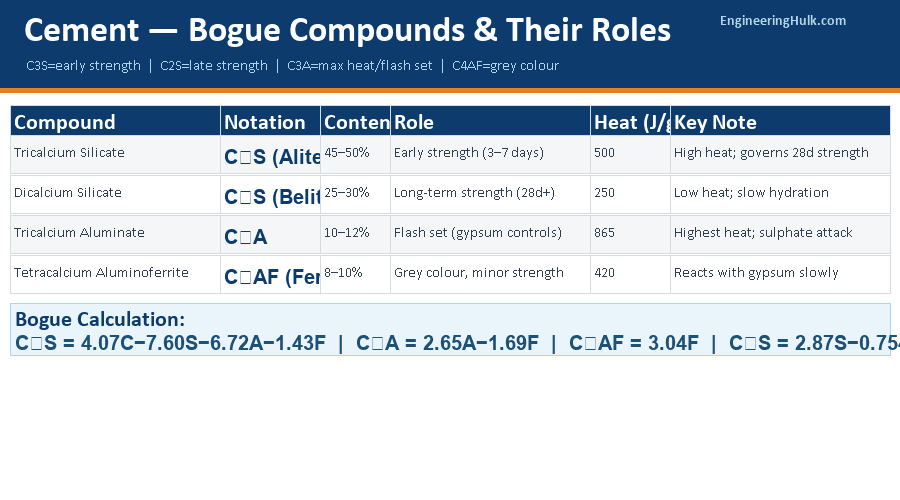
| Compound | Formula | Notation | Content | Contribution | Heat of Hydration |
|---|---|---|---|---|---|
| Tricalcium Silicate | 3CaO·SiO₂ | C3S (Alite) | 45–50% | Early strength (3–7 days), binds paste | 500 J/g (high) |
| Dicalcium Silicate | 2CaO·SiO₂ | C2S (Belite) | 25–30% | Long-term strength (28 days+), slow hydration | 250 J/g (low) |
| Tricalcium Aluminate | 3CaO·Al₂O₃ | C3A | 10–12% | Flash set if no gypsum; sulphate attack susceptibility | 865 J/g (highest) |
| Tetracalcium Aluminoferrite | 4CaO·Al₂O₃·Fe₂O₃ | C4AF (Ferrite) | 8–10% | Grey colour, minor strength, reacts slowly | 420 J/g (low) |
Bogue Calculation (from oxide analysis)
C3S = 4.07C − 7.60S − 6.72A − 1.43F − 2.85SO₃
C2S = 2.87S − 0.754(C3S)
C3A = 2.65A − 1.69F
C4AF = 3.04F
Where C=CaO, S=SiO₂, A=Al₂O₃, F=Fe₂O₃ (all in % by mass)
Hydration products: C3S + H₂O → C-S-H gel (strength) + Ca(OH)₂ (portlandite). C2S similarly but slower. C-S-H (calcium silicate hydrate) gel is the primary binding phase. Ca(OH)₂ (about 25% of hydration products) is soluble and can leach out, reducing durability.
3. Physical Properties
| Property | Value | Significance |
|---|---|---|
| Specific gravity | 3.15 | Used to compute void ratio and mix design water/cement ratio |
| Bulk density (loose) | 1440 kg/m³ | For volumetric batching |
| Bulk density (rodded) | 1600 kg/m³ | |
| Normal consistency (water) | 26–33% | Reference state for all Vicat tests |
| Initial setting time | ≥ 30 min (OPC) | Time available for mixing, transport, placing |
| Final setting time | ≤ 600 min (OPC) | Formwork striking time planning |
| Blaine fineness | ≥ 225 m²/kg (OPC 33) | Higher fineness → faster hydration → higher early strength |
| Soundness (Le Chatelier) | ≤ 10 mm | Excess free lime/magnesia causes late expansion and cracking |
4. Tests on Cement (IS 4031)
Normal Consistency Test
Objective: Find the water content (P%) at which the 10 mm Vicat plunger under 300g weight penetrates 33–35 mm into a 40 mm deep cement paste pat within 30 seconds. This standard consistency is then used to prepare paste for all other Vicat tests (setting time uses 0.85P water, soundness uses 0.78P water).
Setting Time Tests (Vicat Apparatus)
Initial setting time: The sharp Vicat needle (1 mm dia, 300 g total weight) is released every minute. Initial set occurs when the needle penetrates to 33–35 mm depth from the top (i.e., 5–7 mm from the bottom of the 40 mm mould). IS 269 minimum = 30 minutes for OPC.
Final setting time: The needle with annular attachment (collar) is used. Final set occurs when the needle makes only a surface impression (collar does not mark the surface). IS 269 maximum = 600 minutes.
Soundness Tests
Le Chatelier test: A split cylinder (1 mm gap) embedded in a cement disc is submerged in water for 24h at 27°C, then boiled for 25 minutes. Difference in indicator reading before and after = expansion. Limit: ≤ 10 mm.
Autoclave test (IS 4031 Part 3): Mortar bars cured in autoclave at 2.03 MPa (216°C) for 3 hours. Expansion ≤ 0.8%. Used to detect MgO (periclase) expansion which is slow and not detected by Le Chatelier.
Fineness Test
Dry sieve test (IS 90 μm sieve): Residue on 90 μm sieve ≤ 10% for OPC. Quick but not very accurate.
Blaine air permeability test: Measures specific surface area in m²/kg. Blaine fineness ≥ 225 m²/kg (OPC 33), ≥ 225 (OPC 43), ≥ 225 (OPC 53), ≥ 300 (PPC). Based on the time taken for a fixed volume of air to flow through a compacted cement bed.
Compressive Strength Test
Mortar cubes 70.7 mm × 70.7 mm (1:3 cement:sand, w/c = P/4 + 3.5% where P = normal consistency). Cured under water. Tested at 3, 7, and 28 days. Minimum 28-day strength: OPC 33 = 33 MPa, OPC 43 = 43 MPa, OPC 53 = 53 MPa.
5. Types of Cement
| Type | IS Code | Key Feature | Use |
|---|---|---|---|
| OPC 33/43/53 | IS 269 | General purpose; high C3S in OPC 53 | General RCC, masonry, plastering |
| PPC (Portland Pozzolana) | IS 1489 | 15–35% fly ash or calcined clay; slower heat, better durability | Mass concrete, marine works, hot climates |
| PSC (Portland Slag) | IS 455 | 25–70% GGBS (ground granulated blast furnace slag); low heat | Dams, mass concrete, sulphate-resistant |
| SRC (Sulphate Resistant) | IS 12330 | C3A ≤ 5%; resistant to sulphate attack | Foundations in sulphate-bearing soils, sewers |
| RHC (Rapid Hardening) | IS 8041 | High C3S, finer grinding; high early strength | Cold weather concreting, precast, quick repairs |
| LHC (Low Heat) | IS 12600 | Low C3S, high C2S; C3A ≤ 6%; C3S ≤ 35% | Mass concrete (dams, large foundations) |
| White Cement | IS 8042 | No C4AF (uses pure limestone + China clay); white colour | Decorative work, tile grouting, terrazzo |
| Expansive Cement | — | Contains expansive additives to counteract shrinkage | Shrinkage-compensating concrete, grouting |
6. Worked Examples (GATE CE Level)
Example 1 — Bogue Compound Calculation (GATE 2019 type)
Oxide analysis of Portland cement clinker: CaO = 64%, SiO₂ = 20%, Al₂O₃ = 6%, Fe₂O₃ = 3%. Calculate C3S and C3A content.
Solution:
C3A = 2.65A − 1.69F = 2.65 × 6 − 1.69 × 3 = 15.90 − 5.07 = 10.83%
C4AF = 3.04F = 3.04 × 3 = 9.12%
C2S = 2.87S − 0.754×C3S (need C3S first)
C3S = 4.07C − 7.60S − 6.72A − 1.43F − 2.85SO₃ (assume SO₃ = 2%)
= 4.07×64 − 7.60×20 − 6.72×6 − 1.43×3 − 2.85×2 = 260.48 − 152 − 40.32 − 4.29 − 5.70 = 58.17%
Example 2 — Identify Cement Type (GATE 2022 type)
A structure is to be built in soil with high sulphate content. The foundation concrete will be in contact with sulphate-bearing groundwater. Which cement should be used and what is the limit on C3A content?
Answer: Use Sulphate Resistant Cement (SRC, IS 12330). Maximum C3A content = 5%. C3A reacts with sulphates (CaSO₄, MgSO₄) to form ettringite (expansive), which cracks concrete. Low C3A prevents this reaction.
Example 3 — Vicat Test (Normal Consistency)
In a normal consistency test, the Vicat plunger penetrated 28 mm with 28% water, 35 mm with 32% water, and 40 mm with 34% water. What is the normal consistency?
Solution: Normal consistency = water content at which plunger penetrates 33–35 mm. At 32% water, penetration = 35 mm, which is within 33–35 mm range. Therefore normal consistency P = 32%. Setting time tests should use 0.85P = 0.85×32 = 27.2% water.
Common Mistakes
- Mixing up C3S and C2S roles: C3S gives early (3–7 day) strength; C2S gives late (28-day+) strength. Many students confuse these. Mnemonic: C3S = 3-day strength.
- Stating C3A causes late expansion: C3A causes flash set (immediate) and sulphate attack (late). It is free CaO (lime) and free MgO (periclase) that cause unsound late expansion — detected by Le Chatelier and autoclave tests respectively.
- Using wrong water for setting time test: Normal consistency test finds P%. Setting time tests use 0.85P water, NOT the normal consistency water content P%. Using P directly gives incorrect (faster) setting times.
- Confusing IS codes: IS 269 = OPC; IS 1489 = PPC; IS 12330 = SRC; IS 8041 = RHC. GATE frequently asks which IS code applies to a given cement type.
- Stating white cement has no iron: White cement has no C4AF (tetracalcium aluminoferrite, the iron-containing phase that gives grey colour). It uses low-iron raw materials and a reducing flame in the kiln.
Frequently Asked Questions
What are the four Bogue compounds and their roles?
C3S (~45–50%): early strength, high heat. C2S (~25–30%): long-term strength, low heat. C3A (~10–12%): flash set, maximum heat, sulphate-susceptible — kept ≤5% in SRC. C4AF (~8–10%): grey colour, minor strength.
What are the Vicat apparatus tests for cement?
Normal consistency test (plunger penetrates 33–35 mm). Initial setting time (needle penetrates 33–35 mm; min 30 min for OPC). Final setting time (annular attachment makes only surface mark; max 600 min). Setting time tests use 0.85P water, not P.
What is the difference between OPC 33, 43 and 53?
The grade number is the minimum 28-day compressive strength (MPa) of standard mortar cubes. OPC 33 ≥ 33 MPa; OPC 43 ≥ 43 MPa; OPC 53 ≥ 53 MPa. Higher grade = more C3S + finer grinding = higher early strength but more heat and cost.
What does the soundness test check for cement?
Soundness tests detect excess free CaO and MgO that cause delayed, expansive hydration after the cement has hardened. Le Chatelier test: expansion ≤ 10 mm (detects free CaO). Autoclave test: expansion ≤ 0.8% (detects MgO/periclase).