Aggregates, Bricks & Stones
Tests, Grading Zones (IS 383), Mechanical Properties & Quality Limits for GATE CE
Last Updated: April 2026 | GATE CE 2025–2027
📌 Key Takeaways
- Aggregates occupy 60–80% of concrete volume — their quality directly controls concrete strength, durability, and workability.
- Flakiness Index < 35%, Elongation Index < 45% (IS 2386) — flaky particles reduce workability and strength.
- Aggregate Impact Value (AIV): <20% = strong; <30% = satisfactory for highways; >35% = unsuitable for roads.
- IS 383 Fine Aggregate Zones I–IV (I = coarsest, IV = finest); Zone II preferred for structural concrete.
- Bulking of sand: maximum bulking at 4–6% moisture content; fine sand bulks 25–35%, coarse sand 15–25%.
- Brick compressive strength: 1st class ≥ 10.5 MPa; 2nd class ≥ 7 MPa; 3rd class ≥ 3.5 MPa (field classification).
- Brick water absorption ≤ 20% (1st/2nd class), ≤ 25% (3rd class) after 24-hour immersion.
1. Aggregate Classification
| Classification Basis | Types |
|---|---|
| Size | Coarse aggregate: retained on 4.75 mm IS sieve. Fine aggregate: passes 4.75 mm IS sieve. All-in aggregate: mixture without separation. |
| Specific gravity | Normal weight (2.6–2.8): quartzite, granite, basalt. Lightweight (<2.0): expanded clay, pumice. Heavy weight (>3.0): barytes, magnetite — for radiation shielding. |
| Shape | Rounded (river gravel, beach pebbles) — best workability. Irregular (pit gravel) — moderate. Angular (crushed rock) — best interlock, lower workability. Flaky and elongated — worst. |
| Surface texture | Smooth — low bond. Rough — higher bond with cement paste. Porous — high absorption, affects w/c ratio. |
| Source | Natural (river sand, crushed rock), artificial (expanded shale, recycled concrete), industrial by-products (GGBS, fly ash as FA). |
2. Grading & IS 383 Zones
Grading describes the particle size distribution of an aggregate. A well-graded aggregate fills the available volume efficiently, leaving minimum voids — reducing the paste needed and improving concrete strength. The Fineness Modulus (FM) is a single number representing the grading coarseness:
FM = (Sum of cumulative % retained on IS sieves 150μm, 300μm, 600μm, 1.18mm, 2.36mm, 4.75mm) / 100
Typical FM: Fine sand 2.2–2.6; Medium sand 2.6–2.9; Coarse sand 2.9–3.2; Fine CA 5.5–6.5; Coarse CA 6.5–8.0
| Fine Aggregate Zone | Character | % Passing 600μm sieve | Best Use |
|---|---|---|---|
| Zone I | Coarse sand | 15–34% | Concrete with high cement content; road construction |
| Zone II | Medium coarse | 35–59% | General structural concrete — most suitable |
| Zone III | Medium fine | 60–79% | Concrete with care; plaster, mortar |
| Zone IV | Fine sand | 80–100% | Avoid for structural concrete; high water demand |
3. Tests on Aggregates (IS 2386)
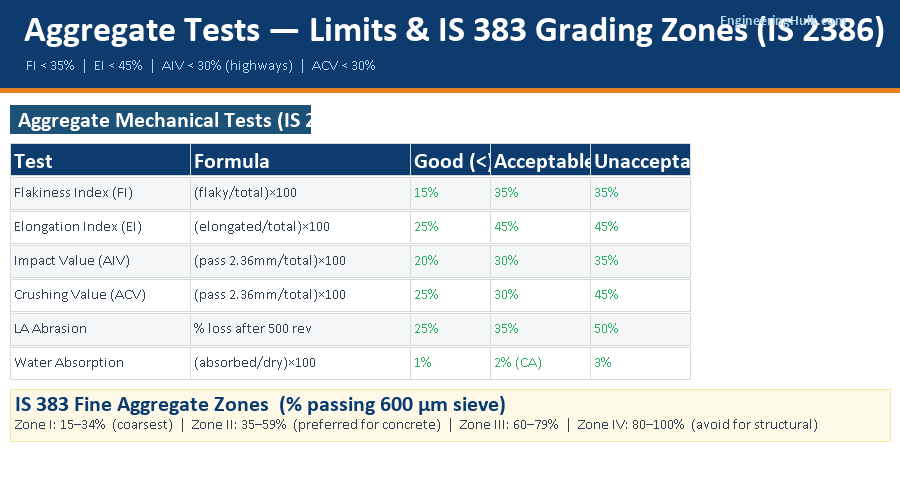
| Test | What It Measures | Procedure | Limit |
|---|---|---|---|
| Flakiness Index (FI) | Percentage of flat particles (least dim < 0.6 × mean size) | Pass aggregate through thickness gauge slots; weigh retained/total | <35% (IS 383) |
| Elongation Index (EI) | Percentage of elongated particles (greatest dim > 1.8 × mean) | Pass aggregate through length gauge slots | <45% (IS 383) |
| Aggregate Impact Value (AIV) | Resistance to sudden impact/dynamic loading | 15 blows of 13.5kg hammer from 380mm; % passing 2.36mm sieve | <20% (road surfacing), <30% (general highways) |
| Aggregate Crushing Value (ACV) | Resistance to crushing under slow compressive load | Compress 14.06mm sieve fraction to 400 kN in 10 min; % passing 2.36mm | <30% (general), <45% (weak concrete) |
| Los Angeles Abrasion Value (AAV) | Resistance to wear/abrasion + impact | LA machine with steel balls; 500/1000 revolutions; % loss | <35% (road surfacing), <50% (general concrete) |
| Specific Gravity & Water Absorption | Density and porosity | Pycnometer method; weigh dry, saturated surface dry, submerged | SG: 2.6–2.8; Water absorption <2% (CA), <3% (FA) |
| Soundness (IS 2386 Part 5) | Resistance to weathering | Sodium sulphate or magnesium sulphate cycles; % loss | <12% (Na₂SO₄), <18% (MgSO₄) |
Flakiness & Elongation Index Formulas
FI = (Weight of flaky particles / Total weight of sample) × 100 %
EI = (Weight of elongated particles / Total weight of sample) × 100 %
AIV = (W₂/W₁) × 100 % (W₂ = fraction passing 2.36mm; W₁ = total)
ACV = (W₂/W₁) × 100 % (W₂ = fraction passing 2.36mm after crushing)
4. Bulking of Sand
When sand is damp, surface tension in the moisture films pushes sand particles apart, increasing its apparent volume (bulking). This is critical in volumetric batching — if you measure sand by volume, damp sand gives less sand than dry sand for the same measured volume.
Maximum bulking: Fine sand → 25–35% increase in volume at ~4–6% moisture content.
Coarse sand → 15–25% increase at ~4–6% moisture content.
At 100% saturation (submerged), bulking = 0 (surface tension eliminated).
Correction for volumetric batching: Increased volume of FA = dry volume × (1 + bulking factor)
Bulking is zero for both bone-dry sand (no moisture films) and fully saturated sand (films broken by excess water). Maximum bulking occurs at the critical moisture content where individual films are thickest relative to particle size. Fine sand bulks more than coarse sand because it has more surface area per unit mass.
5. Bricks — Classification & Tests
Standard Indian brick dimensions: 190 × 90 × 90 mm (modular, IS 1077) or 230 × 110 × 70 mm (old traditional size still widely used). With mortar joints (~10 mm), modular bricks fit into 200 × 100 × 100 mm modules.
| Class | Min. Compressive Strength | Max. Water Absorption | Application |
|---|---|---|---|
| 1st Class | 10.5 MPa (15 MPa for special) | ≤ 20% | External walls, piers, columns, damp-exposed locations |
| 2nd Class | 7.0 MPa | ≤ 20% | Internal walls, partitions |
| 3rd Class (Under-burnt) | 3.5 MPa | ≤ 25% | Temporary structures, non-load-bearing partitions |
| 4th Class (Over-burnt/Jhama) | Hard but irregular | Very low | Road sub-base, soling, drainage aggregate — NOT as masonry |
Tests on Bricks (IS 3495)
- Compressive strength test: Place brick flat between 3mm plywood sheets, apply load at 14 N/mm²/min. CS = Breaking load / Loaded area. Must meet class minimum.
- Water absorption test: Dry in oven (105–115°C) to constant mass, weigh (W₁). Immerse in water for 24 hours at room temperature, weigh (W₂). Absorption = (W₂−W₁)/W₁ × 100. Limit ≤ 20% for 1st/2nd class.
- Efflorescence test: Place brick in dish with 25mm water. Allow to evaporate. Examine surface for white deposits. Rating: Nil, Slight, Moderate, Heavy, Serious. Nil and Slight are acceptable.
- Warpage test: Place brick on flat surface; measure maximum gap. Limit: ≤ 3mm for modular bricks.
6. Stones — Types & Tests
| Rock Type | Examples | Properties | Use in Construction |
|---|---|---|---|
| Igneous | Granite, basalt, trap, dolerite | Hard, dense, durable, low absorption, high crushing strength | Road metal, aggregate, columns, steps, sills |
| Sedimentary | Limestone, sandstone, mudstone, chalk | Softer, porous, may dissolve in acids; easy to dress/carve | Masonry, facing stone, limestone for cement manufacture |
| Metamorphic | Marble, quartzite, slate, gneiss, schist | High strength and hardness; marble polishes well; slate splits into thin sheets | Marble: flooring, cladding. Slate: roofing tiles. Quartzite: road aggregate. |
Tests on Stones
- Smith’s test (acid test): Thin slice of stone placed in HCl solution for 2–3 minutes. Limestone effervesces (carbonate dissolves); granite/quartzite unaffected. Used to distinguish limestones and assess carbonate content.
- Hardness test (Mohs scale): Scratch with minerals of known hardness. Scale: 1 (talc) to 10 (diamond). Granite ≈ 7; marble ≈ 3; limestone ≈ 3.
- Attrition test: Stone fragments tumbled in Deval attrition machine (5-hour rotation at 30 rpm); % loss indicates resistance to wear — used for road stone.
- Crushing strength: 40×40×40mm specimen compressed; crushing strength typically: granite >100 MPa; sandstone 20–170 MPa; limestone 30–250 MPa; marble 70–250 MPa.
7. Worked Examples (GATE CE Level)
Example 1 — Flakiness Index Calculation (GATE 2020 type)
Sieve analysis of a 3 kg aggregate sample shows the following: particles passing the flakiness gauge for the 20mm fraction = 0.45 kg; for 12.5mm fraction = 0.38 kg; for 10mm fraction = 0.22 kg. Total sample = 3.0 kg. Calculate the Flakiness Index.
Solution:
Total flaky particles = 0.45 + 0.38 + 0.22 = 1.05 kg
FI = (1.05/3.0) × 100 = 35%
The aggregate just meets the IS 383 limit of ≤35%. Acceptable but borderline — use with caution in high-quality concrete.
Example 2 — Bulking of Sand
Sand is measured in a container. Dry sand fills the container to 1.0 m³. After absorbing moisture (4% by mass), the sand bulks by 28%. What volume of damp sand must be measured to get 1.0 m³ of dry sand equivalent?
Solution:
1.0 m³ dry sand = 1.0 × (1 + 0.28) = 1.28 m³ of damp sand must be measured.
In volumetric batching, if the mix design calls for 1.0 m³ of sand and you measure by volume, use 1.28 m³ of damp sand to get the correct dry quantity.
Example 3 — Brick Test (Water Absorption)
A brick has dry weight = 2.800 kg. After 24h water immersion, weight = 3.276 kg. Is this brick acceptable as 1st class brick?
Solution:
Water absorbed = 3.276 − 2.800 = 0.476 kg
Water absorption = (0.476/2.800) × 100 = 17%
17% < 20% limit for 1st class → Acceptable.
Common Mistakes
- Confusing FI and EI measurement criteria: FI uses a thickness gauge (least dimension < 0.6 × mean size). EI uses a length gauge (greatest dimension > 1.8 × mean size). Students often swap the 0.6 and 1.8 factors.
- Applying same bulking factor for all sand types: Fine sand bulks significantly more than coarse sand. Assume 25–35% for fine, 15–25% for coarse unless actual field test data are available.
- Using over-burnt (jhama) bricks in walls: Over-burnt bricks are very hard but irregular, porous, and distorted. They are suitable only for soling and sub-base, not for masonry walls where dimensional accuracy and water tightness matter.
- Ignoring Zone IV sand restrictions: Zone IV (very fine) sand should not be used for concrete above M20. Its high surface area demands more water for the same workability, pushing the w/c ratio up and reducing strength.
- Confusing AIV and ACV loading: AIV uses impact loading (hammer blows). ACV uses slow compressive loading (400 kN over 10 min). They measure different properties. A material can have good ACV but poor AIV if it shatters under impact (brittle).
Frequently Asked Questions
What is flakiness index and elongation index?
FI = % particles whose thickness < 0.6 × mean size; limit < 35%. EI = % particles whose length > 1.8 × mean size; limit < 45%. Flaky and elongated particles reduce workability, are prone to breaking, and create planes of weakness.
What is the aggregate impact value test?
AIV = % passing 2.36mm after 15 hammer blows (13.5 kg from 380mm). <20% = strong (road surfacing); <30% = satisfactory for highways; >35% = weak; >45% = unacceptable.
What are the IS 383 fine aggregate grading zones?
Zone I (coarsest, 15–34% passing 600μm) to Zone IV (finest, 80–100% passing 600μm). Zone II is most suitable for structural concrete. Zone IV has high water demand — avoid for high-grade concrete.
What are the brick classes and strength requirements?
1st class: ≥10.5 MPa, water absorption ≤20%. 2nd class: ≥7 MPa, ≤20%. 3rd class: ≥3.5 MPa, ≤25%. 4th class (jhama): hard but irregular — for soling only, not masonry.