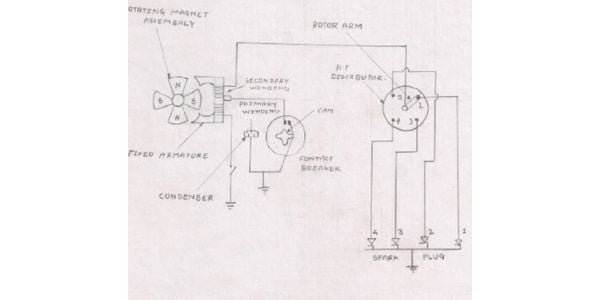
A magneto ignition system is an ignition system that generates its own electricity. A permanent-magnet alternator called a magneto is driven directly by the engine, and the voltage it produces is stepped up by a built-in coil to the 15,000 to 25,000 volts needed to jump the spark plug gap. Because the magneto is the source of the current, no battery is required anywhere in the ignition circuit. That single property is why magneto ignition still runs chainsaws, lawnmowers, outboards, mopeds and every certified piston aircraft engine flying today.
The trade-off is equally simple. A magneto produces voltage in proportion to how fast it is spinning, so the spark is strong at running speed and weak at cranking speed. Everything unusual about the system, from impulse couplings on aircraft engines to the vigorous kick needed on an old kickstart bike, follows from that one fact.
What is a magneto?
A magneto is a small alternator with a permanent magnet instead of a field winding. There is nothing to excite and nothing to energise first, so it starts producing output the instant the engine turns.
In an ignition magneto, that alternator and a step-up transformer are built into one unit. The low-voltage winding that the magnet induces current in is the primary, and wound on the same iron core is a much finer secondary with roughly 100 times as many turns. A few hundred volts in the primary therefore becomes several tens of thousands of volts in the secondary. A magneto built this way is a high-tension magneto, because the high voltage is made inside the unit. Older low-tension magnetos sent low voltage out to a separate coil at each cylinder, an arrangement still found on some large gas engines.
How a magneto ignition system works
The cycle repeats once per spark, and it is worth following the order carefully because the condenser step is the one most explanations get wrong.
- The engine drives the magneto. A gear, chain or flywheel turns the rotating magnet (or the armature) so that the magnetic flux through the coil core reverses twice per revolution.
- Current builds in the primary winding. The changing flux induces a current of a few amperes in the heavy, low-resistance primary, and that current sets up its own magnetic field around the coil core. At this point the contact breaker points are closed, so the primary is a complete loop.
- The cam opens the contact breaker. A cam on the magneto shaft, timed to the crankshaft, pushes the points apart at the moment of peak flux change. The points are set to open just after the magnet passes its neutral position, at the point of fastest flux reversal. That setting is called the E-gap, and it is the internal timing of the magneto.
- The condenser kills the arc so the field collapses fast. A capacitor, called the condenser, sits across the points. As the points separate, the self-induced voltage in the primary tries to keep the current flowing by arcing across the gap. The condenser absorbs that surge and holds the voltage down for the instant it takes the gap to widen, so no sustained arc forms.
- The collapsing flux induces the high voltage. With no arc to sustain it, the primary current stops almost instantly, and the magnetic field around the core collapses in microseconds. Induced voltage depends on how fast the flux changes, so that abrupt collapse, multiplied by the secondary turns ratio, produces 15,000 to 25,000 volts or more in the secondary winding.
- The spark plug fires. The high-tension lead carries that voltage to the plug. On a multi-cylinder engine a rotating distributor arm, driven at half crankshaft speed on a four-stroke, sends each pulse to the correct cylinder. A single-cylinder engine has no distributor at all; the secondary lead goes straight to the plug.
Two things follow from step 4. First, without the condenser you get a fat blue arc at the points, a slow field collapse and a feeble spark, plus points that burn and pit within hours. A failed condenser is the classic cause of “it will not start and the points are black”. Second, the condenser is not storing energy for the spark, the way a capacitor does in a CDI unit. Its job in a points magneto is purely to suppress the arc so the collapse is fast.
Types of magneto construction
Magnetos are classified by which part moves to reverse the flux. All three do the same job and all three are still in service.
1. Rotating magnet type
The coil and its laminated core are fixed, and a multi-pole permanent magnet rotor spins between the pole shoes. This is the standard modern design and it has displaced most others. Nothing carries current on the rotating part, so there are no slip rings and no brushes, and the whole unit is small and light. Aircraft magnetos and small-engine flywheel magnetos are almost all of this type.
2. Rotating armature type
Here the magnet is a fixed horseshoe or block magnet and the coil assembly, called the armature or shuttle, rotates in the gap between the poles. It is the oldest arrangement and the simplest to picture, but the windings and the breaker mechanism spin with the armature, which means slip rings or a collector and a limit on speed and durability. Common in vintage motorcycle and tractor magnetos.
3. Polar inductor type (rotating coil or inductor rotor)
Both the magnet and the windings stay still. A soft iron rotor with projections, the inductor, turns between them and switches the flux path so that the flux through the coil reverses. Since neither the magnet nor the coil moves, the rotor can be small and mechanically strong, which suits high-speed and heavy-duty applications.
Parts of a magneto ignition system
| Component | Function |
|---|---|
| Permanent magnet rotor | Driven by the engine, it supplies the magnetic flux and reverses it twice per revolution. Usually Alnico or a ferrite or rare-earth magnet in modern units. |
| Laminated iron core and pole shoes | Concentrate and guide the flux through the coil. Laminated to keep eddy current losses down. |
| Primary winding | A few hundred turns of thick wire. Carries the low-voltage, few-ampere current that builds the magnetic field to be collapsed. |
| Secondary winding | Tens of thousands of turns of fine wire on the same core, typically about 100 times the primary turns. Delivers the high-tension output. |
| Contact breaker (points) and cam | A mechanical switch in the primary circuit, opened by a cam on the magneto shaft. Opening the points is what triggers the spark and therefore sets the ignition timing. |
| Condenser (capacitor) | Wired across the points. Suppresses the arc as they open so the primary field collapses quickly, and protects the contact faces from burning. |
| Distributor | On multi-cylinder engines, a rotor and cap that route each high-tension pulse to the right spark plug in firing order. Absent on single-cylinder engines. |
| Spark plug | Provides the gap in the combustion chamber where the high voltage breaks down into a spark and ignites the mixture. See the background on spark plugs and electrode materials. |
| Ignition switch or kill switch | Works the opposite way to a battery system. It stops the engine by shorting the primary to earth, not by cutting power. A magneto has no power supply to switch off. |
| Safety gap | A deliberate air gap inside the magneto that flashes over if the high-tension lead is open circuit, protecting the secondary winding insulation. |
The ignition switch entry is worth a second look, because it explains a real hazard. If the earth wire from the points to the switch (the P-lead on an aircraft magneto) breaks, the switch can no longer short the primary. The magneto keeps firing with the key off, and turning the propeller or flywheel by hand can start the engine.
Why the spark gets stronger with engine speed, and why starting is hard
The voltage induced in the primary depends on the rate of change of flux, and the rate of change of flux depends on how fast the magnet is turning. Double the engine speed and you roughly double the primary voltage and current, and the field collapse is quicker too. So the spark energy climbs with revs.
At cranking speed the same relationship works against you. A four-stroke single being kicked over turns the magneto at perhaps 100 to 300 rpm against 3,000 rpm running. The primary current is a fraction of normal, the collapse is slower, and the secondary may not reach the breakdown voltage of the plug gap at all, particularly with a cold, rich mixture and a slightly fouled plug. A battery ignition system has the opposite characteristic: the battery supplies the same 12 volts whether the engine is turning at 100 rpm or 5,000, so it sparks reliably from the first compression stroke.
Three fixes are used in practice.
- Impulse coupling. A spring-loaded coupling between the engine drive and the magneto shaft. At cranking speed a pair of pawls catch on stop pins and hold the magnet still while the drive winds up the spring. Near the firing point the pawls are released and the spring snaps the magnet through the E-gap position far faster than the engine is turning, giving a full-strength spark. The same mechanism also retards the spark to roughly top dead centre during starting, which prevents kickback. Above a few hundred rpm centrifugal force holds the pawls clear and the coupling drives straight through at normal advance.
- Retard breaker and booster (the “shower of sparks” system). A second set of points in one magneto fires late, and during cranking an electrically driven vibrator feeds a rapid train of pulses into that magneto’s primary, producing a burst of sparks at the retarded timing instead of one weak one.
- Booster coil. An older arrangement in which a separate battery-fed induction coil bypasses the magneto entirely during start and feeds high voltage straight to the distributor. It is only energised while the starter is engaged.
On small engines the answer is cruder and works well enough: spin it fast. A recoil starter, a kickstarter or an electric starter turning the flywheel at 500 rpm or more gets the flywheel magneto over the threshold.
Ignition timing and advance
In a magneto the spark happens when the points open, so timing is set by the position of the cam relative to the crankshaft. Most aircraft magnetos are fixed-timed, with the engine data plate specifying the setting; around 25 degrees before top dead centre is typical for a Lycoming or Continental flat engine, though the figure varies by model and must be taken from the plate, not from a rule of thumb.
Two levels of timing exist and they are easy to confuse:
- Internal timing (E-gap). Set on the bench, with the magneto off the engine. It fixes the points to open at the rotor position that gives maximum output.
- Timing to the engine. Done on installation, lining up the magneto’s firing position with the specified number of crankshaft degrees before top dead centre.
Small utility engines are usually fixed-timed too, which is part of why they are cheap. Motorcycle and car magnetos of the older kind carried a centrifugal advance mechanism, flyweights that rotated the cam plate against a spring as revs rose, or a manual advance lever on the handlebar. Modern CDI boxes do the same job electronically, reading a trigger pulse and firing the thyristor earlier or later according to a stored curve.
Magneto ignition vs battery ignition
| Point of comparison | Magneto ignition | Battery ignition |
|---|---|---|
| Source of current | Engine-driven permanent-magnet magneto; self-generating | Battery, kept charged by the alternator or dynamo |
| Battery required | No battery in the ignition circuit at all | Essential; a flat battery means no spark |
| Spark quality at cranking speed | Weak, because output rises with speed | Full strength, independent of speed |
| Spark quality at high speed | Improves with rpm; suits high-revving engines | Falls off at very high rpm as coil charging time shrinks |
| Starting | Hard; needs an impulse coupling, booster or brisk cranking | Easy from cold and at low cranking speed |
| Components | Magneto with primary and secondary, points, condenser, distributor, plugs | Battery, ignition switch, ballast resistor, coil, points or ECU, distributor, plugs |
| Weight and space | Compact and light; no battery or charging system needed for ignition | Heavier because of the battery and its mountings |
| Maintenance | Low; no battery to service, but points and condenser wear | Battery care, terminals, charging system, plus points or electronics |
| Reliability in the field | Very high once running; nothing to go flat | Dependent on battery and charging system health |
| Stopping the engine | Short the primary to earth with a kill switch | Open the circuit with the ignition key |
| Cost | Higher unit cost for the magneto itself | Lower ignition cost where a battery is fitted anyway |
| Typical use | Chainsaws, mowers, outboards, mopeds, racing and aircraft engines | Cars, most motorcycles, tractors, stationary engines with a battery |
Applications of magneto ignition
- Small utility engines. Chainsaws, brush cutters, lawnmowers, generators, water pumps and rotavators. The flywheel magneto is the obvious choice when the machine carries no battery and has to start after months in a shed.
- Outboard motors and marine two-strokes. Self-generating ignition avoids a battery in a wet environment.
- Mopeds, scooters and small motorcycles. A flywheel magneto on the crankshaft supplies both the ignition and the lights on basic models.
- Racing engines. Karting, drag racing, sprint cars and motorcycle racing use magnetos because the spark strengthens exactly where it is needed, at high rpm, and because deleting the battery and charging system saves weight.
- Aircraft piston engines. Every certified piston aero engine uses magnetos, and this is the single most important surviving application.
Why aircraft engines use two magnetos
A piston aero engine has two spark plugs in every cylinder and two entirely independent magnetos. Each magneto fires one plug in each cylinder, through its own distributor, ignition wiring and plug leads. Neither depends on the aircraft’s electrical system, so an alternator failure or a dead battery does not stop the engine.
Dual ignition buys two things. The obvious one is redundancy: a failed magneto, a cracked distributor block or a fouled plug costs some power, not the engine. The less obvious one is combustion quality. Two flame fronts starting on opposite sides of the chamber burn the charge faster and more completely than one, which is worth a few per cent in power and a small gain in efficiency.
The magneto drop check during run-up
Before every flight the pilot verifies both systems on the ground. The procedure, in outline and always subject to the aircraft’s Pilot’s Operating Handbook:
- Run the engine at the run-up rpm given in the handbook, commonly in the 1,700 to 2,000 rpm region, with the ignition switch on BOTH.
- Select R (right magneto only), note the rpm, and return to BOTH. The engine is now firing on one plug per cylinder instead of two, so a small rpm drop is expected.
- Let the rpm stabilise, then select L, note the rpm, and return to BOTH.
What the numbers mean:
- A normal drop on each magneto is typically of the order of 75 to 125 rpm, with the maximum allowable figure stated in the handbook.
- The difference between the two magnetos also has a limit, commonly around 50 rpm. A large difference usually points to a timing problem on one magneto.
- An excessive drop suggests a fouled plug, a bad lead, incorrect timing or a failing magneto, and the aircraft goes to a mechanic.
- No drop at all is the dangerous result. It normally means a broken P-lead, so that magneto is not being earthed by the switch and is live regardless of switch position. The confirming check is the ground or idle cut-off test at low rpm, and until it is fixed the propeller must be treated as a live magneto would demand.
Magneto ignition is not the same as a flywheel alternator
This is the most common confusion around modern two-wheelers, and it matters. On a typical Indian commuter motorcycle the flywheel on the end of the crankshaft carries magnets and spins over a fixed stator. That assembly gets called a “magneto” in the workshop and an “alternator” in the parts book, and it is doing two separate jobs with two separate sets of coils.
- Charging and lighting coils feed the rectifier-regulator, which charges the battery and runs the headlamp and indicators. That function has nothing to do with the spark.
- The ignition source coil on the same stator generates a few hundred volts that charge the capacitor inside the CDI unit. A separate pickup or pulser coil senses a projection on the rotor and tells the CDI when to fire. The thyristor then dumps the capacitor into the ignition coil primary, which steps it up to the plug.
Where the spark energy comes from the source coil, the machine genuinely has magneto ignition, and it is called AC-CDI. It will run with the battery disconnected. Where the CDI unit instead takes 12 volts from the battery and raises it internally with a DC-to-DC converter, it is DC-CDI, and that is a battery ignition system even though a flywheel alternator is fitted. The test is simple: disconnect the battery and see whether it still sparks.
Advantages and limitations
Advantages: no battery needed in the ignition circuit, so nothing can go flat; fewer components and less wiring than a battery system; light and compact, with no charging system required purely for ignition; spark energy increases with engine speed, which suits high-revving and racing engines; excellent reliability once running, and the reason for its retention in aviation; well suited to engines that are stored unused for long periods; maintenance is limited to points, condenser and plugs.
Limitations: weak spark at cranking speed makes starting difficult and often forces an impulse coupling, booster coil or vigorous manual cranking; the magneto unit itself is expensive and precise compared with a coil and battery; contact breaker points and the condenser wear and need periodic setting on the older designs; an engine that idles for long periods runs on a marginal spark, so plug fouling is more likely; fixed-timing units give no advance curve unless a mechanical advance is added; the ignition cannot be switched off by removing power, so a broken earth lead leaves a live magneto.
References
- Federal Aviation Administration, Airplane Flying Handbook (FAA-H-8083-3) and Aviation Maintenance Technician Handbook: Powerplant (FAA-H-8083-32), chapters on reciprocating engine ignition systems.
- AOPA Flight Training, “The Magneto Check”, January 2002.
- AICTE Model Curriculum, Automobile Engineering, internal combustion engine ignition systems.
- NPTEL, Internal Combustion Engines lecture series, IIT.
FAQs
What is a magneto ignition system?
A magneto ignition system is a self-powered ignition system in which an engine-driven permanent-magnet generator, the magneto, produces the current for the spark. A primary winding in the magneto builds a magnetic field, a contact breaker interrupts that current, and the collapsing field induces 15,000 to 25,000 volts in a secondary winding that fires the spark plug. No battery is involved in the ignition circuit.
What is the function of the condenser in a magneto ignition system?
The condenser is a capacitor connected across the contact breaker points. When the points open, the primary current tries to keep flowing by arcing across them. The condenser absorbs that surge, prevents the arc and lets the primary magnetic field collapse in microseconds. Because induced voltage depends on how fast the flux changes, that rapid collapse is what produces a high secondary voltage. It also stops the points burning and pitting.
Why is a magneto engine hard to start?
A magneto’s output is proportional to the speed at which the engine turns it. At cranking speed of 100 to 300 rpm the primary current is only a fraction of its running value, so the secondary may not reach the voltage needed to jump the plug gap. Aircraft engines solve this with an impulse coupling that snaps the magnet through its firing position at high speed, or with a booster coil or a shower-of-sparks system. Small engines simply rely on brisk cranking.
What is the difference between magneto ignition and battery ignition?
Magneto ignition generates its own current from an engine-driven magnet, so no battery is needed and the spark gets stronger as engine speed rises, but it is weak at cranking speed. Battery ignition draws current from a battery through an ignition coil, so the spark is equally strong at any speed, including starting, but the system fails completely if the battery is flat and it weakens at very high rpm.
Why do aircraft engines have two magnetos?
For redundancy and for better combustion. Each cylinder has two spark plugs, and each magneto fires one of them through its own distributor and leads, independently of the aircraft’s electrical system. If one magneto fails the engine keeps running on the other with a small power loss. Two flame fronts also burn the mixture faster and more completely. Pilots confirm both systems work during the run-up by switching to L and R individually and checking the rpm drop against the handbook limits.