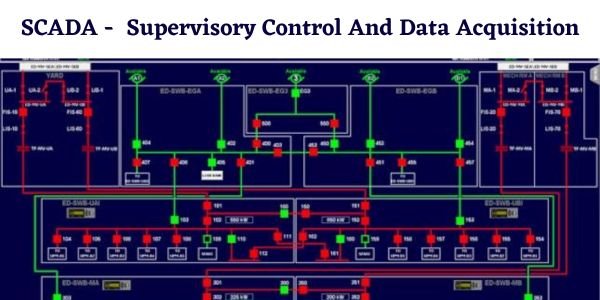
The full form of SCADA is Supervisory Control and Data Acquisition. It is a control system architecture that collects measurements from equipment spread over a wide area, brings them to a central control room over a communication network, displays them to an operator on a screen, stores them, raises alarms, and sends back commands such as open a valve or trip a breaker. Read the name in two halves: data acquisition is the reading, supervisory control is the commanding.
The word “supervisory” is doing real work in that name. SCADA usually does not run the fast closed control loop itself. A local controller in the field holds the loop, and SCADA watches over many such controllers, changes their set points and lets a human step in. That distinction is what separates SCADA from a DCS and from a bare PLC, and it is covered in the comparison table below.
SCADA full form and what each word means
| Letter | Word | What it refers to in the system |
|---|---|---|
| S | Supervisory | A human operator or master station overseeing the process from a control room, not a controller in the loop |
| C | Control | Commands sent out to the field: start a pump, close an isolator, change a set point |
| A | And | – |
| D | Data | Measurements and status: voltage, current, flow, pressure, level, breaker open or closed |
| A | Acquisition | Polling those points from field devices at a fixed interval and time-stamping them |
A note on the search term “SCADA full form in civil engineering”. The expansion does not change by branch. Civil and environmental engineers meet SCADA in water supply schemes, sewage treatment plants, dam gate operation and irrigation canals, where it does the same job of remote monitoring and remote control. Electrical engineers meet it in substations and distribution networks, and mechanical or chemical engineers in pumping stations and pipelines.
What does a SCADA system actually do?
Five functions, in the order an operator experiences them:
- Acquire data. Read thousands of field points on a repeating cycle, typically every 2 to 10 seconds for a distribution network, faster for critical points.
- Display. Draw the plant or network as a mimic diagram on the HMI, with live values, colour-coded equipment states and trend curves.
- Alarm. Compare each value against limits and raise an alarm when it crosses one, with priority, time stamp and an acknowledgement trail showing who saw it.
- Control. Accept an operator command, check it is permitted, send it to the field device and confirm the device actually moved. Serious commands use select-before-operate: the operator selects the point, the field device echoes back what it thinks was selected, and only then is execute sent.
- Record. Write every value and event to a historian so that yesterday’s fault, last month’s peak load or the last year’s energy consumption can be replayed.
Layers of a SCADA system
A SCADA installation is built in five layers, bottom to top.
1. Field instruments (level 0)
Sensors and final control elements sitting on the equipment. Current transformers and potential transformers in a substation; pressure transmitters, electromagnetic flow meters, ultrasonic level sensors, RTDs and thermocouples in a plant. Analogue signals are usually 4-20 mA, which is preferred over 0-10 V because a broken wire reads 0 mA and is instantly distinguishable from a genuine zero. Digital status points are dry contacts at 24 V or 110 V DC. On the output side sit motor starters, solenoid valves, actuators and trip coils.
2. Field controllers: RTU and PLC (level 1)
These are the devices that talk to the instruments and convert their signals into digital values. An RTU (Remote Terminal Unit) is the usual choice at an unmanned remote site, because it is built for wide temperature swings, runs on station battery power and is designed around communications. A PLC (Programmable Logic Controller) is the usual choice inside a plant where there is mains power, shelter and heavy local logic to run. Modern devices blur the line and many products do both jobs. We cover the field device in detail in a separate article on the RTU, its functions and RTU vs PLC, so this page stays at the system level.
3. Communication layer (level 2)
The link between the field and the control room. Media in Indian installations include optical fibre along transmission lines, power line carrier communication, licensed VHF/UHF radio, leased lines, and cellular data with a VPN for scattered sites such as tube wells.
The protocols that matter:
| Protocol | Where it is used | Notes |
|---|---|---|
| Modbus RTU / Modbus TCP | Plant floor, meters, drives | Simple, very widely supported, no built-in security |
| DNP3 | Power and water utilities | Report-by-exception and time-stamped events |
| IEC 60870-5-101 / -104 | Utility SCADA in India and Europe | -101 serial, -104 over TCP/IP |
| IEC 61850 | Inside modern substations | Station bus and process bus, GOOSE messaging |
| OPC UA | Between SCADA and IT systems | Platform independent, supports encryption |
4. SCADA server and HMI (level 3)
The master station. Its heart is the tag database, one record per monitored point holding the current value, engineering units, scaling, quality flag, alarm limits and time stamp. Around it sit the polling engine, the alarm engine, the command handler and the graphics server that renders mimic screens. Control rooms of any importance run the server in a redundant hot-standby pair, so a failed primary hands over in seconds without losing the tag database.
The HMI (Human Machine Interface) is what the operator actually sees: single-line diagrams, pump station schematics, trends, alarm lists and reports.
5. Historian and enterprise interface (level 4)
The historian is a time-series database tuned for storing millions of tag values a day for years. It compresses data by exception, storing a new point only when the value moves outside a deadband, which cuts storage massively without losing the shape of a trend. From here the data feeds energy accounting, billing, maintenance planning and management dashboards on the corporate network.
SCADA data flow, step by step
- A sensor in the field converts a physical quantity into a 4-20 mA signal or a contact state.
- The field controller’s input card samples that signal, converts it to digital, scales it into engineering units and time-stamps it.
- The master station polls the controller on its scan cycle, or the controller reports a change on exception if the protocol supports it. A poll sends a short request and expects a response within a set timeout.
- The received value lands in the tag database and updates the mimic screen. If the response does not arrive, the tag is marked bad quality rather than showing a stale number as if it were live, which is an important safety behaviour.
- The alarm engine compares the value with its limits and, if breached, generates an alarm with priority and time.
- The historian writes the value if it has moved beyond the deadband since the last stored sample.
- The operator decides to act and issues a command. The system checks permissions and interlocks, runs select-before-operate, and sends the command down to the field controller.
- The controller drives the output. The resulting change in equipment status is picked up as a data point on the next cycle and shown back on the screen, closing the loop through the human.
SCADA vs DCS vs PLC
All three are industrial control, and students mix them up constantly. The fastest way to separate them: a PLC is one controller, a DCS controls one plant, and SCADA supervises many sites.
| Aspect | SCADA | DCS | PLC |
|---|---|---|---|
| Full form | Supervisory Control and Data Acquisition | Distributed Control System | Programmable Logic Controller |
| Geography | Wide area: a city, a grid, a pipeline of hundreds of kilometres | One plant or one process unit | One machine, line or panel |
| Main purpose | Monitoring and supervisory commands over many remote sites | Continuous closed-loop process control | Fast discrete and sequence logic |
| Who closes the loop | The field controller, or the operator | The DCS controllers themselves, continuously | The PLC itself |
| Typical cycle | Poll every 2-10 seconds | 100-500 ms control loops | 1-100 ms scan |
| Communication | WAN: radio, fibre, leased line, cellular, often unreliable links | Dedicated plant network, high reliability | Local I/O bus or fieldbus |
| Behaviour if the link drops | Field site keeps running standalone; operator loses visibility | Unacceptable; the network is engineered not to drop | Not applicable |
| Engineering focus | Event driven, communications, alarms | Process driven, loop tuning | Logic driven, ladder programs |
| Typical industries | Power distribution, water supply, oil and gas pipelines, railways | Refineries, chemicals, cement, large thermal power plants | Manufacturing, packaging, material handling |
In practice the three overlap. A big SCADA system is fed by hundreds of PLCs, and modern DCS products include SCADA-style remote monitoring. The label often follows the vendor’s marketing more than the architecture.
SCADA applications in India
Power distribution and transmission
Every State Load Despatch Centre, the Regional Load Despatch Centres and the National Load Despatch Centre operated by Grid Controller of India run SCADA with an energy management system on top, watching frequency, line flows and generation schedules in real time. At the distribution end, the Revamped Distribution Sector Scheme (RDSS), launched in 2021, funds SCADA and distribution management systems for urban distribution areas, which is why so many state discoms have been commissioning new control centres. The payoff is measured in outage duration: an operator who can see which feeder tripped and switch a remote sectionaliser restores supply in minutes instead of sending a van to find the fault.
Water supply and waste water
Urban water schemes under AMRUT and 24×7 water supply projects use SCADA to monitor reservoir levels, pump running status, flow at district metering areas and residual chlorine, and to start and stop pumps from a central room. Because leakage is the dominant loss in Indian water networks, flow balance across district metering areas is often the main reason the SCADA is installed at all. Irrigation departments use the same setup for canal gate positions and dam levels.
Oil, gas and pipelines
Cross-country crude, product and gas pipelines are the textbook SCADA case: unmanned stations every few tens of kilometres, a single control centre, and a system watching pressure and flow at each station. Comparing inflow with outflow across a segment gives a leak detection signal, and the control centre can shut isolation valves remotely. Refinery tank farms, city gas distribution networks and LPG bottling plants use SCADA for inventory and safety monitoring.
Other sectors
Metro rail uses SCADA for traction power, tunnel ventilation and station services. Railways use it for traction substations. Large buildings and campuses use the same ideas under the name building management system. Solar and wind farms use SCADA to track per-inverter and per-turbine generation and availability.
SCADA security concerns
SCADA was designed in an era when the network was private and physically separate, so the older protocols carry no authentication and no encryption. A device that receives a correctly formatted Modbus or IEC 60870-5-104 command obeys it, without asking who sent it. As control networks have been connected to corporate IT for reporting, and to cellular links for remote sites, that assumption has stopped holding.
The main exposures:
- The air gap is usually a myth. Engineering laptops, vendor remote-support connections, USB drives and shared historians bridge the supposed gap.
- Unauthenticated protocols. Anyone with network access can inject a valid-looking command or replay a captured one.
- Long-lived, unpatched systems. A control room commissioned a decade ago may still run an operating system that no longer receives security updates, because the SCADA vendor has not certified anything newer.
- Weak remote access. Shared passwords, default credentials on field devices, and remote desktop exposed to the internet.
- Consequences are physical. An IT breach leaks data; an operational technology breach can open a breaker, overspeed a machine or spill a tank.
Two incidents defined the field. Stuxnet, discovered in 2010, altered the speed of centrifuges through their controllers while reporting normal values to the operators. The December 2015 attack on Ukrainian distribution utilities left about 225,000 customers without power after intruders operated breakers through the utilities’ own control systems.
What good practice looks like now: segment the control network from IT using the Purdue model levels and a demilitarised zone, use unidirectional gateways or data diodes where data only needs to flow outward to the historian, apply the IEC 62443 series of standards for industrial automation security, move to authenticated protocol variants such as secure DNP3 and OPC UA with certificates, enforce per-user accounts with role-based rights and full command logging, monitor the control network for traffic that should never occur, and keep tested offline backups of the SCADA configuration. In India, power and water are designated critical infrastructure sectors, so utilities also follow the advisories issued by NCIIPC and CERT-In.
References
- Data acquisition system – an overview, ScienceDirect Topics.
- IEC 62443 series, Security for industrial automation and control systems, International Electrotechnical Commission.
- Revamped Distribution Sector Scheme (RDSS) guidelines, Ministry of Power, Government of India.
FAQs
What is the full form of SCADA?
SCADA stands for Supervisory Control and Data Acquisition. It is a control system architecture that acquires data from field devices spread over a wide area, presents it to an operator in a central control room, records it, and sends supervisory commands back to the field.
What is the SCADA full form in civil engineering?
The same: Supervisory Control and Data Acquisition. The expansion does not change with the branch. In civil and environmental work, SCADA is applied to water supply networks, sewage treatment plants, dam gates and irrigation canals rather than to substations.
What are the main components of a SCADA system?
Field instruments and sensors, field controllers such as RTUs and PLCs, a communication network, the SCADA server with its tag database and alarm engine, the HMI screens an operator works on, and a historian that stores the data for later analysis.
What is the difference between SCADA and PLC?
A PLC is a single controller that runs logic on one machine or panel with a scan time of a few milliseconds. SCADA is the supervisory layer above many such controllers, often at different sites, that collects their data, shows it to an operator and sends commands. SCADA does not replace the PLC; it oversees it.
Is SCADA used in India?
Widely. Load despatch centres run SCADA with energy management systems for the grid, state distribution utilities are adding SCADA and distribution management systems under the Revamped Distribution Sector Scheme, urban water schemes use it for pumping and leakage control, and cross-country oil and gas pipelines run on it.