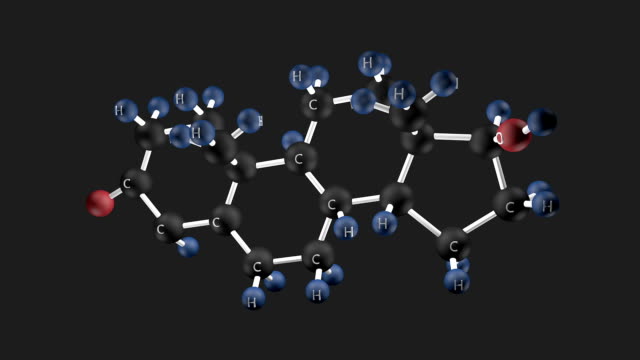
Carbon is tetravalent because it has four electrons in its outermost shell and completes its octet by sharing all four of them, forming four covalent bonds. Its valency is therefore 4. It cannot reach a stable octet by losing those four electrons or by gaining four more, because either route costs far too much energy for such a small atom. Sharing is the only affordable option, and that single fact is what gives carbon its four-bond chemistry, its ability to chain to itself, and the several million carbon compounds now known.
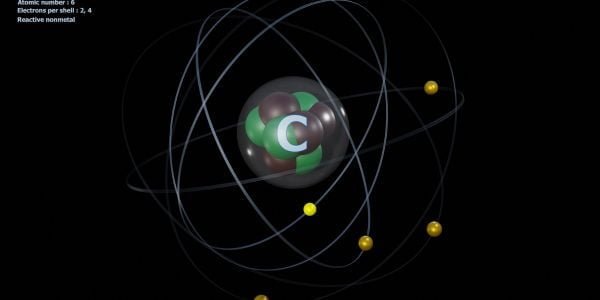
Carbon’s atomic structure: where the four comes from
Carbon has atomic number Z = 6, so a neutral carbon atom has 6 protons and 6 electrons. Those electrons fill up as:
- Full notation: 1s2 2s2 2p2
- Shell notation: K = 2, L = 4, usually written (2, 4)
The two 1s electrons are core electrons and take no part in bonding. The four electrons in the second shell, two in 2s and two in 2p, are the valence electrons. Four valence electrons, four bonds, valency 4. That is tetravalency in one line, and everything below explains why carbon settles on that route rather than another.
Why carbon shares electrons instead of gaining or losing them
An atom with four valence electrons has three arithmetic options for reaching a stable octet. Two of them are ruled out by energy.
Losing four electrons to form C4+
Stripping four electrons off a carbon atom needs the sum of its first four ionisation energies. Those are approximately 1086, 2353, 4621 and 6223 kJ/mol, giving a total of roughly 14,280 kJ/mol. No ordinary chemical reaction releases anything close to that. The reason the figures climb so steeply is that each electron removed leaves a more positive ion holding the remaining electrons more tightly, and carbon’s nucleus of only 6 protons is already gripping a very small atom.
Gaining four electrons to form C4-
The first added electron is easy enough: carbon’s electron gain enthalpy is about -122 kJ/mol, so that step releases energy. The next three do not. Each extra electron must be pushed into an ion that is already negative, against increasing electron-electron repulsion, and a nucleus with only 6 protons cannot hold ten electrons in a shell that small. Building C4- is strongly endothermic.
Sharing four electrons
Sharing costs nothing in ionisation or electron-gain terms and gives every atom involved a completed octet. Carbon contributes one electron to each of four shared pairs and counts all eight electrons as its own. The result is four covalent bonds, which is the defining behaviour of carbon and the reason organic chemistry is covalent chemistry.
Ground state, excited state and hybridisation
The simple picture above has one gap, and this is the part examiners actually test. Write out the ground state properly:
Ground state: 1s2 2s2 2px1 2py1 2pz0
The 2s orbital is full and paired. Only two orbitals, 2px and 2py, hold unpaired electrons. On that configuration alone carbon should be divalent and methane should be CH2. It is not. Something has to change first.
The excited state
One of the paired 2s electrons is promoted into the empty 2pz orbital:
Excited state: 1s2 2s1 2px1 2py1 2pz1
Now there are four unpaired electrons in four separate orbitals, and carbon can form four bonds. The promotion costs about 406 kJ/mol (roughly 4.2 eV), which looks expensive until you count what it buys. In methane it allows two extra C-H bonds to form at about 413 kJ/mol each, about 826 kJ/mol returned against 406 kJ/mol spent. The atom is several hundred kJ/mol better off, so the promotion happens.
Why the four bonds are identical
One further problem remains. After promotion, the four orbitals are not the same: one is a 2s orbital and three are 2p orbitals with different shapes and energies. That should make one C-H bond in methane different from the other three. Experiment says all four are identical in length and strength.
Hybridisation resolves this. The one 2s and three 2p orbitals mix to produce four new, equivalent orbitals of intermediate energy called sp3 hybrid orbitals. Each has 25% s character and 75% p character, each holds one electron, and mutual repulsion pushes them as far apart as possible, which for four orbitals is a tetrahedron with an angle of 109.5° (109°28′) between any two.
Carbon does not always mix all three p orbitals. How many it mixes sets the geometry.
| Hybridisation | Orbitals mixed | s character | Shape | Bond angle | Example | C-C bond length | C-C bond energy |
|---|---|---|---|---|---|---|---|
| sp3 | One 2s + three 2p, giving four sp3 orbitals | 25% | Tetrahedral | 109.5° | Methane CH4, ethane C2H6, diamond | C-C single, 154 pm | About 348 kJ/mol |
| sp2 | One 2s + two 2p, giving three sp2 orbitals and one unhybridised p | 33% | Trigonal planar | 120° | Ethene C2H4, benzene, graphite | C=C double, 134 pm | About 614 kJ/mol |
| sp | One 2s + one 2p, giving two sp orbitals and two unhybridised p | 50% | Linear | 180° | Ethyne C2H2, carbon dioxide | C≡C triple, 120 pm | About 839 kJ/mol |
Methane, ethene and ethyne worked through
Methane, CH4, sp3. Four sp3 orbitals overlap head-on with four hydrogen 1s orbitals. Four identical sigma bonds, C-H length about 109 to 110 pm, H-C-H angle 109.5°, shape tetrahedral. The valency of carbon here is unambiguously 4.
Ethene, C2H4, sp2. Each carbon uses three sp2 orbitals for three sigma bonds, one to the other carbon and two to hydrogens. The leftover unhybridised p orbital on each carbon lies perpendicular to that plane, and the two overlap sideways to form a pi bond. So the C=C double bond is one sigma plus one pi. The molecule is flat, the ideal angle is 120°, and the measured values are close to it (H-C-H about 117°, H-C=C about 121°). The pi bond blocks rotation about the C=C axis, which is what makes geometrical isomerism possible. Each carbon still forms four bonds in total: two single bonds plus a double bond counted as two.
Ethyne, C2H2, sp. Each carbon uses two sp orbitals, one to the other carbon and one to a hydrogen, and keeps two unhybridised p orbitals that form two pi bonds at right angles. The C≡C triple bond is one sigma plus two pi. The molecule is linear at 180°, the shortest and strongest carbon-carbon bond of the three. Again, four bonds per carbon.
Notice the pattern down the table: more s character shortens the bond and raises its energy, 154 pm at 348 kJ/mol, 134 pm at 614 kJ/mol, 120 pm at 839 kJ/mol. Shorter bonds are stronger bonds.
Catenation: carbon bonding to itself
Catenation is the ability of an element to form bonds with atoms of its own kind, producing chains and rings. Carbon does this better than any other element. Chains can be straight or branched, they can close into rings of three, four, five, six or more carbons, and the bonds along them can be single, double or triple in any combination.
Tetravalency makes this possible. Each carbon in a chain uses two of its four bonds to hold the neighbours on either side and still has two bonds left for hydrogen or any other group, so a chain can grow without running out of bonding capacity.
Why carbon beats silicon at catenation
Silicon sits directly below carbon in group 14 and also has four valence electrons, so it is also tetravalent. Yet silicon chains beyond two or three atoms are rare and unstable, while carbon chains run to thousands of atoms in polymers. The numbers explain it.
| Bond | Bond length | Mean bond enthalpy |
|---|---|---|
| C-C | 154 pm | About 348 kJ/mol |
| Si-Si | 233 pm (measured in disilane, Si2H6) | Quoted between about 226 and 297 kJ/mol depending on the table used |
| C-H | About 109 pm | About 413 kJ/mol |
| Si-H | 148 pm (disilane) | About 318 kJ/mol |
Two things follow. Carbon is the smaller atom, so its 2p orbitals are compact and overlap efficiently; silicon bonds through larger, more diffuse 3p orbitals, so the Si-Si bond is both longer and weaker on every published set of values. And the Si-H bond is weaker than C-H, so a silicon chain is vulnerable at its hydrogens as well as along its backbone. Silanes are consequently unstable above about three silicon atoms, ignite readily in air and hydrolyse in alkali, where the equivalent alkanes are unreactive enough to be bottled as cooking gas.
There is a third reason. The Si-O bond is very strong, around 452 kJ/mol, so oxidation of a silicon chain to silicate is strongly favoured. That is why silicon in nature occurs as silicates and silica rather than as silicon chains, while carbon chains survive.
Isomerism: the second consequence of four bonds
Isomers are compounds with the same molecular formula but different arrangements of atoms. Tetravalency plus catenation makes them inevitable, because once a chain has four or more carbons there is more than one way to connect them while giving every carbon its four bonds.
Butane, C4H10, is the first alkane to show it: a straight chain (n-butane) and a branched chain (isobutane, or 2-methylpropane). Both satisfy every valency, and both are real, separable substances with different boiling points. The count then grows fast.
| Alkane | Formula | Structural isomers |
|---|---|---|
| Butane | C4H10 | 2 |
| Pentane | C5H12 | 3 |
| Hexane | C6H14 | 5 |
| Decane | C10H22 | 75 |
| Eicosane | C20H42 | 366,319 |
The common types you will meet at school and first-year level:
- Chain isomerism. Same formula, different carbon skeleton, as in n-butane and isobutane.
- Position isomerism. Same skeleton, the functional group sits on a different carbon, as in propan-1-ol and propan-2-ol.
- Functional group isomerism. Same formula, different functional group entirely. C2H6O is both ethanol and dimethyl ether.
- Geometrical isomerism. Cis and trans forms, possible because the pi bond of a C=C locks rotation, as in but-2-ene.
- Optical isomerism. A tetrahedral sp3 carbon carrying four different groups is chiral, so the molecule and its mirror image cannot be superimposed. This depends directly on the tetrahedral geometry that tetravalency produces.
Put catenation and isomerism together and the arithmetic explodes. Carbon chains of unlimited length, multiple ways to arrange each chain, and a wide choice of functional groups to hang on it: that combination, not any single property, is why several million carbon compounds are known while most other elements manage a few hundred.
Allotropes of carbon, read through hybridisation
Carbon’s allotropes are pure carbon in different structures, and each one is simply a different hybridisation repeated through a solid.
- Diamond, sp3. Every carbon is bonded tetrahedrally to four others at 154 pm, building one continuous three-dimensional covalent network. All four valence electrons are locked in sigma bonds, so diamond has no mobile charge carriers and does not conduct electricity, while the stiff, uniform lattice makes it the hardest natural substance (Mohs 10) and an outstanding conductor of heat.
- Graphite, sp2. Each carbon bonds to three others in flat hexagonal sheets with an in-plane bond length of about 142 pm, shorter than diamond’s because of partial double-bond character. The fourth electron sits in an unhybridised p orbital and is delocalised across the sheet, so graphite conducts electricity along its layers. The sheets are about 335 pm apart and held only by weak van der Waals forces, which lets them slide. That is why the same element is the hardest material in one form and a lubricant and pencil lead in another.
- Fullerene, mainly sp2. C60 is a closed cage of 60 carbon atoms arranged as 20 hexagons and 12 pentagons, the pattern of a football. The curvature forces the sp2 carbons slightly out of plane. Its discovery earned the 1996 Nobel Prize in Chemistry.
- Graphene, sp2. A single graphite sheet, one atom thick. Isolating it earned the 2010 Nobel Prize in Physics, and it is now studied for transparent electrodes, sensors and composites.
Why tetravalency matters beyond the exam
Every biomolecule is built on it. Proteins are chains of amino acids joined through carbon and nitrogen backbones, DNA runs on a sugar-phosphate chain, and carbohydrates are rings and chains of carbon carrying hydroxyl groups. Fats are long hydrocarbon chains with a carboxyl head.
Engineering materials follow the same logic. Polymers such as polyethylene, PVC, nylon and PET are long catenated carbon chains with different side groups. Carbon fibre is aligned graphitic carbon, giving very high specific strength for aerospace and sports equipment. Activated carbon filters water and air by surface adsorption. Silicon carbide and tungsten carbide are hard, high-temperature ceramics. Petrol, diesel and LPG are mixtures of catenated hydrocarbons sorted by chain length.
A study tip for board exams: tetravalency questions are almost always answered with the same four moves. State the configuration (2, 4). Rule out C4+ and C4- on energy grounds. Show the promotion from 2s to 2p and the hybridisation that follows. Then name the geometry and angle for the example asked. Write them in that order and the answer is complete.
References
- NCERT Chemistry – Carbon and its Compounds, Class 10 Science and Class 11 Chemistry (chemical bonding and molecular structure; the p-block elements).
- Standard mean bond enthalpy and bond length tables for group 14 elements.
- Gas-phase electron diffraction data for disilane, Si2H6.
FAQs
Why is carbon tetravalent?
Because a carbon atom has four electrons in its outermost shell and shares all four to complete its octet, forming four covalent bonds. It cannot lose them, since removing four electrons needs about 14,280 kJ/mol, and it cannot gain four, since a nucleus of only 6 protons cannot hold ten electrons against their mutual repulsion. Sharing is the only route open to it, so the valency of carbon is 4.
What is the electron configuration of carbon in the ground and excited states?
In the ground state carbon is 1s2 2s2 2px1 2py1, written (2, 4), with only two unpaired electrons. In the excited state one 2s electron is promoted to the empty 2pz orbital, giving 1s2 2s1 2px1 2py1 2pz1 and four unpaired electrons. The promotion costs about 406 kJ/mol and is repaid by the two extra bonds formed.
What are the bond angles in sp3, sp2 and sp hybridised carbon?
An sp3 carbon is tetrahedral with bond angles of 109.5°, as in methane. An sp2 carbon is trigonal planar with angles of 120°, as in ethene. An sp carbon is linear with an angle of 180°, as in ethyne. The bond shortens and strengthens as s character rises: 154 pm and about 348 kJ/mol for C-C, 134 pm and about 614 kJ/mol for C=C, 120 pm and about 839 kJ/mol for the carbon-carbon triple bond.
What is catenation and why is carbon better at it than silicon?
Catenation is an element’s ability to bond to atoms of its own kind and form chains and rings. Carbon is the smaller atom, so its compact 2p orbitals overlap efficiently and the C-C bond is short at 154 pm and strong at about 348 kJ/mol. Silicon bonds through larger 3p orbitals, giving an Si-Si bond of 233 pm that is weaker on every published table, and a weaker Si-H bond of about 318 kJ/mol against 413 kJ/mol for C-H. Silanes therefore decompose, ignite in air and hydrolyse where alkanes are stable.
How does tetravalency lead to millions of carbon compounds?
Four bonds let each carbon hold two chain neighbours and still have two bonds free for other atoms, so chains and rings can grow without limit. Once a chain has four or more carbons there is more than one valid arrangement, which produces isomers: 2 for butane, 3 for pentane, 5 for hexane, 75 for decane and 366,319 for C20H42. Unlimited chain length, multiple arrangements per formula and a wide choice of functional groups together give several million known carbon compounds.