
Engineering at Arizona State University is taught by the Ira A. Fulton Schools of Engineering, a group of eight schools that enrolled 32,378 students in Fall 2025 and is the largest engineering programme in the United States by enrolment. On the ASU engineering ranking most readers are looking for, the Fulton Schools state #20 for undergraduate and #23 for graduate engineering among public universities in the U.S. News 2025-26 tables, and #12 for online engineering master’s degrees. Most engineering degrees sit on the Tempe campus, with manufacturing, robotics, aviation and several technology degrees on the Polytechnic campus in Mesa and a newer School of Integrated Engineering in the West Valley.
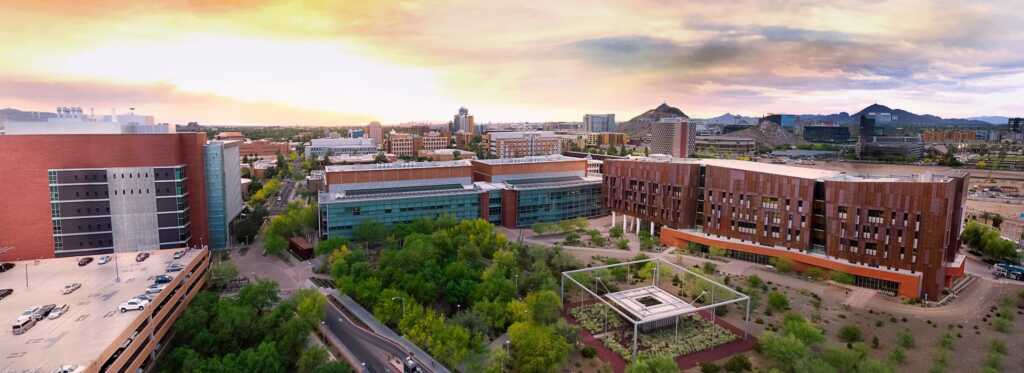
This page is written for an Indian student deciding whether to apply. Everything date-bound below is stated with the year it applies to and the ASU page it came from, because tuition, test minimums and deadlines at ASU are reset every year.
What exactly is the ASU engineering ranking?
Three separate claims get mixed together in study-abroad marketing, so it is worth separating them.
- U.S. News engineering ranks. The Fulton Schools’ own homepage states #20 undergraduate engineering and #23 graduate engineering among public universities in the U.S. News 2025-26 tables, and #12 for online engineering master’s programmes (2025). “Among public universities” is doing real work in that sentence; the all-institutions rank is lower.
- The innovation ranking. ASU is #1 on the U.S. News Most Innovative Schools list in the 2026 Best Colleges edition, the eleventh consecutive year it has held that spot since the category was created. This is a reputational survey in which university presidents, provosts and admissions deans nominate schools making the most innovative improvements. It is a real ranking with a real awarding body, but it measures peer perception of curriculum, faculty, campus life and technology changes, not research output or graduate salaries. Read it as “ASU experiments a lot and other universities notice”, not as a measure of teaching quality in your specific department.
- Global rankings. ASU News reports the university at 173rd in the world and 36th in the U.S. in the QS World University Rankings 2026, up from 200th the previous year.
A second, less-quoted figure says more about the engineering college than any of these. ASU’s own about page states that the Fulton Schools generated 71% of all ASU patents in 2025, 132 in total, and that this would place ASU Engineering among the top 20 patent-producing universities in the world on National Academy of Inventors data. For a student choosing a thesis group, patent throughput is a more useful signal than a survey rank.
The eight Fulton Schools and what each one covers
ASU does not have a single “department of mechanical engineering” in the way an Indian NIT does. It has eight named schools, and your degree, your adviser and your assistantship all sit inside one of them.
| School | Main subject areas |
|---|---|
| School of Biological and Health Systems Engineering | Biomedical engineering, biomedical devices, neural engineering |
| School of Computing and Augmented Intelligence | Computer science, computer systems engineering, software engineering, industrial engineering, engineering management, informatics |
| School of Electrical, Computer and Energy Engineering | Electrical engineering, power and energy systems, microelectronics, communications |
| School for Engineering of Matter, Transport and Energy | Mechanical, aerospace, chemical and materials science engineering |
| School of Sustainable Engineering and the Built Environment | Civil, construction and environmental engineering |
| School of Manufacturing Systems and Networks | Manufacturing engineering, robotics and autonomous systems (Polytechnic campus) |
| The Polytechnic School | Aviation, engineering (general), graphic information technology, human systems engineering, information technology (Polytechnic campus) |
| School of Integrated Engineering | Engineering science, including business and microelectronics concentrations (West Valley campus) |
Across those eight schools the Fulton Schools list 28 undergraduate programmes and more than 55 graduate programmes, offered in person and online. Fall 2025 enrolment split as 24,649 bachelor’s, 6,145 master’s and 1,419 doctoral students, and 7,157 degrees were awarded in 2024-25.
Which campus will you actually be on?
Tempe is the main campus and the default answer for aerospace, chemical, civil, electrical, mechanical, materials, biomedical and computer science degrees. Polytechnic, about 25 km south-east in Mesa, runs manufacturing engineering, robotics and autonomous systems, aviation and several applied technology degrees, and feels smaller and more workshop-based. West Valley hosts the newer School of Integrated Engineering.
This matters practically. Tempe sits on the light rail line into Phoenix and has the dense off-campus student rental market. Polytechnic is quieter and further out, and most students there keep a car. Check which campus your degree code is attached to before you sign a housing lease.
Undergraduate admission to ASU engineering
The Fulton Schools publish one set of criteria for first-year applicants. You need one of: an SAT combined score of 1210, an ACT composite of 24, a 3.00 ABOR GPA, or a class rank in the top 25% of your school. On top of that, the selective engineering majors (aerospace, biomedical, chemical, civil, computer science, electrical, mechanical) require every high-school maths and science competency to be complete; engineering management, informatics and software engineering allow one missing competency in maths or science, but not both.
International undergraduates must also show English proficiency: TOEFL iBT 79, IELTS 6.5, PTE 58 or Duolingo 105, as listed on the Fulton Schools admission requirements page.
Master’s admission requirements for Indian applicants
Academic record
ASU Graduate College states that competitive applicants typically have a “B” average, 3.00 on a 4.00 scale, in the last 60 semester hours or 90 quarter hours of undergraduate coursework, and that an application below that may still be considered by the department. There is no published Indian percentage cut-off, and you should not assume one. ASU carries out its own in-house credential evaluation of foreign coursework at no extra cost, and separately accepts evaluations from ECE, FCSA, ACEI and Scholaro.
On the three-year degree question that comes up constantly for B.Sc. and B.C.A. holders: ASU’s Graduate College guidance says most three-year bachelor’s degrees are not treated as equivalent to a U.S. four-year degree, but ASU will evaluate them for acceptability, and specifically notes that Indian three-year degrees involve intensive study in the major. It is a case-by-case review, not an automatic rejection and not an automatic pass. A four-year B.E./B.Tech. removes the question entirely.
GRE: required or waived?
This has changed and it is programme-specific, so check your own degree page rather than any third-party list. The Fulton Schools graduate admission page currently states: “GRE is required for PhD programs. MS degrees do not require GRE.” Individual programmes can still ask for it, and the ASU catalog entry for your specific degree is the authority. If you are targeting a funded PhD, budget for the GRE.
English test minimums
| Test | Minimum for graduate admission |
|---|---|
| TOEFL iBT (taken before 21 January 2026) | 80 |
| TOEFL iBT (taken on or after 21 January 2026) | 4, on the new score scale |
| IELTS Academic | 6.5 overall |
| PTE Academic | 60 |
| Duolingo English Test | 105 |
Those are the ASU international graduate English proficiency minimums as published in September 2026. The TOEFL change is not a typo: ETS moved the iBT to a new scale for tests taken from 21 January 2026, and ASU has set its minimum at 4 on that scale. The test must be no more than two years old at your start date. Individual programmes may set higher bars than the university minimum.
Application deadlines and the intake that is open now
ASU opens graduate applications a full year ahead. As listed on the ASU graduate admission page, the Fall 2027 application opened on 1 September 2026 and the Spring 2027 application opened on 1 February 2026. So as of September 2026, Fall 2027 is the intake to work towards.
ASU does not publish one university-wide deadline: “application deadlines are set and enforced by academic program offices”, and each degree’s page in Degree Search carries its own date. In practice, Fulton Schools programmes commonly use a 31 December or mid-January priority deadline for fall entry, because that is the round that is considered for fellowships and assistantships, with later rounds staying open for self-funded applicants. Applying by roughly mid-April for a fall start is the usual advice for international students so that the I-20 and visa interview fit in before August.
Student-facing tip: the funding deadline and the admission deadline are two different dates at ASU, and missing the earlier one usually means you can still be admitted but not considered for money. Find both on your degree’s catalog page before you start the application.
ASU engineering fees: the 2026-27 numbers
These are the figures ASU has published as approved for the 2026-27 academic year. ASU states plainly that it may increase or modify tuition and fees on Arizona Board of Regents approval, so treat them as this year’s numbers and re-check before you commit.
| Fall 2026 semester | International graduate | International undergraduate (engineering) |
|---|---|---|
| Tuition at 9 credit hours | $15,930 | n/a |
| Tuition at 12+ credit hours | $21,238 | included below |
| Total with mandatory fees, 9 hours | $16,759 | n/a |
| Total with mandatory fees, 12+ hours | $22,067 | $21,305 (College Fee 5 band: engineering, business, nursing) |
Those semester totals include the tuition surcharge, student-initiated fees, the graduate student support fee and the advanced technology fee. Nine credit hours is the normal full-time load for a graduate student, so a taught master’s student typically pays closer to the $16,759 line than the $22,067 line. A 30-credit MS is three semesters of coursework for most students, which is where the frequently quoted “about $50,000 in tuition for the degree” comes from.
ASU’s own published cost of attendance for 2026-27 puts an international graduate student at $66,646 for the year and an international undergraduate at $69,906, covering tuition, fees, on-campus housing and meals, books, travel, personal expenses, health insurance and the international student fee. At roughly ₹96 to the dollar in September 2026, that is about ₹64 lakh a year, though the rupee rate moves and you should price it yourself on the day.
Scholarships, assistantships and fellowships
ASU does not offer full-ride scholarships to international taught master’s students as a matter of course. The realistic funding routes, in order of value:
- Research or teaching assistantship (RA/TA). A 50% FTE appointment is 20 hours a week. ASU Graduate College lists an estimated minimum stipend of $26,544 for a 50% academic-year RA/TA appointment in 2026-27, and a 50% appointment carries premium coverage for ASU individual health insurance if you enrol through myASU. The appointment may carry a full or partial tuition award, shown as RA/TA remission on your student account; how much is remitted depends on the appointment, so get it in writing. ASU caps total work across all ASU positions at 25 hours a week.
- Fulton Schools fellowships. The Fulton Schools run a general fellowship application through Scholarship Universe, with the 2026-27 round having closed on 15 March 2026. Awards are merit- and need-based and funded by donors, companies and professional bodies, and some gifts are earmarked specifically for international students. Roughly 60 fellowships were awarded in the recent cycle, against a graduate population of more than 7,500, so plan around the assistantship route and treat a fellowship as upside.
- Tuition scholarships at admission. Some Fulton programmes attach a partial tuition award to strong admits. These come with the offer letter, not on request.
- On-campus work. F-1 students may work on campus up to 20 hours a week during term. It covers groceries, not tuition.
PhD admits are a different market. Funded PhD offers in the Fulton Schools usually bundle an assistantship, tuition remission and health cover, which is why the cost-benefit for a PhD looks nothing like the cost-benefit for a self-funded MS.
Living costs in Tempe
ASU’s cost-of-attendance model budgets $21,087 for on-campus housing and meals, $1,908 for books and materials and $4,785 for personal expenses over the 2026-27 year for a graduate student.
Off campus is where most Indian graduate students end up, usually sharing. Rent-tracking services put a one-bedroom in Tempe in the region of $1,270 to $1,490 a month as of August 2026 depending on whose index you read, so a shared two-bedroom split two ways lands meaningfully below the on-campus figure. Against that, budget for the Phoenix summer: electricity bills in June to August are the line item students consistently underestimate, because air conditioning runs continuously through 45 °C afternoons. The Valley Metro light rail serves Tempe campus and reduces the pressure to buy a car; Polytechnic does not have the same coverage.
OPT and STEM OPT for engineering graduates
This is the part of the calculation that actually decides whether the degree pays back. Under U.S. Immigration and Customs Enforcement rules, an F-1 student gets 12 months of post-completion Optional Practical Training at each education level, so a master’s gives you a fresh 12 months even if you used OPT after a U.S. bachelor’s.
Engineering degrees are on the STEM Designated Degree Program List, which makes you eligible for a 24-month STEM OPT extension, for a working total of 36 months. The conditions are specific: the degree must come from an accredited, SEVP-certified institution, the employer must be enrolled in E-Verify, and you and the employer must complete and sign a Form I-983 training plan. Three years of work authorisation is normally enough for two or three attempts at the H-1B lottery.
One live caution, stated as of 22 September 2026: a presidential proclamation from September 2025 introduced a $100,000 fee on certain new H-1B petitions, and it has been through several rounds of litigation with conflicting outcomes in different circuits. Its enforceability has changed more than once. Do not plan on any particular answer; check the position with your employer’s immigration counsel at the time you file.
Is ASU engineering worth it for an Indian student?
Honest version, with the arithmetic on the table.
The cost. Using ASU’s own 2026-27 graduate cost of attendance of $66,646 a year, a two-year self-funded MS is roughly $130,000 all-in, about ₹1.25 crore at September 2026 rates. Finish a 30-credit MS in three semesters instead of four and you take a meaningful bite out of that. An unfunded MS at ASU is a large loan against an uncertain U.S. job market, and nobody should sign it on the strength of a ranking line.
What you are buying. Scale, breadth and a large employer network in the Phoenix metro, which has become a serious semiconductor and microelectronics cluster. The Fulton Schools’ microelectronics and semiconductor focus, the size of the research operation and the patent output are real. So is the fact that 32,378 students means large classes and a degree where you have to go and find opportunities rather than have them handed to you.
What changes the maths. An assistantship. A 50% RA/TA with tuition remission and a $26,544 stipend turns an MS from a ₹1.25 crore outlay into something close to self-supporting. Assistantships are competitive and mostly go to students who contacted faculty early, have research output or a strong CGPA, and applied in the first round. If you are applying to ASU purely self-funded with no plan for funding and no clear specialisation, the return is much weaker than the brochure suggests.
Who it suits. Students with a four-year B.E./B.Tech., a clear target area (semiconductors, power systems, robotics, computing, construction), the maths to be competitive for an assistantship, and a realistic plan for the three OPT years. Students hoping a U.S. master’s will by itself produce a job offer should compare the total cost against an M.Tech. in India or a funded PhD elsewhere before signing anything.
Placement and salary figures for ASU engineering graduates circulate widely on study-abroad sites and are rarely sourced. This page does not repeat them. Ask the specific programme office for their own graduate outcome data and treat anything else as marketing.
References
- Ira A. Fulton Schools of Engineering, ranking statements and school listing, accessed 22 September 2026.
- Fulton Schools enrolment and degrees granted, Fall 2025 21st-day census.
- ASU Academic Catalog, Fall 2026 graduate tuition and fees, approved for 2026-27.
- ASU Academic Catalog, Fall 2026 international undergraduate tuition and fees.
- ASU international graduate English proficiency requirements.
- ASU graduate student admission, GPA benchmark and application opening dates.
- Fulton Schools undergraduate admission requirements.
- U.S. Immigration and Customs Enforcement, Practical Training, OPT and 24-month STEM OPT extension.
- U.S. News Most Innovative National Universities, 2026 edition.
- Ira A. Fulton, the Arizona construction entrepreneur whose 2003 gift named the schools.
FAQs
What is the ASU engineering ranking?
The Ira A. Fulton Schools of Engineering state #20 for undergraduate engineering and #23 for graduate engineering among public universities in the U.S. News 2025-26 tables, and #12 for online engineering master’s programmes in 2025. Separately, ASU is #1 on the U.S. News Most Innovative Schools list in the 2026 Best Colleges edition, its eleventh year in that position, and ASU reports a QS World University Rankings 2026 position of 173rd globally.
How many schools make up the Fulton Schools of Engineering?
Eight: Biological and Health Systems Engineering; Computing and Augmented Intelligence; Electrical, Computer and Energy Engineering; Engineering of Matter, Transport and Energy; Sustainable Engineering and the Built Environment; Manufacturing Systems and Networks; The Polytechnic School; and the School of Integrated Engineering. Together they run 28 undergraduate and more than 55 graduate programmes across the Tempe, Polytechnic and West Valley campuses and online.
Is the GRE required for an MS at ASU engineering?
The Fulton Schools graduate admission page states that the GRE is required for PhD programmes and that MS degrees do not require it. Requirements are set programme by programme and can change, so check the ASU catalog entry for your specific degree before deciding to skip the test. If you are applying for a funded PhD place, plan on taking the GRE.
How much does ASU engineering cost for an international student in 2026-27?
For Fall 2026, international graduate tuition and mandatory fees are $16,759 at a nine-credit full-time load and $22,067 at 12 or more credits per semester, per the ASU academic catalog for 2026-27. International undergraduates in the engineering fee band pay $21,305 per semester. ASU’s published full cost of attendance for 2026-27, including housing, food, books, insurance and personal expenses, is $66,646 for an international graduate student and $69,906 for an international undergraduate.
Can an Indian student with a three-year bachelor’s degree apply to ASU for a master’s?
Yes, but it is reviewed case by case. ASU Graduate College guidance says most three-year bachelor’s degrees are not considered equivalent to a U.S. four-year degree, while noting that Indian three-year degrees involve intensive study in the major, and ASU evaluates them for acceptability rather than rejecting them automatically. ASU performs its own credential evaluation at no extra cost. A four-year B.E. or B.Tech. avoids the question.
Related Topics on EngineeringHulk
- 👉 Charlotte Engineering Early College: Programs & Overview