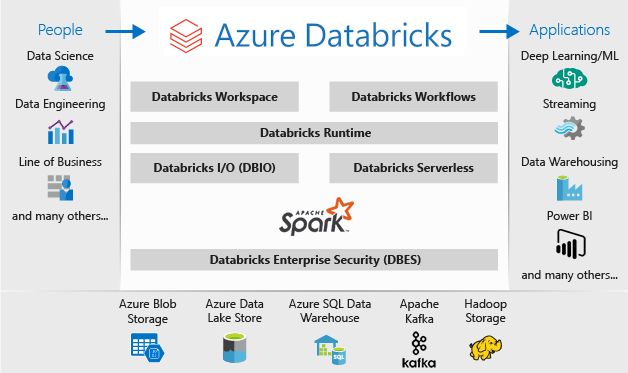
Databricks is a cloud platform for processing large amounts of data, building data pipelines, running analytics and training machine learning models in one place. It is built on Apache Spark and runs on top of AWS, Microsoft Azure and Google Cloud, so companies use their existing cloud storage while Databricks provides the compute, notebooks, SQL engine and governance. Databricks calls this design a “data lakehouse”: the cheap storage of a data lake combined with the reliability and speed of a data warehouse.
Databricks is also the name of the company behind the platform, founded in 2013 by the researchers at UC Berkeley who created Apache Spark.
What does Databricks do?
In practice, teams use Databricks for four main jobs:
- Data engineering: ingesting raw data from apps, databases and files, cleaning it and loading it into reliable tables on a schedule (ETL/ELT pipelines).
- Analytics and BI: running SQL queries and dashboards on those tables, often from tools such as Power BI or Tableau.
- Data science and machine learning: exploring data in notebooks, training models in Python, tracking experiments and deploying models.
- Generative AI: building applications on large language models using the company’s own data, with governance over who can see what.
Main parts of the Databricks platform
| Component | What it does |
|---|---|
| Apache Spark | The distributed engine that splits big jobs across many machines in a cluster. |
| Delta Lake | An open-source table format on cloud storage that adds ACID transactions, versioning (“time travel”) and schema checks to data lake files. |
| Notebooks | Collaborative notebooks that mix Python, SQL, Scala and R, similar to Jupyter. |
| Databricks SQL | SQL warehouses for fast queries and dashboards. |
| Workflows / Jobs | Scheduling and orchestration of pipelines and notebooks. |
| Unity Catalog | Central governance: permissions, lineage and auditing for tables, files and models. |
| MLflow | Open-source tool (created by Databricks) for tracking ML experiments and managing models. |
| Photon | A faster query engine written in C++ that speeds up SQL and DataFrame workloads. |
How Databricks works, step by step
- Your data sits in your own cloud storage, such as Amazon S3, Azure Data Lake Storage or Google Cloud Storage.
- You create a cluster (a group of virtual machines) or use serverless compute. Databricks starts and manages Spark on it.
- You write code in a notebook or SQL editor. Spark splits the work across the cluster so a job on terabytes of data runs in parallel.
- Results are saved as Delta tables, which other users, dashboards and ML models can read safely.
- When the job finishes, clusters can shut down automatically, so you pay only while they run.
Why companies choose Databricks
- One platform for many roles: data engineers, analysts and data scientists work on the same copy of the data instead of moving it between separate systems.
- Open formats: data is stored in open formats (Delta Lake, Parquet), which reduces lock-in.
- Scale: Spark handles data far larger than a single computer’s memory.
- Multi-cloud: the same platform runs on AWS, Azure and Google Cloud.
Limitations to know: costs can climb if clusters are left running or sized badly; small datasets do not need a distributed platform at all; and teams need Spark and cloud skills to use it well.
How Databricks pricing works
Databricks charges in Databricks Units (DBUs), a unit of processing capacity billed per second of use. The DBU rate depends on the workload type (jobs, SQL, all-purpose notebooks) and the plan. On top of that you pay your cloud provider for the underlying virtual machines and storage, unless you use serverless compute where Databricks bundles the machine cost. Check the official pricing page for current rates, because they differ by cloud and region.
Databricks vs Snowflake (quick comparison)
| Point | Databricks | Snowflake |
|---|---|---|
| Origin | Data lake and Spark, moved towards warehousing | Cloud data warehouse, moved towards data science |
| Strongest at | Data engineering, ML and AI on large, varied data | SQL analytics with minimal tuning |
| Main languages | Python, SQL, Scala, R | SQL, with Python through Snowpark |
| Storage | Open Delta tables in your own cloud storage | Managed internal storage (Iceberg tables also supported) |
Why engineering students should know Databricks
Data engineering and ML engineering job listings in India frequently ask for Spark and Databricks experience. You can learn it without spending money using Databricks’ free edition for learners, and the Databricks Certified Data Engineer Associate exam is a common first certification. A good first project: load a public dataset into Delta tables, clean it with PySpark, and build a simple dashboard in Databricks SQL.
Frequently asked questions
What is Databricks in simple words?
Databricks is a cloud service where companies store, clean, analyse and learn from very large datasets, using Apache Spark underneath and notebooks or SQL on top.
Is Databricks a database?
Not exactly. It is a data and AI platform. Data is kept in open-format tables (Delta Lake) in cloud storage, and Databricks provides the engines to query and process it.
Is Databricks the same as Apache Spark?
No. Spark is the open-source processing engine; Databricks is a managed commercial platform built around Spark by the people who created it, with extra tools for governance, SQL and machine learning.
Which language is used in Databricks?
Python (PySpark) and SQL are the most common. Scala and R are also supported in Databricks notebooks.
Is Databricks free?
There is a free edition for learning. Business use is paid per use in Databricks Units plus the cost of the cloud infrastructure.