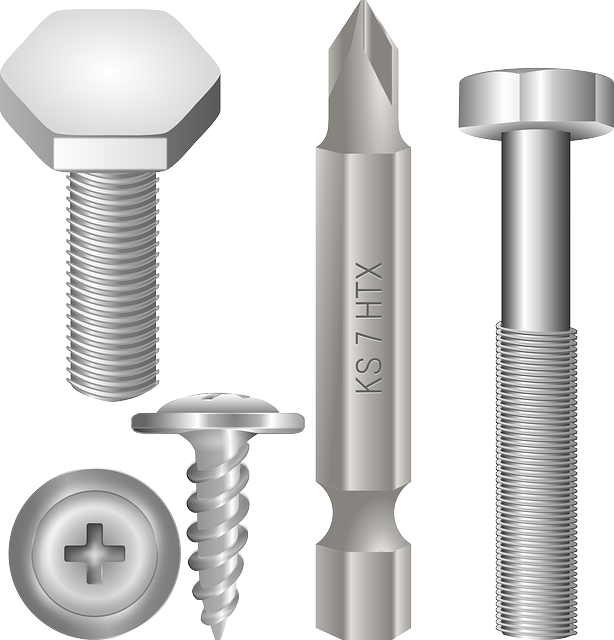
A bolt is an externally threaded male fastener with a head at one end; a nut is an internally threaded female block that screws onto it. They are not alternatives, they are a pair: the bolt passes through clearance holes in the parts and the nut is tightened against the far face, stretching the bolt so it clamps the joint. The follow-up question is bolt versus screw: a bolt is tightened by turning a nut, while a screw threads into a tapped hole in the part itself, so the same hex-head fastener is a bolt in one job and a screw in the other.
Nut vs bolt: comparison table
| Parameter | Bolt | Nut |
|---|---|---|
| Thread | External (male), on the shank | Internal (female), tapped through |
| Driven by | Held still with a spanner | Turned to develop clamping force |
| Load path | Tension along its axis, shear across the joint faces | Turns bolt tension into bearing pressure on the joint face |
| Grading | Two-part class: 4.6, 8.8, 10.9, 12.9 | Single number: 5, 8, 10, 12 |
| Standards | IS 1364, ISO 4014/4017; properties ISO 898-1 | IS 1364, ISO 4032; properties ISO 898-2 |
How a nut and bolt hold a joint
The common picture is that the bolt pins the plates together. In a properly made joint it does not. Tightening the nut stretches the bolt elastically by a few hundredths of a millimetre, so it acts as a stiff spring. That stretch is preload, and the clamping force it creates squeezes the plates so hard that friction between the faces carries the load.
- A loose bolt is a failing bolt. Lose preload and the plates move, the bolt starts taking shear and bending, and fatigue cracks begin at the first thread root.
- The nut must be at least as strong as the bolt, or its threads strip first.
Types of bolts
- Hex bolt – the general structural and machine fastener (IS 1364, ISO 4014).
- Carriage bolt – domed head with a square neck that bites into timber so it cannot turn.
- Flange bolt – integral washer face spreads the load and resists loosening.
- Anchor bolt – cast or chemically fixed into concrete for machine bases and base plates.
- Eye bolt – looped head for a sling. Only lifting-rated ones may be used for lifting.
- U-bolt – threaded U with a nut on each leg, clamping pipes, exhausts and springs to axles.
- Stud – headless rod threaded both ends; one end stays in the part, the other takes a nut.
- Shoulder bolt – ground unthreaded shoulder used as a pivot or spacer in jigs and dies.
Types of nuts
- Hex nut – the plain standard nut (IS 1364, ISO 4032).
- Lock nut (nylock) – nylon insert grips the thread against vibration, to about 120 degrees C; weakens on reuse.
- Wing nut – hand tightened, for guards and covers that come off often.
- Cap or dome nut – closed top covers the bolt end and keeps water out.
- Flange nut – serrated conical flange spreads load and grips the surface.
- Castle nut – slotted for a split pin through the bolt; a positive lock for hubs and steering.
- Coupling nut – long nut joining two threaded rods end to end.
- Weld nut – projections welded to sheet, giving a tapped hole in metal too thin to tap.
Bolt grades and matching nut grades
The number stamped on a bolt head is its property class under IS 1367 Part 3, identical to ISO 898-1. The first number is minimum tensile strength in hundreds of MPa; the second is the yield-to-tensile ratio in tenths.
| Class | Min tensile | Min yield | Proof stress | Nut class |
|---|---|---|---|---|
| 4.6 | 400 MPa | 0.6 x 400 = 240 MPa | 225 MPa | 4 or 5 |
| 8.8 | 800 MPa | 0.8 x 800 = 640 MPa | 580 MPa (d up to 16 mm) | 8 |
| 10.9 | 1000 MPa | 900 MPa | 830 MPa | 10 |
| 12.9 | 1200 MPa | 1080 MPa | 970 MPa | 12 |
Worked arithmetic, M12 class 8.8. The tensile stress area of an M12 coarse thread is 84.3 mm², and proof stress at this size is 580 MPa.
- Proof load = 580 × 84.3 = 48,894 N = 48.9 kN
- Minimum breaking load = 800 × 84.3 = 67.4 kN
Proof load, not breaking load, is what tightening is planned against: it is the tension the bolt takes with no permanent set. For nuts the class number times 100 gives roughly the proof load stress the threads must survive, so a class 8 nut belongs on an 8.8 bolt. Higher is safe, lower is not.
Class 4.6 is plain carbon steel, 8.8 is quenched and tempered medium carbon steel, and 10.9 and 12.9 are quenched and tempered alloy steel, where electroplating risks hydrogen embrittlement. Stainless uses ISO 3506 instead: A2-70 and A4-80, A4 being the marine grade. Finishes are zinc plating, hot dip galvanizing outdoors (oversize nut threads clear the coating) and zinc flake.
Torque and preload
You cannot measure preload with a spanner, so you set torque and estimate the preload it gives.
T = K × D × P, where T is torque in N·m, K is the nut factor (about 0.20 dry steel on steel, 0.15 lubricated), D is nominal diameter in m and P is target preload in N.
M12 class 8.8, dry, at the usual 75 percent of proof load:
- P = 0.75 × 48,894 = 36,670 N
- T = 0.20 × 0.012 × 36,670 = 88 N·m
Oil the same bolt and K drops to about 0.15, so 88 N·m would produce close to 48,900 N, the full proof load. Never apply a dry torque figure to a lubricated bolt. Only 10 to 15 percent of applied torque becomes bolt stretch; the rest goes to friction, which is why torque control rarely holds preload closer than plus or minus 25 percent.
Which one do I need?
- Bolt and nut when both sides are reachable. Most repairable, because the thread lives in a replaceable nut, not in your casting.
- Screw into a tapped hole when only one side is accessible. The thread is now in the component, so stripping it damages the part.
- Stud and nut when a joint is opened repeatedly in soft material, such as an aluminium cylinder block.
- Grade. 4.6 for brackets and guards, 8.8 for general machine and structural work, 10.9 and 12.9 only with controlled tightening.
- Engagement. At least one bolt diameter of thread in steel, 1.5 to 2 diameters in aluminium or cast iron.
Fastener selection and joint calculation sit in the AICTE Model Curriculum for Machine Design.
FAQs
What is the main difference between a nut and a bolt?
A bolt is an externally threaded male fastener with a head; a nut is an internally threaded female block that screws onto it. The bolt carries the tensile load, and the nut is turned against the far face to stretch the bolt and clamp the joint.
What is the difference between a bolt and a screw?
A bolt is tightened by turning a nut, so the mating thread sits in a separate removable part. A screw threads directly into a tapped hole in the component itself. The same hex-head fastener can be either, depending on how it is used.
What does 8.8 mean on a bolt head?
It is the property class under ISO 898-1 (IS 1367 Part 3). The first 8 means a minimum tensile strength of 800 MPa; the second means yield is 0.8 of that, so 640 MPa. Proof stress is 580 MPa up to 16 mm diameter, giving an M12 8.8 bolt a 48.9 kN proof load.
How much torque does an M12 8.8 bolt need?
About 88 N·m dry: T = K x D x P with K = 0.20, D = 0.012 m and a preload of 75 percent of the 48.9 kN proof load. If the threads are lubricated, K falls to roughly 0.15 and the torque must come down by about a quarter for the same preload.