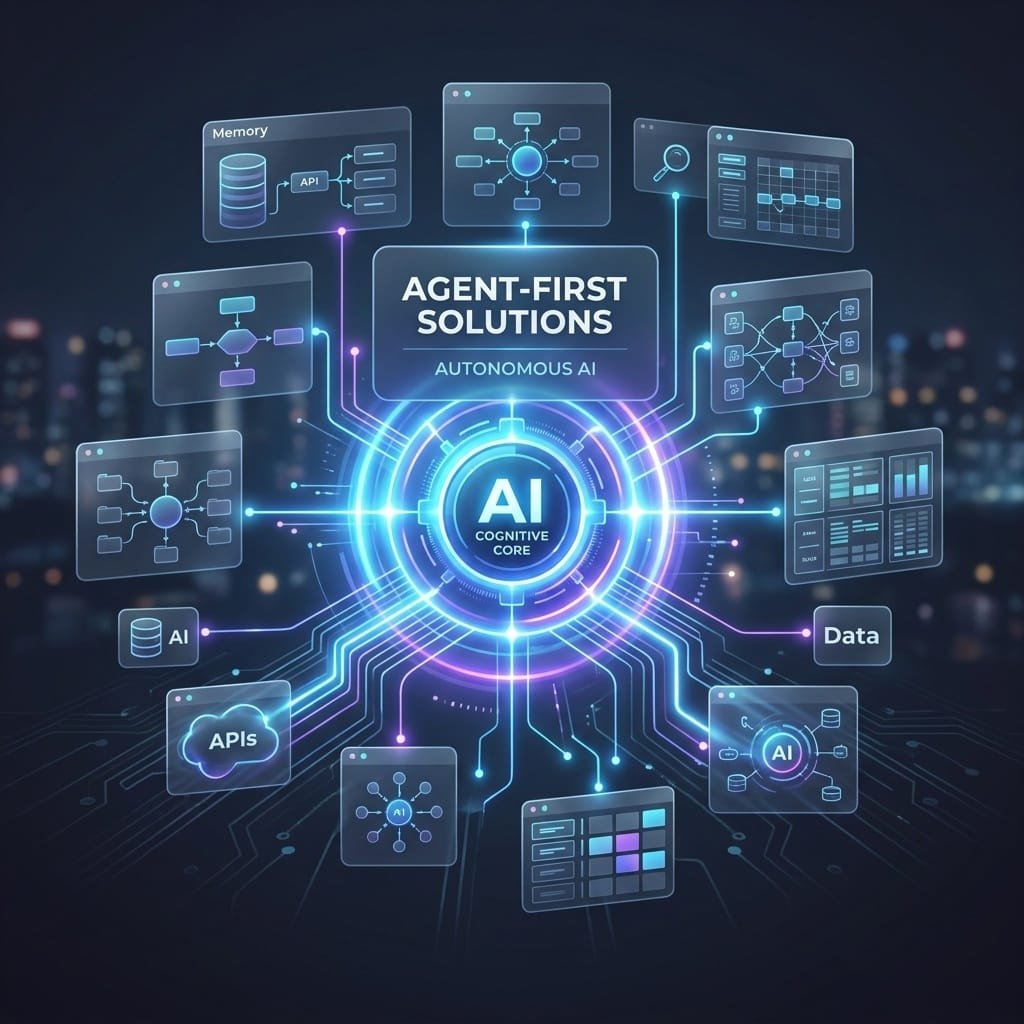
What is an Agent-First Solution?
To understand “Agent-First,” it helps to contrast it with the software design paradigms that came before it.
- User-First (Traditional SaaS): Built entirely for human interaction. The human navigates the Graphical User Interface (GUI), inputs data, and triggers actions. The software acts as a passive database and execution tool.
- Agent-Enabled (Co-pilot SaaS): Traditional software retrofitted with AI features. You still use the traditional interface, but you have a chat box on the side where you can ask the AI to perform a task within the software, like “summarize this spreadsheet.”
- Agent-First (AI-Native): Systems built from the ground up under the assumption that the primary user and operator is an AI agent, not a human. The software’s underlying databases, APIs, and communication layers are optimized for machine-to-machine (M2M) action.
In an agent-first architecture, the focus shifts from User Experience (UX) to Agent Experience (AX). Systems are designed to make it as easy as possible for an autonomous AI model to discover available actions, access data securely, reason through choices, and execute tasks without getting stuck in an interface designed for human eyes.
Co-Pilot vs. Agent-First: A Direct Comparison
Understanding the structural differences between these two concepts is essential for any business planning its technology roadmap.
| Feature | Co-Pilot (Agent-Enabled) | Agent-First Solution |
|---|---|---|
| Primary Operator | Human User (AI assists) | Autonomous AI Agent |
| Execution Style | Step-by-step guidance required | Goal-oriented execution |
| Trigger Mechanism | Reactive (waits for manual prompt) | Proactive (triggered by events or APIs) |
| Workflow Handling | Handles single tasks (e.g., draft email) | Orchestrates end-to-end processes |
| Integration Method | Retrofitted via plugin or UI overlay | Native API and protocol connections |
| Human Involvement | Continuous (Human-in-the-loop) | Exceptional (Human-on-the-loop) |
The Technical Pillars: How Agent-First Solutions Work
An agent-first solution is not just a single large language model (LLM) running in a loop. It is a sophisticated software architecture composed of several interconnected layers.
1. The Reasoning Engine
At the core of the agent is a reasoning model. Unlike standard models that only generate the next word in a sentence, reasoning engines are trained to execute cognitive loops. Using techniques like the ReAct (Reasoning and Acting) framework, the agent breaks a high-level goal down into sub-tasks, determines what information it needs, calls external tools, and evaluates if the output was successful. If a step fails, the reasoning engine self-corrects and tries a different approach.
2. Memory Systems
To be effective, agents need memory. Agent-first architectures utilize two types of memory:
- Short-Term Memory: Maintains context of the current task. It tracks completed steps and user input during the current session.
- Long-Term Memory: Stores historical data across sessions, such as user preferences, past transactions, and company policies. This is typically powered by vector databases that allow the agent to perform semantic searches to retrieve guidelines on the fly.
3. The Model Context Protocol (MCP)
In legacy systems, connecting an AI model to an external database or application required writing custom integration code. Agent-first solutions overcome this by adopting open standards like the Model Context Protocol (MCP).
Developed as a universal connector for AI, MCP provides a secure, standardized way for agents to read data, execute tools, and interact with external systems. It allows developers to build a single “MCP Server” that exposes databases or APIs, which any compatible AI agent can immediately discover and use.
4. Orchestration (Multi-Agent Systems)
A single entity rarely handles complex business processes. Agent-first solutions often deploy multi-agent architectures, where multiple specialized agents work together:
- An Orchestrator Agent receives the initial request and delegates tasks.
- A Search Agent retrieves customer records from the CRM.
- A Transaction Agent interfaces with the billing system.
By splitting responsibilities, these systems minimize errors and handle workflows that would overwhelm a single LLM.
Key Benefits of the Agent-First Approach
The shift to agent-first solutions offers distinct advantages across efficiency, satisfaction, and scalability.
- Proactive Operations: Traditional software sits idle until a human logs in. Agent-first solutions monitor data streams, event logs, and emails in real-time. If an agent detects an anomaly (such as a drop in inventory), it proactively launches a workflow to resolve the issue, notifying human supervisors only if it encounters a policy roadblock.
- Cross-Silo Action: In a typical business, data is locked in separate silos: CRM, ticketing, and logistics. Humans spend hours copying and pasting data between these systems. An agent-first solution acts as a cognitive bridge, accessing and updating records across platforms to complete processes autonomously.
- Deep Context Preservation: In customer service, repeating problems to multiple representatives is a major friction point. Because agent-first solutions maintain strict state management and memory, they remember every detail of a customer’s journey. If a customer transitions from chat to a phone call, the context remains intact.
- Infinite Scalability: Unlike human labor, digital agents scale instantly. During peak hours, an agent-first platform can spin up thousands of concurrent agent instances in seconds, maintaining sub-second response times without increasing human overhead.
Real-World Applications of Agent-First Solutions
Agent-first paradigms are moving from theory to reality across several major business verticals.
1. Autonomous Customer Experience (CX)
This is the most mature application. Companies are moving past basic chatbots to deployment platforms like Sierra and Decagon.
Rather than simply linking users to help articles, these autonomous CX agents execute actions. For example, a Sierra agent handling a request can check tracking numbers, contact the shipping carrier’s API, determine if a package is lost, process a refund, and issue a discount code—all in a natural, conversational interface.
2. Go-To-Market (GTM) and Sales Operations
Sales and marketing departments are integrating agents into the customer journey. Platforms like HubSpot are pioneering agent-first GTM models.
Autonomous agents monitor website traffic, identify high-intent leads, research companies, draft personalized outreach, and schedule meetings on sales representatives’ calendars. This allows human sales teams to focus on closing deals rather than manual prospecting.
3. Legacy Modernization
For enterprises running legacy monolithic systems, updating code to support new processes is expensive. Organizations use agent-first development tools, like Microsoft Copilot Studio and Salesforce Agentforce, to build agents that act as intelligent interfaces over legacy databases. Humans can query and update databases using natural language, while the underlying agents translate those requests into SQL queries safely.
The Vendor Landscape: Who is Building Agent-First Platforms?
The market is split between specialized, AI-native startups and established enterprise software incumbents.
- Sierra: Focuses on high-volume customer experience for major consumer brands. Sierra’s strength lies in its conversational empathy and complex workflow design tools.
- Decagon: Popular among tech startups and SaaS companies. Decagon utilizes “Agent Operating Procedures” (AOPs), which allow operational teams to write rules for agents in plain English, avoiding complex coding cycles.
- Salesforce (Agentforce): Leveraging its customer data footprint, Salesforce has repositioned its ecosystem around “Agentforce.” This layer allows companies to build and deploy autonomous agents that natively access Salesforce Data Cloud, ensuring real-time access to customer records.
- Microsoft (Copilot Studio): Copilot Studio allows developers to build custom agents, leverage pre-built connectors, and deploy them across Teams, websites, and mobile applications, backed by Azure’s security infrastructure.
Challenges and Best Practices for Implementation
Transitioning to agent-first systems requires careful planning, risk management, and governance.
- Implementing Robust Guardrails: Because autonomous agents can take actions (like sending emails or updating billing), preventing unauthorized actions is critical. Best practices include restricting agent actions to pre-defined API schemas and requiring human approval for high-risk actions.
- Ensuring Observability: Unlike traditional software with predictable execution paths, LLM-based agents can take non-linear paths to solve problems. Businesses must implement deep observability tools to record the exact prompt, the agent’s step-by-step thoughts, and a history of every tool call and API response.
- Preparing the Data Layer: An agent is only as good as the data it can access. If company documentation is outdated, the agent will fail or hallucinate. Before deploying, organizations must clean, structure, and catalog data assets, establishing secure APIs that agents can query.
Conclusion: The Shift to Digital Operators
We are moving away from software that requires human orchestration to software that drives itself. Agent-First Solutions represent the logical evolution of artificial intelligence in the enterprise. By structuring systems, databases, and processes for autonomous AI consumption, organizations unlock unprecedented levels of efficiency, responsiveness, and scale.
The companies that succeed in the next decade will not be those that simply equip employees with co-pilots. They will be the ones that build agent-first architectures, deploying fleets of autonomous digital operators to handle routine workflows, allowing human talent to focus on creativity, strategy, and high-value relationship building.
Frequently Asked Questions (FAQ)
What is the difference between a chatbot and an autonomous agent?
Traditional chatbots rely on hard-coded decision trees and keyword matching; they can only answer questions they were programmed to handle. Autonomous agents use reasoning engines (LLMs) to understand open-ended goals, create plans, use external tools (APIs), and learn from their mistakes to complete tasks without predefined scripts.
What is the Model Context Protocol (MCP)?
The Model Context Protocol (MCP) is an open standard that allows AI agents to securely connect to external data sources and tools. Instead of writing custom integration code for every tool a model needs to use, MCP provides a universal adapter, making it easy to expose databases, local files, and APIs to any agent.
Will Agent-First Solutions replace human workers?
Rather than replacing human workers, agent-first solutions are designed to automate repetitive, low-value administrative tasks (like data entry, ticket routing, and routine refunds). This shifts the human role from manual execution to orchestration, strategy, and handling complex customer situations.
How do I start building agentic solutions for my business?
Identify repetitive, multi-step processes in your business that rely on structured data. Use low-code agent platforms like Microsoft Copilot Studio or Salesforce Agentforce to prototype agents, ensuring you establish clear security guardrails, vector databases for memory, and clean API endpoints.
Also, read about Neural Networks
References
- Model Context Protocol (MCP) Specification: An open standard for connecting AI models to data sources. modelcontextprotocol.org
- ReAct: Synergizing Reasoning and Acting in Language Models: Research paper outlining the cognitive loops used by modern autonomous agents. (Yao et al., arXiv:2210.03629)
- Salesforce Agentforce Announcement: Overview of Salesforce’s transition to autonomous enterprise agents. salesforce.com/agentforce
- Sierra AI Platform: Bret Taylor’s platform focusing on autonomous customer experience. sierra.ai
- Decagon Agentic CX Guide: Explains Agent Operating Procedures (AOPs) and natural-language agent instructions. decagon.ai