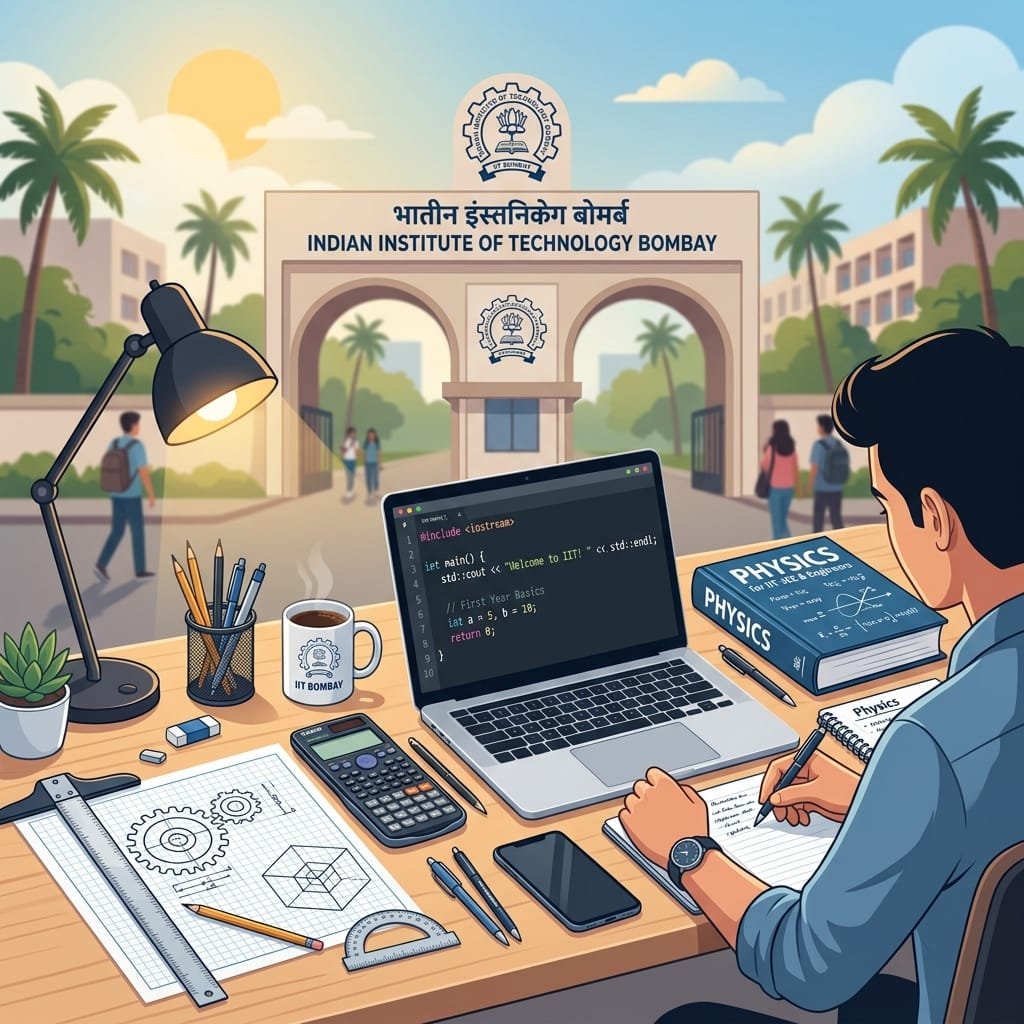
Introduction: The Great Transition from JEE to IIT
Cracking the Joint Entrance Examination (JEE) Advanced is arguably one of the most grueling academic challenges in the world. For years, students in India have spent 12 to 14 hours a day in coaching hubs like Kota, Hyderabad, or Ranchi, focused entirely on Physics, Chemistry, and Mathematics (PCM). A common phrase repeated by parents and teachers alike during this journey is, “Just get into an IIT, and your life is set.”
However, once you step through the gates of a prestigious Indian Institute of Technology, reality presents a new academic landscape. The intense focus on cracked equations and multiple-choice shortcuts gives way to rigorous engineering sciences, abstract mathematical proofs, and hands-on laboratory experiments.
The first year at an IIT is a unique equalizer. Regardless of whether you secured a top rank in Computer Science Engineering (CSE) or entered through a specialization like Metallurgy or Biotechnology, every single undergraduate student undergoes the exact same foundational curriculum. This guide provides a detailed blueprint of the first-year IIT syllabus, highlighting the subjects, standard textbooks, evaluation structures, and academic survival strategies that will help you transition smoothly from a JEE aspirant to a thriving engineer.
Why is the First-Year Syllabus Common Across All IITs?
The common core curriculum is a deliberate pedagogical choice made by the IIT Senates. There are three primary reasons for this structural design:
- Building a Multidisciplinary Foundation: Modern engineering does not operate in silos. A computer scientist working on autonomous vehicles must understand classical mechanics (physics) and control systems (electrical engineering). A chemical engineer developing new polymers needs a grasp of molecular orbital theory (chemistry) and computing (programming). The first year ensures every graduate has a baseline literacy in all primary scientific domains.
- Standardizing Academic Benchmarks: JEE preparation styles vary wildly across the country. The common first year brings all students, regardless of their background, to the same level of academic rigor and conceptual depth.
- Facilitating Branch Changes (DepC): At the end of the first year, IITs allow high-performing students to change their engineering branch (e.g., from Chemical to Computer Science). Having a common syllabus ensures that all students are evaluated on a level playing field when competing for these highly sought-after seats.
Understanding the L-T-P-C Course Structure
IIT courses are not measured merely by the number of hours you sit in a lecture hall. Instead, they follow the highly structured L-T-P-C model:
- L (Lecture): Number of formal instructional hours taught by a professor per week.
- T (Tutorial): Problem-solving sessions conducted in smaller groups (typically 20-30 students) led by Teaching Assistants (TAs). These sessions focus on solving complex “tut sheets” that bridge theory and exams.
- P (Practical/Lab): Hands-on laboratory or workshop hours per week.
- C (Credits): The overall weight of the course. The credit formula generally follows: C≈L+T+(P/2) or similar metrics depending on the specific IIT.
For instance, a core course like Linear Algebra & Calculus might have a structure of 3-1-0-4, indicating 3 lectures, 1 tutorial, 0 lab hours, and 4 credits. A laboratory course like Physics Lab might be structured as 0-0-3-1.5. Understanding this system is crucial, as your Cumulative Grade Point Average (CGPA) is calculated as a weighted average of these credits.
Detailed Semester-Wise Course Blueprint
While minor variations exist between institutes (for instance, IIT Madras might offer a specific course in Semester 1 that IIT Kanpur offers in Semester 2), the curriculum is generally divided into two broad buckets. In most IITs, students are split into two halves (often called divisions or groups), which swap their curriculum between the autumn (odd) and spring (even) semesters.
Here is a typical layout of how these courses are distributed across the first year:
Division A (Typical Autumn Semester Courses)
- Mathematics I: Calculus & Linear Algebra (Theory + Tutorials)
- Physics I: Classical Mechanics & Quantum Physics (Theory + Tutorials)
- Computer Programming & Data Structures (Theory + Lab)
- Engineering Graphics & Drawing (Practical/CAD)
- Humanities & Social Sciences (HSS) Elective / Technical Communication (Theory)
- Physical Education (NSO) / National Service Scheme (NSS) (Practical)
Division B (Typical Spring Semester Courses)
- Mathematics II: Vector Calculus & Ordinary Differential Equations (Theory + Tutorials)
- Physics II: Electromagnetic Theory & Waves (Theory + Tutorials)
- Chemistry: Physical, Inorganic & Organic Principles (Theory + Lab)
- Introduction to Electrical & Electronics Engineering (Theory + Lab)
- Workshop Practice / Manufacturing Processes (Practical)
- Introductory Life Sciences / Biology for Engineers (Theory)
Core Theoretical Subjects: In-Depth Syllabus & Textbooks
1. Engineering Mathematics (Math I & Math II)
Engineering Mathematics at the IIT level is markedly different from JEE math. The emphasis shifts from finding numerical answers to proving existence, convergence, and structural properties.
Math I: Calculus and Linear Algebra
- Calculus Syllabus: Sequences and series, convergence tests (ratio, root, integral tests), Taylor and Maclaurin series, limits, continuity, differentiability, mean value theorems, Riemann integration, improper integrals, and applications to area and volume.
- Linear Algebra Syllabus: Vector spaces, subspaces, linear independence, bases, dimension, linear transformations, matrix representations, systems of linear equations, eigenvalues, eigenvectors, diagonalization, and symmetric matrices.
- Why it Matters: Linear algebra is the absolute foundation for machine learning, data science, graphics, and structural mechanics.
- Standard Reference Books:
- Thomas’ Calculus by George B. Thomas, Maurice D. Weir, and Joel R. Hass. (Excellent for physical visualization of calculus concepts).
- Linear Algebra and Its Applications by Gilbert Strang. (The gold standard for understanding vector spaces and matrix theory intuitively).
- Advanced Engineering Mathematics by Erwin Kreyszig. (A comprehensive reference for practice problems).
Math II: Vector Calculus and Differential Equations
- Vector Calculus Syllabus: Vector fields, gradient, divergence, curl, line integrals, surface integrals, Green’s theorem, Stokes’ theorem, and the Divergence (Gauss) theorem.
- Differential Equations Syllabus: First-order ordinary differential equations (ODEs), linear ODEs of higher order with constant coefficients, Laplace transforms, systems of linear differential equations, and a brief introduction to partial differential equations (PDEs) and Fourier series.
- Why it Matters: Every physical law, from fluid dynamics to heat transfer and electromagnetic waves, is expressed as a differential equation.
- Standard Reference Books:
- Advanced Engineering Mathematics by Erwin Kreyszig.
- Calculus, Vol. II by Tom M. Apostol. (For students seeking a highly rigorous, proof-oriented mathematical approach).
2. Engineering Physics (Physics I & Physics II)
Physics in the first year strips away the highly simplified approximations used in high school and introduces advanced mathematical tools (like vector calculus and differential operators) to explain natural phenomena.
Physics I: Classical Mechanics and Modern Physics
- Mechanics Syllabus: Inertial and non-inertial frames, rotating coordinate systems, Coriolis force, central force motion, Kepler’s laws, rigid body dynamics, angular momentum, Euler’s equations, and an introduction to special relativity (Lorentz transformations, mass-energy equivalence).
- Modern Physics Syllabus: Wave-particle duality, de Broglie hypothesis, uncertainty principle, Schrödinger equation (time-dependent and independent), particle in a one-dimensional box, quantum tunneling, and basic atomic structure.
- Why it Matters: Understanding mechanics is vital for structural design, robotics, and aerospace, while quantum mechanics forms the foundation of modern semiconductor electronics.
- Standard Reference Books:
- An Introduction to Mechanics by Daniel Kleppner and Robert J. Kolenkow. (Highly challenging, conceptual problems).
- Introduction to Quantum Mechanics by David J. Griffiths. (Incredibly lucid explanations of quantum mechanics).
- Concepts of Modern Physics by Arthur Beiser.
Physics II: Electromagnetism and Wave Optics
- Electromagnetism Syllabus: Electrostatics in vacuum and matter, Gauss’s law, electric potential, Laplace and Poisson equations, magnetostatics, Biot-Savart law, Ampere’s law, Faraday’s law, Maxwell’s equations in differential and integral forms, electromagnetic waves, and Poynting vector.
- Optics Syllabus: Interference, diffraction (Fraunhofer and Fresnel), polarization, and laser physics principles.
- Why it Matters: Maxwell’s equations govern all modern communication systems, electrical grids, optical fibers, and high-frequency electronics.
- Standard Reference Books:
- Introduction to Electrodynamics by David J. Griffiths. (Universal textbook used in almost every IIT).
- Electricity and Magnetism (Berkeley Physics Course, Vol. 2) by Edward M. Purcell.
3. Engineering Chemistry
Chemistry at the IIT level focuses heavily on the physical and molecular principles that dictate material properties, energy systems, and chemical synthesis.
- Syllabus: Quantum chemistry (postulates, operators, hydrogen atom model), molecular orbital theory (homo- and hetero-nuclear diatomic molecules), chemical kinetics (rate laws, transition state theory), thermodynamics (entropy, free energy, chemical equilibrium), electrochemistry (corrosion, batteries, fuel cells), spectroscopy (UV-Vis, IR, NMR spectroscopy, and their analytical applications), and basic organic reaction mechanisms (nucleophilic substitutions, eliminations, polymer synthesis).
- Why it Matters: Crucial for material science, chemical engineering, battery technology, nanotechnology, and environmental engineering.
- Standard Reference Books:
- Physical Chemistry by Peter Atkins and Julio de Paula. (Comprehensive and highly conceptual physical chemistry).
- Organic Chemistry by Robert Thornton Morrison and Robert Neilson Boyd. (Excellent for understanding reaction mechanisms).
- Concise Inorganic Chemistry by J.D. Lee.
4. Computer Programming & Data Structures
No matter your branch, coding is an indispensable skill in the modern workforce. This course teaches algorithmic thinking, problem-solving, and clean coding practices.
- Syllabus: Introduction to computer architecture, variables, data types, operators, control flow statements (loops, conditionals), functions, parameter passing (call-by-value vs. call-by-reference), recursion, arrays, pointers, dynamic memory allocation (malloc, calloc), strings, structures, file handling, and basic data structures (linked lists, stacks, queues). The course also covers basic algorithms like sorting (bubble, insertion, selection) and searching (linear, binary).
- Implementation Language: Usually C or C++ due to their low-level control and speed, though some IITs (like IIT Bombay) have integrated Python into their introductory syllabus to focus on computational thinking.
- Why it Matters: Coding is vital for software development, simulation modeling, quantitative finance, data analysis, and automation in every branch of engineering.
- Standard Reference Books:
- The C Programming Language by Brian W. Kernighan and Dennis M. Ritchie. (The definitive, concise guide to C programming).
- Programming in ANSI C by E. Balagurusamy. (Widely popular for beginners seeking step-by-step programming paradigms).
5. Basic Electrical & Electronics Engineering (BEE / Technology Arts)
This course introduces the hardware side of electrical and electronic circuits, preparing students to design and analyze analog and digital systems.
- Syllabus: Network analysis (KCL, KVL, nodal and mesh analysis), network theorems (Thevenin’s, Norton’s, Superposition, Maximum Power Transfer), AC circuits (phasors, impedance, power factor, three-phase systems), magnetic circuits and transformers, DC and AC motors, semiconductor physics (p-n junction diodes, Zener diodes, BJTs, MOSFETs), operational amplifiers (op-amps, inverting/non-inverting amplifiers, integrators, differentiators), and basic digital logic gates.
- Why it Matters: Forms the theoretical bridge for IoT systems, hardware prototyping, instrumentation, robotics, and electrical machine designs.
- Standard Reference Books:
- Electrical Technology by Edward Hughes.
- Basic Electrical Engineering by Vincent Del Toro. (A vintage, highly respected text in Indian institutes).
- Electronic Devices and Circuit Theory by Robert L. Boylestad and Louis Nashelsky.
Practical & Workshop Courses (The Hands-On Elements)
Engineering is not just about solving equations on paper; it is about physical creation. The practical courses in the first year are designed to build tangible, tactile engineering skills.
1. Engineering Graphics / Technical Drawing (Manual & CAD)
Before an engineer builds something, they must draw it. This course transitions from traditional manual drawing instruments to modern software.
- Manual Drawing: Orthographic projections, isometric projections, sectioning of solids, intersections of surfaces, and development of surfaces using drawing sheets and drafters.
- Computer-Aided Design (CAD): Transitioning manual concepts into 2D and 3D digital models using industrial design software like AutoCAD, SolidWorks, or Fusion 360.
- Standard Reference: Engineering Drawing by N.D. Bhatt.
2. Workshop Practice / Manufacturing Processes
This is a highly popular hands-on course where you step into the institute’s physical machine shops to work directly with raw materials.
- Fitting Shop: Filing, sawing, and drilling metal blocks to match precise dimensions (often down to millimeters).
- Carpentry Shop: Learning to join wood using traditional joints (mortise and tenon, dovetail).
- Welding Shop: Hands-on training in Arc welding and Gas welding.
- Sheet Metal & Smithy: Bending, forming, and forging hot metal into utility tools.
- Machining Shop: Watching demonstrations or practicing basic operations on Lathes, Milling machines, and CNC machines.
3. Basic Science Labs (Physics & Chemistry Labs)
Unlike high school labs where results are often manipulated to match theory, IIT labs emphasize experimental accuracy, error analysis, and scientific documentation.
- Physics Lab: Experiments with pendulums, spectrometers, Hall effect setups, bandgap measurements, and optical fibers. A significant focus is placed on calculating experimental uncertainty and systematic errors.
- Chemistry Lab: Titrations, qualitative analysis of inorganic mixtures, synthesis of polymers (like Bakelite or Nylon), spectrophotometric estimations, and pH metric measurements.
Interdisciplinary & Non-Core Compulsory Subjects
To cultivate well-rounded global professionals, the IIT curriculum includes several mandatory non-engineering modules:
- Introductory Life Sciences / Biology for Engineers: Explores molecular biology, cell structures, DNA replication, gene expression, and modern intersections of biology and technology (bioinformatics, computational biology, bio-MEMS).
- Humanities & Social Sciences (HSS) Electives: Introductory courses in economics, sociology, psychology, philosophy, or literature. These courses are designed to broaden critical thinking and socio-economic perspectives.
- Professional Communication / Technical English: Focuses on scientific report writing, resume building, presentation skills, and public speaking.
- Extra Academic Activity (EAA): A mandatory non-credit requirement in the first year. Students must enroll in one of the following and complete a specified number of physical activity hours:
- NSO (National Sports Organisation): Structured training in specific sports (football, basketball, swimming, athletics).
- NSS (National Service Scheme): Community service, tutoring underprivileged children, organizing blood donation camps, and rural development drives.
- NCC (National Cadet Corps): Military-style training, drills, parades, and camps.
The Relentless Battle for CGPA & Branch Change (DepC)
In the first year, an underlying current of intense competition runs through the student body. The catalyst for this competition is the Branch Change (or Department Change, commonly referred to as DepC).
Many students enter IITs in branches they have little interest in, hoping to upgrade to highly coveted branches like Computer Science & Engineering (CSE), Electrical Engineering (EE), or Data Science & AI. To secure a branch change, you must rank at the absolute top of the entire first-year batch.
The Mechanics of Branch Change
- Criteria: Purely based on your Cumulative Grade Point Average (CGPA) at the end of the second semester.
- Required CGPA: While minimum eligibility might be a 7.5 or 8.0 CGPA, the actual cut-off for converting to CSE or EE at top IITs (like IIT Delhi, Bombay, or Kharagpur) is exceptionally high—typically between 9.6 and 10.0.
- Success Rate: Usually, only the top 1% to 2% of the entire batch manages to change their branch.
This system creates a hyper-competitive atmosphere in the first year, sometimes mirroring the high-pressure environment of the JEE coaching days. It is critical for incoming students to balance this drive with healthy mental habits to avoid early academic burnout.
The Ultimate First-Year IIT Survival Guide (Advice from Seniors)
Transitioning to university life—often far away from home in a massive residential campus—can be overwhelming. Here is practical, actionable advice compiled from IIT alumni to help you navigate your first year successfully:
1. Master the Art of Relative Grading
Unlike schools where getting 90% guarantees an A, IITs evaluate you based on your performance relative to your peers.
- The class average is typically mapped to a middle-tier grade (like a ‘C’ or ‘C+’).
- If a physics paper is exceptionally tough and the class average is 30 out of 100, scoring 55 might land you an ‘A’ or ‘Ex’ (Excellent) grade.
- Conversely, if an exam is easy and the average is 85, scoring 80 might result in a poor grade.
- Strategy: Never give up in a difficult exam. If a paper is brutal for you, it is brutal for everyone else. Stay calm, pick up easy marks, and aim to stay ahead of the class average.
Class Average (Mean) │ ┌─────┴─────┐ │ │ ▼ ▼ Below Mean ◄───────────────► Above Mean (Grades: C, D, F) (Grades: B, A, EX)
2. Never Skip the Tutorial Sheets
Professors rarely set exam questions directly from the textbooks. Instead, the primary source of exam inspiration is the weekly Tutorial (Tut) Sheets.
- Solve these sheets independently before the tutorial class.
- Engage actively with the Teaching Assistants (TAs). TAs are senior PG/Ph.D. students who grade your answer scripts. Building a good rapport with them and understanding their analytical expectations can significantly impact your grades.
3. Bridge the Rote-Learning Gap
In JEE preparation, many students memorize shortcut formulas and templates. In an IIT, this approach will fail.
- Professors design questions to test the limits of physical assumptions.
- Always focus on deriving equations from first principles rather than memorizing their final forms.
- Understand the “why” behind boundary conditions in physics and mathematical proofs.
4. Balance Academics with the “Campus Culture”
While grades are important, the real value of an IIT lies in its peer ecosystem.
- Get involved in student clubs (robotics, coding, debating, dramatics, music).
- Participate in organizing massive cultural and technical festivals (like Mood Indigo at IITB, Antaragni at IITK, or Rendezvous at IITD). These activities teach you vital soft skills like project management, leadership, negotiation, and teamwork.
- Avoid the temptation to lock yourself in your hostel room studying 24/7. Conversely, avoid getting so caught up in club culture that you fall below the minimum attendance requirement (usually 75%), which can lead to an automatic ‘F’ (Fail) grade.
Frequently Asked Questions (FAQs)
Q1. Do I need to buy textbooks before joining an IIT?
No. You should absolutely wait until your classes begin. Professors will specify their preferred editions, and they often provide highly customized lecture slides, notes, or digital PDFs. Additionally, the institute library holds dozens of copies of all standard reference books. Borrow them or access the digital library resources instead of spending money upfront.
Q2. Is C programming difficult for students with no prior coding background?
Not at all. The introductory programming courses are designed assuming zero prior knowledge. They start from basic binary logic and computer architecture before introducing code syntax. Millions of successful IITians who had never touched a line of code before college have gone on to build stellar careers in software engineering. Consistent practice on platform labs is the key.
Q3. How many hours of self-study are required daily to maintain a 8+ CGPA?
There is no fixed formula, but maintaining an 8+ CGPA generally requires 2 to 3 hours of consistent self-study on weekdays, and slightly more on weekends to catch up on assignments, lab reports, and tutorial sheets. The key is consistency—cramming the night before an exam (a practice known as “chugging”) rarely works at the IIT level due to the conceptual depth of the papers.
Q4. What happens if I fail a course in the first year?
If you fail a course (usually represented by an ‘F’ grade), you must clear it. Depending on the institute, you can either sit for a re-examination (make-up exam) during the winter/summer break, or you must repeat the course by registering for it in a subsequent semester or during a summer semester. Failing a course drops your GPA significantly and eliminates your eligibility for a branch change.
Q5. Can I get a branch change if my first-semester CGPA is low but my second-semester CGPA is high?
The branch change is evaluated on the cumulative performance of both the first and second semesters (your overall first-year CGPA). While a spectacular second semester can pull up a lower first-semester average, the competition is so tight that even a minor slip-up in Semester 1 (e.g., getting a 7.5 CGPA) makes upgrading to top branches like Computer Science virtually impossible.
Also, read The 5 JEE Pillars — Pick Your Stage