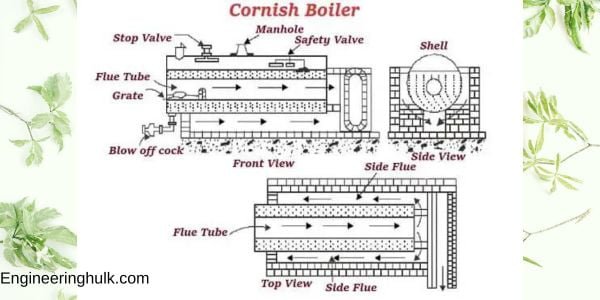
A Cornish boiler is a horizontal, stationary, internally fired, natural-circulation fire-tube boiler in which a single large flue tube runs the full length of a cylindrical water-filled shell. That one flue is its defining feature and the exact thing that separates it from the two-flue Lancashire boiler. Richard Trevithick introduced it in 1812, and it stayed in service for well over a century because it is simple, tolerant of bad feed water and easy to repair.
The fire burns on a grate inside the flue, the gases sweep down the flue and are then led back around the outside of the shell through brick side and bottom flues before reaching the chimney. Steam pressure in the common sizes is low, of the order of 10 to 12 bar, and output is modest for the floor space the boiler occupies.
Why Trevithick built it in 1812
Before the Cornish boiler, Cornish mine engines were fed by wagon boilers: a wide, flat-sided box with a curved top, externally fired underneath. Flat plates are weak against internal pressure, so a wagon boiler could only be worked at a fraction of a bar, near enough atmospheric. That limited the engine to condensing duty and made it heavy on coal.
Richard Trevithick replaced the box with a plain cylinder, and put the fire inside it rather than under it. The change did three things at once:
- It raised the working pressure. A cylinder under internal pressure carries the load as hoop tension in the plate instead of bending a flat sheet. Trevithick’s early Cornish boilers worked at around 25 psi, roughly 1.7 bar, which was high pressure in 1812 and enough to run his high-pressure engines.
- It moved the fire inside the water. The flue tube is surrounded by water on all sides, so almost none of the heat released on the grate is lost to the boiler house. This is what “internally fired” means.
- It moved the sediment away from the fire. Mud and scale settle on the bottom of the shell, well below the flue. In a wagon boiler the same sludge lay directly on the hottest plate, insulated it and caused overheating and bursts.
The first installation is usually placed at Dolcoath mine in Cornwall in 1812, which is where the name comes from. The Lancashire boiler, with two flues instead of one, followed in 1844 when larger grates were needed for harder coals.
What the single flue does, and where the Lancashire differs
One flue tube is not just a smaller version of two. It sets the whole character of the boiler.
The flue diameter is normally about 0.6 times the shell diameter, so on a 1.5 m shell the flue is roughly 0.9 m across. Everything the boiler can burn has to fit on a grate inside that one tube, so the grate area is limited and with it the firing rate. A Cornish boiler therefore makes less steam than a Lancashire boiler of similar length, and it cannot be banked and cleaned on one fire while the other keeps steaming, which is the operating trick a two-flue boiler allows.
What the single flue buys is a smaller, lighter, cheaper shell, fewer plates and joints, and less exposed tube crown to overheat. For a small works needing a few tonnes of steam an hour, that trade was worth making.
Construction: parts of a Cornish boiler
| Part | What it is and what it does |
|---|---|
| Cylindrical shell | The main pressure vessel, made from riveted or welded steel plates, typically 1.25 to 1.75 m in diameter and 4 to 7 m long. It is filled with water to a level above the flue crown, leaving a steam space at the top. |
| Single flue tube | One large tube, about 0.6 times the shell diameter, running the full length of the shell from the front plate to the back plate. The fire and the hot gases are inside it; water surrounds it. Often built in short flanged or Adamson-jointed sections so it can expand without buckling. |
| Grate | The fire bars at the front end of the flue tube, carrying the coal bed. Air enters below the bars through the ashpit damper. |
| Firebridge | A short brick wall built across the flue just behind the grate. It stops unburnt fuel being dragged along the flue, throws the gases up against the hot flue crown and helps mix them with secondary air so combustion is completed. |
| Brickwork setting | The brick chamber the shell sits in. It forms the bottom flue and the two side flues, insulates the boiler and supports it on saddles that allow the shell to expand lengthwise. |
| Bottom and side flues | The passages in the brickwork that carry gas leaving the flue tube back along the underside of the shell and then along both flanks, so the gas wipes the outside of the shell as well as the inside of the flue. |
| Dampers | Plates in the gas passages and at the chimney base that set the draught and therefore the firing rate. |
| Manholes and mudholes | Access openings in the shell ends and at the bottom, used for internal inspection, descaling and removing the sludge that collects under the flue. |
| Mountings | Fitted on the boiler and required for safe working: two safety valves, a steam stop valve, pressure gauge, water level indicator, feed check valve, blow-off cock and a fusible plug set in the flue crown. |
| Accessories | Fitted off the boiler to improve efficiency or operation: feed pump, economiser in the flue to the chimney, air preheater, superheater where dry steam is needed, and a steam trap on the distribution line. |
Why the fusible plug sits in the flue crown
The flue crown is the top of the flue tube, the hottest surface and the first part to be uncovered if the water level falls. A fusible plug is a bronze plug with a core of low-melting alloy screwed into that crown. While water covers it, the water keeps it cool. If the level drops below the crown, the core melts, steam and water blow down into the flue and put the fire out before the plate can overheat and fail. The working rule is that the water level must never be allowed below roughly 100 to 150 mm above the flue crown.
Working of a Cornish boiler: the gas path in order
The gas makes three passes. Trace them in this order:
- Combustion inside the flue. Coal burns on the grate at the front of the flue tube. Air comes in under the bars and past the firebridge.
- First pass, along the flue tube. The hot gases travel the length of the flue to the back of the boiler, giving up heat through the flue wall to the water surrounding it. This pass does most of the heat transfer because the gas is hottest here.
- Second pass, the bottom flue. At the rear the gases turn down into the brickwork and return along the underside of the shell to the front, heating the bottom plates from outside.
- Third pass, the two side flues. At the front the stream splits and travels back along both flanks of the shell, scrubbing the side plates.
- To the chimney. The gases rejoin, pass the damper and go up the stack, usually through an economiser that preheats the feed water. Natural chimney draught does the whole job; no fan is needed.
The water and steam circuit
Circulation is natural and driven by density difference alone. Water touching the hot flue tube heats, becomes lighter and rises along the flue crown into the steam space. Water near the cooler outer shell plates is denser and sinks down the sides and along the bottom, then flows inward to replace what rose. The result is a slow, continuous loop around the flue.
Steam released at the surface collects in the steam space above the water line and leaves through the steam stop valve at the top of the shell, where the least water is carried over. Feed water enters through the feed check valve, which is a non-return valve so boiler pressure cannot push water back into the feed line. Because the steam space is large and the water surface is wide and calm, a Cornish boiler is comparatively good at delivering steam that is not wet, and it copes with sudden demand better than its small volume of tubes would suggest.
Typical dimensions, pressure and output
These are the ranges usually quoted for stationary Cornish boilers. Treat them as typical rather than as limits; any individual boiler is set by its design and its statutory certificate.
| Parameter | Typical value |
|---|---|
| Shell diameter | 1.25 to 1.75 m |
| Shell length | 4 to 7 m |
| Flue tube diameter | About 0.6 times the shell diameter, so roughly 0.75 to 1.05 m |
| Working pressure | Commonly up to about 10 to 12 bar; Trevithick’s original worked near 1.7 bar |
| Evaporation rate | Low. The figure most often quoted in Indian textbooks is about 1,350 kg of steam per hour, though published values for large settings run several times higher, so treat any single number as indicative |
| Steam condition | Saturated, unless a superheater is added |
| Thermal efficiency | About 60 to 70 per cent for a well-set boiler on good coal |
| Circulation | Natural, by density difference |
| Draught | Natural chimney draught |
Cornish boiler vs Lancashire boiler
These two are the pair students mix up, and the difference reduces to one number: the count of flues.
| Feature | Cornish boiler | Lancashire boiler |
|---|---|---|
| Number of flue tubes | One | Two, side by side |
| Introduced | 1812, Richard Trevithick | 1844, William Fairbairn and John Hetherington |
| Shell diameter | 1.25 to 1.75 m | 1.75 to 2.75 m |
| Shell length | 4 to 7 m | 7.25 to 9 m |
| Working pressure | Up to about 10 to 12 bar | Up to about 16 bar |
| Evaporation rate | Usually quoted near 1,350 kg/h | Up to about 9,000 kg/h |
| Grate area and firing rate | Small, limited by the one flue | Larger, two independent grates |
| Cleaning the fire | Steam output drops while the single fire is cleaned | One fire can be cleaned while the other carries the load |
| Floor area per kg of steam | Higher | Lower |
| Cost and complexity | Lower, fewer plates and joints | Higher |
| Everything else | Identical in kind: horizontal, stationary, internally fired, fire-tube, natural circulation, natural draught, brick setting with bottom and side flues | |
How the Cornish boiler is classified
- Axis of the shell: horizontal.
- Mobility: stationary, built into brickwork and not movable like a locomotive or marine boiler.
- Firing: internally fired, because the grate sits inside the shell.
- Tube contents: fire-tube, because hot gas is inside the tube and water is outside it. A Babcock and Wilcox boiler is the opposite arrangement, water inside the tubes and gas outside, which is why it reaches far higher pressures and outputs than any Cornish boiler can.
- Circulation: natural, unlike forced-circulation designs such as the Loeffler boiler.
- Pressure: low pressure.
- Draught: natural.
Advantages
- Simple construction with one large flue, few joints and no tube nest, so it is cheap to build for its size.
- Internally fired, so radiation loss from the fire to the boiler house is small.
- The large water volume acts as a store, so the boiler holds pressure through short peaks in demand without the pressure collapsing.
- A big, quiet steam space gives reasonably dry steam with little priming.
- Tolerant of hard and dirty feed water, because scale and mud drop to the bottom of the shell rather than onto the hottest plate.
- Easy to inspect and clean from inside through the manholes, and easy for a small workshop to repair.
- Can be installed and operated in remote locations without a fan, a treatment plant or skilled attendance.
Limitations
- Low steam output and a low rate of evaporation for the floor area and mass of the installation.
- Limited grate area, so the firing rate cannot be pushed.
- Low working pressure, which rules out power generation at modern conditions.
- Slow to raise steam from cold, because the whole large mass of water has to be heated.
- A single fire means output falls whenever the grate is cleaned or the fire is banked.
- The brickwork setting takes time and money to build and needs regular repointing; air leaking into the side flues wastes draught.
- A large volume of water at pressure is stored, so a shell failure releases far more energy than a water-tube boiler of the same duty would.
- Not suitable where load swings rapidly or where superheated, high-pressure steam is needed.
Where Cornish boilers are still used
New Cornish boilers are effectively no longer built for industry. Packaged shell boilers of the three-pass wet-back type, and water-tube boilers for larger duties, have taken the work. Where you still meet one:
- Small process heating and hot water duty in older textile mills, dyeing units, sugar mills, distilleries, tanneries and brick works, usually as a surviving installation rather than a new one.
- Small traditional workshops and rural industry running on wood, bagasse or low-grade coal where a simple, low-pressure steam supply is enough.
- Preserved and heritage plant: Cornish engines, pumping stations, museum steam plant and traction engine yards.
- Teaching, where it is the standard first example of an internally fired fire-tube boiler in the thermal engineering syllabus of most B.Tech and diploma courses.
Student tip: in an exam, if a question gives you a horizontal shell, an internal grate and one flue, the answer is Cornish. Add a second flue and the same boiler becomes Lancashire. Put the water inside the tubes instead, and it becomes a water-tube boiler.
References
- Richard Trevithick, biography and the 1812 Cornish boiler.
- NPTEL – Thermal Engineering (Boilers) lecture series, IIT.
- AICTE Model Curriculum – Thermal Engineering.
- Indian Boilers Act, 1923 and the Indian Boiler Regulations, 1950, for registration and inspection of stationary boilers in India.
FAQs
What is a Cornish boiler?
A Cornish boiler is a horizontal, stationary, internally fired, natural-circulation fire-tube boiler. A single large flue tube runs the length of a cylindrical shell that is filled with water; coal burns on a grate inside that flue, and the hot gases pass along it and then back around the outside of the shell through brick bottom and side flues before going to the chimney. It produces saturated steam at low pressure, commonly up to about 10 to 12 bar.
What is the difference between a Cornish boiler and a Lancashire boiler?
The Cornish boiler has one flue tube and the Lancashire boiler has two. Everything else follows from that. The Lancashire has a larger shell, 1.75 to 2.75 m across and 7.25 to 9 m long against 1.25 to 1.75 m by 4 to 7 m, works up to about 16 bar against 10 to 12 bar, evaporates up to about 9,000 kg/h against a figure usually quoted near 1,350 kg/h, and lets one fire be cleaned while the other keeps steaming.
Who invented the Cornish boiler and when?
Richard Trevithick introduced it in 1812, with the first installation usually credited to Dolcoath mine in Cornwall. It replaced the wagon boiler, whose flat plates limited it to a fraction of a bar. Trevithick’s cylindrical shell with an internal flue carried its pressure as hoop tension in the plate and worked at around 25 psi, about 1.7 bar, which made his high-pressure engines practical.
Is a Cornish boiler a fire-tube or a water-tube boiler?
It is a fire-tube boiler. The hot flue gas is inside the tube and the water is outside it, surrounding the tube within the shell. In a water-tube boiler the arrangement is reversed, with water circulating inside small tubes and gas passing over them, which is what allows water-tube designs to reach much higher pressures and far larger outputs.
Why is a fusible plug fitted in the flue tube of a Cornish boiler?
The top of the flue tube, the flue crown, is the hottest surface in the boiler and the first to be uncovered if the water level falls. The fusible plug is screwed into that crown and has a core of low-melting alloy that stays cool while water covers it. If the level drops below the crown, the core melts and steam and water blow into the flue and extinguish the fire before the plate can overheat and fail.