Theodolite Surveying & Traversing
Angle Measurement, Latitude & Departure, Closing Error, Bowditch & Transit Rule
Last Updated: April 2026 | GATE CE 2025–2027
📌 Key Takeaways
- A theodolite measures both horizontal and vertical angles with high precision (vernier least count 20″ to 1′).
- Always take Face Left and Face Right readings and average them to eliminate instrumental errors.
- Latitude = d·cosθ (N = +ve, S = −ve); Departure = d·sinθ (E = +ve, W = −ve).
- Closing error e = √(ΣL² + ΣD²); accuracy = Perimeter/e (express as 1/n).
- Bowditch rule: correction ∝ side length — used for chain traverses with equal precision.
- Transit rule: correction ∝ L or D of that line — used for theodolite traverses.
- Angular misclosure in a closed traverse = Sum of interior angles − (n−2)×180°, where n = number of sides.
1. Theodolite — Parts & Temporary Adjustments
A transit theodolite is the standard instrument for measuring horizontal and vertical angles in civil engineering. It has two main circles: a horizontal circle (graduated 0°–360°) for measuring horizontal angles, and a vertical circle (graduated 0°–360° or 0°–90° each quadrant) for measuring vertical angles.
Key parts: Lower plate (horizontal circle, fixed during measurement), upper plate (vernier, rotates for reading), altitude bubble (levelling the vertical circle), plate bubble (levelling the horizontal plate), diaphragm (cross-hairs for sighting), focusing screw, clamp and tangent screws for both plates.
Temporary adjustments (done at each setup): (1) Centering over the station — using a plumb bob or optical plummet. (2) Levelling — using plate level bubble with foot screws (three-screw levelling). (3) Elimination of parallax — focus the eyepiece on the cross-hairs, then focus the objective on the target.
Permanent adjustments (in workshop): adjustment of plate level, cross-hair ring, collimation in azimuth, spire test (trunnion axis), altitude level, vertical arc index.
2. Angle Measurement Methods
| Method | Procedure | Best For |
|---|---|---|
| Direct method | Set 0° on one direction, read the other. Mean of FL and FR. | Single angle, quick measurement |
| Repetition method | Accumulate angle n times without zeroing; final/n = mean angle. Eliminates graduation error. | Improving precision beyond least count |
| Reiteration (Direction) method | Observe all directions from one station and close back to first. Suitable when several rays are observed. Used in triangulation. | Multiple directions from one station |
Face Left (FL) + Face Right (FR): The mean of FL and FR readings eliminates collimation error, eccentricity of centres, and graduation errors. For a horizontal angle: Mean = (FL + FR)/2, but account for the 180° difference — FR reading = FL reading ± 180° theoretically. Discrepancy indicates collimation error.
3. Traverse — Types & Introduction
A traverse is a series of connected survey lines whose lengths and directions are measured. It is the most common method for establishing horizontal control.
- Closed traverse: Starts and ends at the same point (loop traverse) or at two known points (connecting traverse). Can be checked mathematically.
- Open traverse: Starts at one point and ends at a different, unknown point. No mathematical check possible — used only for preliminary surveys or where closure is impractical.
- Chain traverse: Bearings measured by compass; distances by chain. Lower accuracy.
- Theodolite traverse: Angles measured by theodolite; distances by tape or EDM. High accuracy. Gale’s traverse table is used for computation.
4. Latitude, Departure & Closing Error
Latitude & Departure
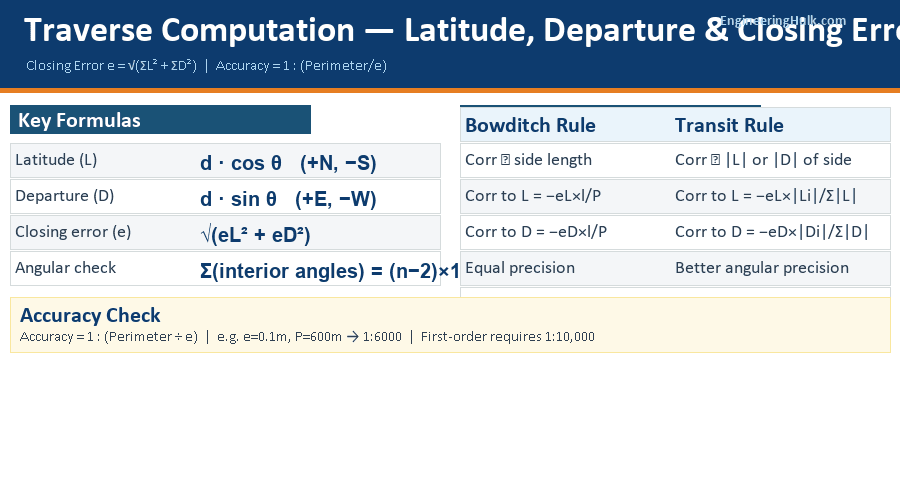
Latitude (L) = d · cos θ (+ = North, − = South)
Departure (D) = d · sin θ (+ = East, − = West)
θ = WCB of the line
For a closed traverse: ΣL = 0 and ΣD = 0 (theoretically)
Misclosure in L: eL = ΣL | Misclosure in D: eD = ΣD
Linear closing error: e = √(eL² + eD²)
Direction of closing error: tan δ = eD / eL
Accuracy = 1 in (Perimeter / e) — express as 1:n
Angular Misclosure
For a closed traverse with n sides:
Theoretical sum of interior angles = (n − 2) × 180°
Angular misclosure = Observed sum − Theoretical sum
Correction per angle = −Misclosure / n (distributed equally)
5. Traverse Adjustment — Bowditch & Transit Rule
Bowditch (Compass) Rule
Correction to L of side i = −eL × (length of side i) / (Perimeter)
Correction to D of side i = −eD × (length of side i) / (Perimeter)
Use when linear and angular precision are comparable (chain traverse, low-order theodolite).
Transit Rule
Correction to L of side i = −eL × |Li| / Σ|L|
Correction to D of side i = −eD × |Di| / Σ|D|
Use when angular precision > linear precision (theodolite angles, tape distances).
Least squares adjustment is the rigorous method — minimises the sum of squares of corrections. Used for high-precision control surveys. Not typically required for GATE but conceptually important.
6. Coordinate System & Gale’s Table
After adjusting the traverse, independent coordinates of each station are computed. Starting from the first station with assigned coordinates (often 0,0 or an arbitrary origin), successive coordinates are computed as:
En+1 = En + Corrected Departure of side
Nn+1 = Nn + Corrected Latitude of side
Gale’s traverse table organises all traverse computations in one table: bearing, length, latitude, departure, corrections, corrected latitude/departure, and accumulated coordinates. The final row must return to the starting coordinates — providing the closure check.
Area of a closed traverse can be calculated from coordinates using the coordinate method (Gauss’s shoelace formula): Area = ½|Σ(En·Nn+1 − En+1·Nn)|
7. Worked Examples (GATE CE Level)
Example 1 — Traverse Closing Error & Accuracy
A closed traverse ABCDE has ΣLatitude = −0.082 m and ΣDeparture = +0.064 m. The perimeter is 850 m. Find the closing error and accuracy.
Solution:
e = √(0.082² + 0.064²) = √(0.006724 + 0.004096) = √0.01082 = 0.1040 m
Accuracy = 850 / 0.1040 = 8173 → 1 in 8173 (first-order work requires 1:10,000, so this is close)
Example 2 — Bowditch Rule Correction (GATE 2018 type)
Side AB has length 120 m in a traverse with perimeter 600 m. eL = 0.15 m (excess northing), eD = 0.10 m (excess easting). Find Bowditch corrections to L and D of AB.
Solution:
Corr to LAB = −(0.15 × 120/600) = −0.030 m (reduce northing of AB by 0.030 m)
Corr to DAB = −(0.10 × 120/600) = −0.020 m (reduce easting of AB by 0.020 m)
Example 3 — Angular Misclosure Distribution
A 5-sided closed traverse has measured interior angles: 95°12′, 128°30′, 97°45′, 115°22′, 103°14′. Find the angular misclosure and corrected angles.
Solution:
Sum of measured angles = 95°12′ + 128°30′ + 97°45′ + 115°22′ + 103°14′ = 540°03′
Theoretical sum = (5−2)×180° = 540°00′
Misclosure = +3′ (excess)
Correction per angle = −3’/5 = −0’36” per angle
Corrected angles: 95°11’24”, 128°29’24”, 97°44’24”, 115°21’24”, 103°13’24”. Sum = 540°00′ ✓
Common Mistakes
- Not taking FL and FR readings: A single face reading retains all instrumental errors — always observe both faces and average.
- Using WCB directly in latitude formula without quadrant check: With WCB, latitude = d·cosθ will give correct sign automatically (cos is positive for 0–90° and 270–360° range, negative for 90–270°). However, departure = d·sinθ: sin is positive for 0–180°, negative for 180–360°. No quadrant adjustment needed if you are careful with the calculator, but many students get the sign wrong.
- Choosing the wrong adjustment rule: Bowditch for chain traverses (equal precision); Transit for theodolite traverses (better angular precision).
- Forgetting to correct angles before computing latitudes/departures: First distribute the angular misclosure, recompute bearings, then calculate L and D.
- Applying the closing error in the same direction instead of opposite: The correction to each side’s L and D must be opposite in sign to eL and eD.
Frequently Asked Questions
What is the difference between Bowditch rule and Transit rule?
Bowditch rule distributes closing error proportional to side length — for traverses with equal linear and angular precision. Transit rule distributes proportional to the absolute latitude or departure — for theodolite traverses where angular precision exceeds linear precision. Bowditch is more commonly tested in GATE.
What is the closing error in a traverse?
In a closed traverse, ΣLatitudes and ΣDepartures should equal zero theoretically. Due to measurement errors, residuals eL and eD exist. Closing error e = √(eL² + eD²). Accuracy = 1:(Perimeter/e).
What is the repetition method of measuring angles?
An angle is accumulated on the circle over n repetitions without zeroing between readings. Final accumulated reading divided by n gives the mean angle with precision beyond the vernier least count. It eliminates graduation errors in the circle.
What is the difference between face left and face right observations?
Face Left (FL) — vertical circle on observer’s left. Face Right (FR) — vertical circle on right. Mean of FL and FR eliminates collimation error, eccentricity of centres, and graduation errors. FL + FR horizontal readings should differ by 180°; discrepancy reveals collimation error.