EngineeringHulk
  • Home
  • General
  • Manufacturing Engineering
  • Automobile Engineering
  • Universities and Colleges
  • Thermodynamics
  • Contact us
  • Home
  • General
  • Manufacturing Engineering
  • Automobile Engineering
  • Universities and Colleges
  • Thermodynamics
  • Contact us
  1. Home
  2. ›
  3. General
  4. ›
  5. Parallelogram law of forces – Statement & Derivation
General

Parallelogram law of forces – Statement & Derivation

Dr. Jennifer Russel
April 27, 2023
4 min read
Parallelogram law of forces – Statement & Derivation

Table of Contents

  • Introduction:
  • What is the Parallelogram Law of Forces?
  • Derivation of the Parallelogram Law of Forces Formula
  • Applications of the Parallelogram Law of Forces

Introduction:

The parallelogram law of forces is a fundamental principle in physics that describes how two forces acting at a point can be combined to create a resultant force. This law is essential for understanding the mechanics of structures and machines, as well as for analyzing the forces acting on objects in motion.

What is the Parallelogram Law of Forces?

The parallelogram law of forces states that “if two forces acting on a point are represented by two adjacent sides of a parallelogram, then their resultant force is represented by the diagonal passing through the point”. This means that the resultant force is equal in magnitude and direction to the diagonal of the parallelogram formed by the two forces.

In other words, the parallelogram law of forces formula allows us to calculate the magnitude and direction of the resultant force when two forces acting at an angle to each other are combined.

Derivation of the Parallelogram Law of Forces Formula

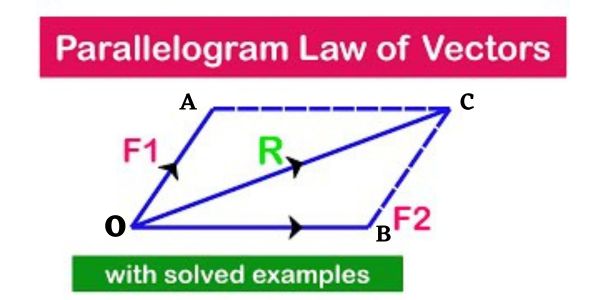
The parallelogram law of forces formula can be derived using the principles of vector addition. Consider two forces F1 and F2 acting at a point O as shown in the figure below.

Parallelogram law of forces

To calculate the resultant force, we draw the vectors F1 and F2 as adjacent sides of a parallelogram OABC. The diagonal OC passing through point O represents the resultant force both in magnitude and direction.

The vector OC can be calculated using the following formula:

OC = √(OA² + AC² + 2OA.AC cosθ)

where OA and AC are the magnitudes of F1 and F2, respectively, θ is the angle between the two forces, and cosθ is the cosine of the angle between the two forces.

The direction of the resultant force can be determined using the following formula:

tanα = (AC sinθ)/(OA + AC cosθ)

where α is the angle between the resultant force and the force F1.

**Examples of Application of the Parallelogram Law of Forces Formula**

Let’s consider some examples to see how the parallelogram law of forces formula is applied in practice.

Example 1: Two forces F1 and F2 of magnitudes 10 N and 8 N, respectively, act on a point O at an angle of 60 degrees to each other. Calculate the magnitude and direction of the resultant force.

Using the parallelogram law of forces formula, we can calculate the magnitude of the resultant force as follows:

OC = √(OA² + AC² + 2OA.AC cosθ)

   = √(10² + 8² + 2x10x8xcos60)

   = √(100 + 64 + 80)

   = √(244)

   = 15.62 N

The direction of the resultant force can be calculated as follows:

tanα = (AC sinθ)/(OA + AC cosθ)

      = (8 sin60)/(10 + 8 cos60)

      = 0.83

Therefore, α = tan⁻¹(0.83) = 39.33 degrees.

Hence, the magnitude and direction of the resultant force are 15.62 N and 39.33 degrees, respectively.

Applications of the Parallelogram Law of Forces

The parallelogram law of forces has numerous applications in various fields of science and engineering. Some of these applications are discussed below.

1. Structural Engineering

In structural engineering, the parallelogram law of forces is used to calculate the forces acting on a structure, such as a bridge or a building. By analyzing the forces acting on each component of the structure, engineers can determine the stresses and strains that the structure can withstand.

2. Mechanical Engineering

In mechanical engineering, the parallelogram law of forces is used to calculate the forces acting on machines and mechanical systems. By understanding the forces acting on each component of a machine, engineers can design machines that are efficient and safe to use.

3. Physics

In physics, the parallelogram law of forces is used to analyze the motion of objects under the influence of multiple forces. By understanding the resultant force acting on an object, physicists can predict its motion and calculate its velocity and acceleration.

4. Aviation

In aviation, the parallelogram law of forces is used to calculate the forces acting on an aircraft. By analyzing the forces acting on the wings and other components of an aircraft, engineers can design planes that are aerodynamically stable and safe to fly.

Also, read the hardness test

Share: Twitter LinkedIn

Author

Dr. Jennifer Russel

PHD in Engineering | Works as Engineering Expert in different engineering aspects and works as professor at Theem college of Engineering

You Might Also Like

Complete Guide to Reverse Image Search in 2026
General

Complete Guide to Reverse Image Search in 2026

Reverse Image Search is one of the Image search techniques that has become one of the most powerful tools on…

Dr. Jennifer RusselDec 31, 20257 min read
Read →
Image Search Techniques: Tools, Tips & AI Visual Search Guide
General

Image Search Techniques: Tools, Tips & AI Visual Search Guide

1. Intro to Image Search Techniques Image search is a technology that allows users to find images on the internet…

Dr. Jennifer RusselDec 30, 202512 min read
Read →
Is the EMS Sculpting Machine Good for Your Skin?
General

Is the EMS Sculpting Machine Good for Your Skin?

If you are researching body contouring treatments and searching for “EMS Body Sculpting Machine,” you will find here you are…

Dr. Jennifer RusselNov 25, 20256 min read
Read →

Recent Posts

  • Reverse Image Search featured image
    Complete Guide to Reverse Image Search in 2026
    Dec 31, 2025
  • Image Search Techniques
    Image Search Techniques: Tools, Tips & AI Visual Search Guide
    Dec 30, 2025
  • EMS Sculpting Machine
    Is the EMS Sculpting Machine Good for Your Skin?
    Nov 25, 2025
  • titanium
    The Go-To Material for Longevity in a Landscape of Planned Obsolescence
    Sep 28, 2025
  • fafsa
    Free Application for Federal Student Aid (FAFSA)
    Sep 27, 2025

Topics

  • General 335
  • Manufacturing Engineering 91
  • Computer Engineering 41
  • Automobile Engineering 30
  • Renewable sources of Energy 26
  • Universities and Colleges 26
  • Scholarships 22
  • Thermodynamics 17
  • Module 2 10
  • Module 1 10

Newsletter

Stay Updated

Get the latest engineering articles delivered to your inbox.

Subscribe Free

Tags

geothermal energy engineering notes Biogas generation plants RES notes welding cnc Reverse Image Search Benson boilers boiler Deep Neural Networks neural network Data Annotation Tech Vision Pro Apple what is Apple Vision Pro Apple Vision Pro cost apple vision pro price Apple Vision Pro pipe bender machine pipe bender Tube Bender Machine
EngineeringHulk

Practical engineering knowledge, tutorials, and insights for builders, makers, and technical professionals.

Topics

  • General
  • Manufacturing Engineering
  • Computer Engineering
  • Automobile Engineering
  • Renewable sources of Energy
  • Universities and Colleges

Resources

  • Tutorials
  • Tools
  • Calculators
  • RSS Feed
  • Sitemap

Company

  • About Us
  • Contact
  • Write For Us
  • Advertise
  • Privacy Policy

© 2026 EngineeringHulk. All rights reserved. Built with passion for engineering.

Privacy Terms Sitemap